
Last updated: 10 October 2026
Know the real cost of open access publication fees before you submit. See APC journal fees, who pays, how APC waivers work for Indian authors and which fee patterns signal a predatory journal.
Get a free journal and APC review Call +91 78459 26182Free fee and waiver check
Scopus, SCI, UGC guidance

An article processing charge (APC) is a fee paid by an author, their institution or their funder to a publisher so that an accepted paper can be read free of charge by everyone. In short, it is how most open access journals cover peer review management, production and hosting. This guide explains what an article processing charge is , what APC journal fees look like in 2026, who pays, and how Indian authors can reduce or avoid open access publication fees.
From no author fee to roughly CHF 2,900 per article at some large publishers; many journals charge a few hundred dollars or pounds, depending on the journal and article type.
An APC for an accepted open-access article is generally invoiced after acceptance, but the exact payment schedule varies by publisher. Separate submission or editorial fees may apply earlier.
You, your university, or your funder.
Ask for an APC waiver before submitting, check institutional agreements, or choose a diamond open access journal.
Nobody explains this clearly to scholars in India, and the anxiety is real. A fee quoted in Swiss francs or pounds can look enormous in rupees, and fake journals exploit that confusion. The sections below cover the real cost, the exceptions, and the warning signs.
A quick summary table of this page. Select a topic to jump straight to the full explanation.
| Topic | Quick Answer |
|---|---|
| What an APC is | A one-time gold open access fee for an accepted article, not a reward for acceptance and not a submission fee. |
| Other author fees | Submission, page or colour, and language editing fees are separate from the APC. |
| What it covers | Peer review administration, production, hosting, discoverability and integrity checks. Indexing is not guaranteed. |
| Typical cost | No author fee to roughly CHF 2,900 per article at some large publishers. |
| Who pays | You, your university, your funder, or a co-author at a covered institution. |
| When you pay | Generally after acceptance at gold open access journals; diamond and green open access have no APC. |
| Indian authors | Currency, tax, payment windows, reimbursement rules and what your university recognises. |
| APC waiver | Request it in writing before you submit; routes include institutional deals and reviewer vouchers. |
| Reduce fees | Diamond open access, grants, comparing journals, article type and green open access. |
| Red flags | Hidden fees, personal accounts, payment pressure and third-party invoices. |
| Checklist | Eight checks to complete before you submit. |
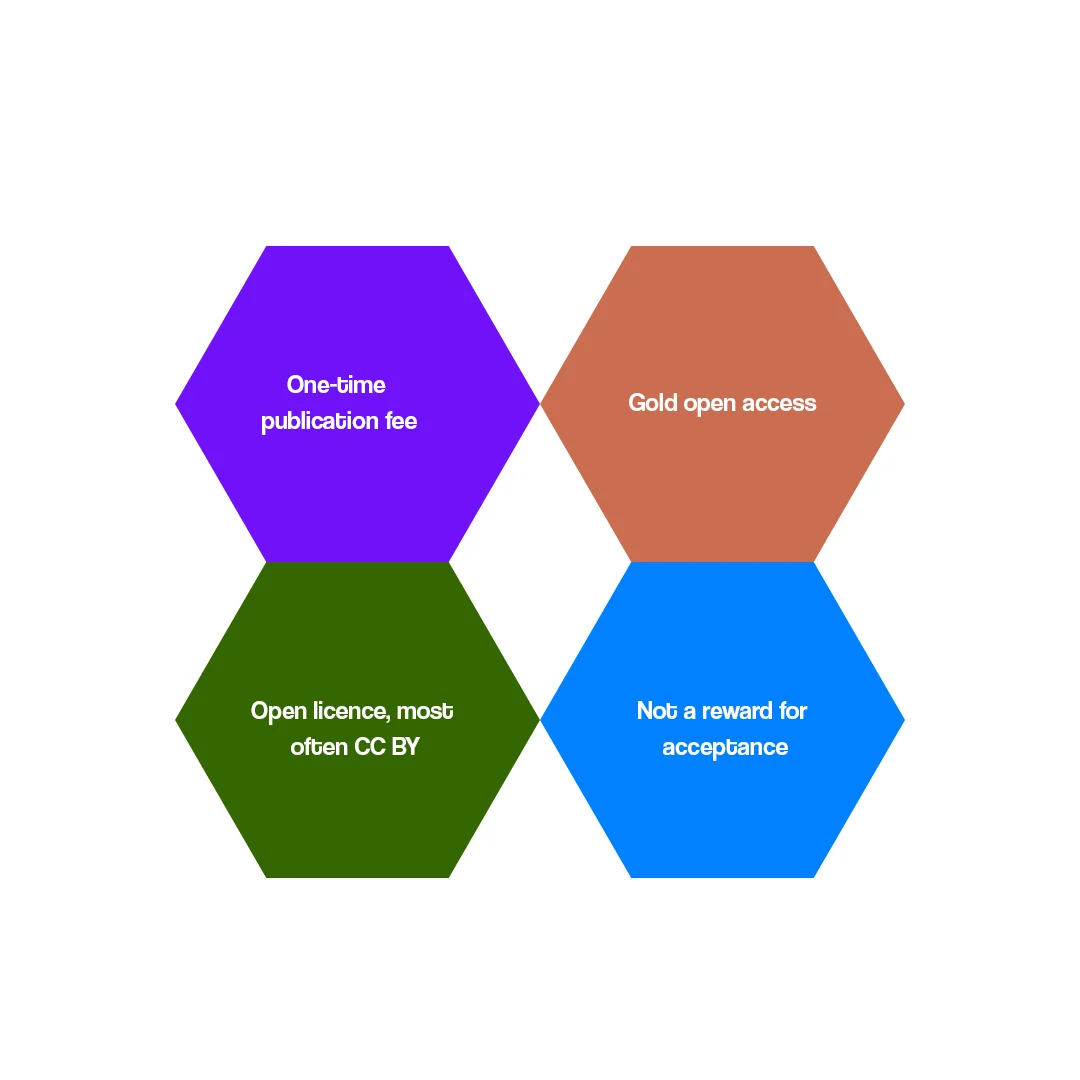
An APC is a one-time publication fee attached to gold open access publishing. Instead of readers or libraries paying for subscriptions, the cost is shifted to the point of publication, and the finished article is released under an open licence, most often Creative Commons CC BY. Anyone can read, download and reuse it with credit to the authors.
The charge is not a reward for acceptance and it is not a fee for submitting. Reputable publishers state that payment does not influence the editorial decision, and that waiver information is kept separate from the editors who judge the manuscript.
Charged when you submit, regardless of outcome. Uncommon at established journals.
Older print-era fees for length or colour figures, sometimes found in subscription journals.
Optional services, separate from the APC.
The open access fee for an accepted article.
The fee this guide explainsThe fee pays for the machinery between "accepted" and "findable". Publishers describe the same core elements, with some variation in detail:
Running the submission system, checking technical and ethical requirements, inviting reviewers and coordinating revisions. The editorial decision itself stays with the academic editor.
Copy-editing, typesetting, XML and PDF files, and proofs.
Permanent, free, worldwide availability of the article.
Depending on the publisher, publishing operations may include online dissemination, metadata distribution, DOI registration and digital preservation. Paying an APC does not guarantee inclusion in a particular indexing database.
Plagiarism screening and image or data checks, which also absorb the cost of manuscripts that are ultimately rejected.
Extensive English-language editing, redrawing poor figures, or guarantees of indexing in a particular database. Some publishers include only minor language editing, so unclear writing can still delay or sink a paper.
There is no single price. APC journal fees depend on the publisher, the journal's selectivity, the article type and the discipline. The examples below come from publisher pages checked in October 2026. Always confirm the current figure on the journal's own website, because fees change and are often quoted before tax.
| Publisher Example | Published APC | Notes |
|---|---|---|
| MDPI (journal-specific) | CHF 1,000 to CHF 2,900 for many current titles, with some titles priced differently | APCs vary by journal. MDPI lists journal-specific prices and states that APCs support peer-review administration, production and dissemination. Institutional agreements and reviewer vouchers may reduce the charge. |
| EJMCR (medical case reports) | £200 for case reports, case series and clinical audits | Letters and images £25; from 15 September 2026 the journal lists €220 + tax for £200 APC categories and €40 + tax for £25 categories. Discounts are available for eligible students/trainees, developing-country authors and qualifying financial circumstances. |
| AME Publishing journals | QIMS example: US$1,900 original; US$950 long case report | AME APCs vary by journal and article type. For QIMS, 2026 pricing includes US$1,900 for original articles and US$950 for long case reports; invited articles are free. |
| Diamond open access journals | No author fee | Funded by institutions, societies or grants, so neither authors nor readers pay. |
Highly selective titles spend more on rejected manuscripts, which is recovered through accepted ones.
Case reports, letters and short communications are often cheaper than full research articles.
Fees may be listed in CHF, EUR, GBP or USD, and local taxes can be added to the invoice.
Language editing, figure redrawing and expedited processing are usually extra.
For Indian authors, the final INR amount can depend on the publisher's invoiced currency, exchange rate, applicable taxes, payment-provider or bank charges, and any institutional discount or waiver. A foreign-currency APC can therefore cost substantially more in INR than the headline foreign-currency figure suggests.
The invoice usually goes to the corresponding author, but the money often comes from somewhere else:
Many grants allow publication costs as an eligible expense. Check your sanction letter before spending your own money.
Some universities and libraries negotiate "read and publish" or similar agreements so that eligible authors pay little or nothing.
Common for self-funded PhD scholars, and the case where planning matters most.
A co-author at a covered institution may be able to settle the fee. Confirm the publisher's rules on this first.

Not every journal charges an APC. The publishing model decides who carries the cost.
| Model | Who Pays | Author Fee |
|---|---|---|
| Subscription | Readers and libraries | Usually none, though some charge page or colour fees |
| Hybrid open access | Author chooses: subscription or paid open access | APC only if you select open access |
| Gold open access | Author, institution or funder | APC on acceptance |
| Diamond open access | Institutions, societies or grants | None |
| Green open access | Nobody for self-archiving | None, where the journal permits depositing the accepted manuscript in a repository |
In the Directory of Open Access Journals, you can filter to journals without fees.
SCImago lets you filter its journal rankings to diamond open access titles.
Neither replaces your own check of the journal, but both save time.
An APC should not be presented as a condition for receiving peer review or as a way to influence the editorial decision. However, some legitimate journals may charge separate submission or editorial fees before or during review. Distinguish an APC from other author charges before deciding that a fee is suspicious. Jump to the red flags section below.
Searches for journal publication charges India mix up two different things: fees charged by Indian journals and APCs charged by international publishers. Both exist, and Indian scholars face a few practical issues beyond the headline price.
Most international invoices are in CHF, EUR, GBP or USD. Check your card limits and bank charges, and ask your finance office how institutional foreign payments are handled.
Invoices may add local tax depending on where the payer is based, and your institution may have its own rules on tax for foreign services. Ask your accounts office before paying.
Some publishers expect payment within days of the invoice, so line up funding before acceptance.
Universities differ on whether they reimburse publication fees. Get approval in writing first.
Access programmes can widen what eligible institutions can read, but reading access does not automatically mean that an APC will be paid for your article. Confirm publication funding with your library or research office.
Also check what your university or regulator currently recognises. Requirements around indexed or approved journals have changed over time, and an expensive APC in a journal your institution does not accept is money wasted. Verify against your university's current guidelines before you commit.
Most major publishers run waiver schemes, and many authors never ask. An APC waiver removes the fee entirely, while a discount reduces it. APC waiver for Indian authors is possible through several routes.
Some publishers link waivers or discounts to country, institutional or other eligibility criteria. Do not assume that an Indian author automatically qualifies for a Research4Life-based APC waiver; check the publisher's current country policy and eligibility rules.
Your university library may hold a deal that covers or discounts the fee for affiliated authors.
Publishers such as MDPI give selected reviewers vouchers that reduce a later APC. These must be applied before acceptance and cannot be transferred.
Smaller journals sometimes publish fixed percentages. EJMCR, for instance, lists tiered discounts for students, developing-country authors and charities.
Some journals waive or reduce fees on request.
Editors may offer discounts or waivers when they personally invite a paper for a special issue.
Note the fee, currency, tax, and the waiver policy.
Publishers that handle waivers separately from editors expect the request early. Requests after acceptance are often refused or too late to apply.
Use the editorial office or APC support address listed on the journal site, not a third party.
Give your affiliation, country, funding situation and the article type. Attach proof if requested.
A written confirmation protects you if the invoice later shows the full amount.
If the answer is no, move to a journal with a fee you can pay or a diamond open access alternative.
The fee itself is rarely the problem. How and when it is requested tells you more. Treat these as red flags:
A legitimate journal may have separate submission or editorial fees, so verify exactly what the fee covers and whether it is disclosed on the official fee page.
On the journal's site, with the amount revealed only after acceptance.
For a journal that claims strong indexing, combined with very fast "peer review".
Instead of the publisher's official channel.
That was never disclosed during submission.
To "secure a publication slot".
Some publishers state that only invoices from their own official email domain are valid and that no one else is authorised to collect fees.
Before paying any APC, confirm the journal's ownership, editorial board, indexing claims and licence terms. Check indexing on the database's own website instead of trusting the journal's homepage badge.
APC, DOI and indexing are different things. A DOI provides a persistent identifier and link for a publication; indexing is a separate decision made by each database. Paying an APC does not guarantee Scopus, Web of Science, PubMed or any other database indexing.
A low APC does not by itself prove that a journal is predatory, and a high APC does not prove that a journal is legitimate. Evaluate peer review, editorial governance, publisher identity, indexing claims, fee transparency and licensing together.
The APC is not always the complete publishing cost. Depending on the journal, authors may also encounter taxes, currency-conversion or bank charges, submission fees, page charges, colour charges, language editing, figure preparation or optional services. Before submission, check the journal's complete author-fee schedule rather than looking only at the headline APC.
Is the exact APC, currency and tax shown on the journal website?
Is payment due only after acceptance?
Does the journal accept my article type, and is the price different for it?
Have I asked about a waiver or discount, in writing, before submitting?
Does my grant, university or co-author's institution cover the fee?
Is the journal accepted by my university for my degree or promotion?
Is the payment channel the publisher's official one?
Do I know the licence (for example CC BY) and what it allows others to do?
Fees are one piece of choosing where to publish. Zonduo supports PhD scholars across India with practical, journal-specific guidance:
Matching your paper to journals that fit your scope, indexing needs and budget, as part of our journal paper publication support .
Help understanding requirements for Scopus, Web of Science, SCI and UGC journals.
Reviewing a journal's APC page, waiver policy and warning signs before you submit.
Research paper editing , formatting and plagiarism checking , so you are not paying an APC on a paper that fails on basics.
Help responding to reviewer comments through our journal revision service .
Send us the journal name, your subject area and your budget. We will review its APC, waiver options and credibility signals before you submit
Get a free journal and APC review →
Share the journal name, your subject area and your budget. Our team will check its fee, waiver options and credibility signals.
It is a publication fee paid by the author, institution or funder to make an accepted article open access. Depending on the publisher, it can support peer-review administration, production, hosting, dissemination and related publishing services. It does not guarantee acceptance or indexing.
Prices vary widely. MDPI's current journal-specific list includes APCs up to CHF 2,900 for some titles, while other journals charge a few hundred pounds or dollars. Diamond open access journals generally charge no APC. For an Indian author, the final INR amount can depend on the invoiced currency, exchange rate, applicable taxes, bank or payment-provider charges, and any discount or waiver.
Usually the corresponding author, their university, or a funder. Institutional agreements can cover some or all of it.
At legitimate journals, no. Fees apply to accepted articles only.
Each MDPI journal sets its own basic APC, listed on MDPI's APC page. Authors can reduce it through institutional programmes, reviewer vouchers and invited-submission offers. MDPI also states that only invoices from its official email domain are valid.
No. An APC should not buy acceptance or influence peer review. Payment requests that are hidden, misleading, directed to unofficial personal accounts, or presented as a condition for editorial consideration can be warning signs. Also distinguish legitimate submission or editorial fees from APCs.
Look for diamond open access journals, subscription journals that charge no author fee, or green open access repository deposit where the journal allows it. Always verify the journal's quality before submitting.
No. Subscription journals usually charge authors nothing. APCs apply to open access journals, while diamond open access journals generally charge no APC.
After acceptance. A journal asking for payment before or during peer review should be treated cautiously. Also distinguish legitimate submission or editorial fees from an article processing charge.
Letters and images £25; from 15 September 2026 the journal lists €220 + tax for £200 APC categories and €40 + tax for £25 categories. Discounts are available for eligible students/trainees, developing-country authors and qualifying financial circumstances. (so check the current page before submitting).
No, and any journal implying it does is one to avoid. Editorial decisions and peer review should be independent of APC payment.
No. Our fee covers manuscript preparation and submission support. Any APC is set and collected by the publisher, not Zonduo.


