
Last updated: 18 October 2026
The UGC CARE list was the University Grants Commission's reference list of approved peer-reviewed journals. The UGC discontinued it on 3 October 2024 and now expects universities to assess journals themselves. Many Indian universities still require a journal to have been on the list, and some maintain their own lists in its place — which is why scholars are still asked for it two years later.
The historical UGC-CARE listing should not be presented as a current approval mechanism. The current approach is to evaluate journal quality using the UGC's suggestive parameters, current indexing evidence and the publication rules of the relevant institution.

Journal-selection risks now include misleading indexing claims, weak peer review, unclear editorial ownership, excessive publication promises, hidden fees and journals that incorrectly market themselves as currently UGC-CARE approved.


Until October 2024, UGC maintained the CARE list — a central register of journals considered acceptable for API scoring, promotions and PhD submission. Journals were assessed on peer review, editorial quality and international reputation, and publishing in a listed journal carried weight in academic evaluation.
That central list no longer exists. UGC devolved journal evaluation to individual institutions, which now assess journals themselves against UGC's suggestive parameters. In practice this means your university — not UGC — decides which journals count for your submission.
The UGC-CARE List is no longer an active list for approving or recommending journals. Therefore, researchers should not rely on claims such as “UGC-CARE approved journal 2026” when selecting a journal for publication.
Instead, evaluate the journal using objective publication and indexing criteria and check your university, institution, or PhD regulations to confirm which journals are accepted for your academic requirement.
First, verify whether the journal is indexed in a recognized database relevant to your discipline. Depending on your subject and institutional requirements, this may include Scopus, Web of Science, or the Directory of Open Access Journals (DOAJ).
Do not assume that indexing in one database means that the journal is approved by UGC or automatically accepted by your university. Always verify the current indexing status directly from the relevant database.
Check whether the journal has a valid ISSN or eISSN and confirm that the journal title, publisher, and ISSN details are consistent across the journal website and recognized indexing or registration sources.
An ISSN alone does not establish the quality or academic acceptance of a journal. It is only one part of the verification process.
Review the journal's editorial board and check whether the listed editors have identifiable academic affiliations and relevant expertise.
A credible journal should provide transparent information about its editors, affiliations, publisher, and contact details. Be cautious when editorial information is incomplete, unverifiable, or misleading.
Read the journal's peer-review policy before submitting your manuscript. A legitimate scholarly journal should clearly explain how manuscripts are evaluated and what type of peer review is used.
Avoid journals that guarantee acceptance, promise publication within an unrealistically short period, or appear to accept manuscripts without meaningful academic review.
Check whether the journal provides clear information about publication ethics, plagiarism, conflicts of interest, corrections, retractions, authorship, and research integrity.
Where applicable, also review the journal's policies relating to recognized publishing-ethics standards and practices.
Make sure your research topic fits the journal's stated aims and scope. Publishing in a journal that is closely aligned with your research area can improve the relevance and academic value of your publication.
Do not select a journal only because it has a low publication fee or promises fast acceptance.
Read several recently published articles from the journal. Examine their subject areas, methodological quality, references, publication dates, and overall relevance to your research.
This can help you determine whether the journal is genuinely publishing research within your field.
Most importantly, check your university, department, PhD regulations, supervisor, or research guidelines to determine which journal criteria apply to your thesis or academic evaluation.
A journal being indexed in Scopus or Web of Science does not automatically mean that it satisfies every university's PhD publication requirement. Institutional rules can differ by university, programme, discipline, and regulation.
Before submitting your manuscript, verify:
Current indexing status
ISSN/eISSN details
Publisher information
Editorial board and affiliations
Peer-review policy
Publication ethics and integrity policies
Journal aims and scope
Recent published articles
Article processing charges, if applicable
Your university's current publication requirements
Important: The phrase “UGC-CARE approved” should not be treated as evidence of current UGC approval. If a journal continues to advertise itself as “UGC-CARE approved” for 2026, verify the claim carefully and check the current requirements of your institution before submitting your research.
Publishing a research paper involves more than selecting a journal and submitting a manuscript. A suitable journal should be evaluated for scope, indexing, editorial standards, peer-review practices, publication ethics, and institutional requirements before submission.
Our journal publication support follows a structured process to help researchers prepare their manuscripts and identify suitable publication venues.
We review the manuscript for basic academic and publication requirements, including structure, clarity, formatting, language, references, and field-specific requirements.
Where improvements are needed, our experts provide guidance on revisions before the manuscript is submitted to a journal.
We assess the research topic, methodology, subject area, and manuscript type against potential journals.
The objective is to identify journals whose aims and scope, article types, and subject coverage are appropriate for the research rather than selecting a journal solely on publication speed or cost.
We verify the journal's current indexing information using relevant sources, depending on the researcher's requirements. These may include Scopus, Web of Science, DOAJ, or other discipline-specific databases.
Indexing status should always be checked for the specific journal and should not be assumed from claims made on third-party websites or promotional materials.
Before submission, we review important journal policies such as:
Peer-review process
Publication ethics
Plagiarism and originality requirements
Authorship policies
Conflict-of-interest requirements
Retraction and correction policies
Article processing charges, where applicable
Submission and manuscript requirements
Researchers should be cautious of journals that guarantee acceptance or promise publication without a credible peer-review process.
Once a suitable journal has been identified, the manuscript is formatted according to the journal's author guidelines.
This may include requirements for:
Manuscript structure
Font and layout
Tables and figures
Reference style
Citation format
Word count
Supplementary files
Author Information
Following the journal's instructions can help prevent avoidable administrative delays during submission.
The manuscript is submitted through the journal's designated submission system or according to the publisher's official submission instructions.
Authors should carefully review all submission requirements and provide the necessary information, declarations, affiliations, files, and supporting documents.
After submission, the journal may conduct an editorial screening followed by peer review. If reviewers request changes, the authors may need to revise the manuscript and provide a response to the reviewers' comments. Our experts can assist researchers in understanding reviewer feedback and preparing appropriate revisions.
If the manuscript is accepted, the journal may proceed with copyediting, typesetting, proofreading, author queries, and final publication.
Publication timelines vary by journal and manuscript, so researchers should avoid relying on claims of guaranteed or exceptionally fast publication.
Important: Choose a Journal Based on Evidence
There is no single journal-selection criterion that is suitable for every researcher. The appropriate journal depends on the research field, manuscript scope, indexing requirements, university or institutional regulations, and the journal's own publication standards.
Most importantly, do not select a journal simply because it claims to be “UGC-CARE approved” for 2026. The former UGC-CARE List should not be treated as a current journal-approval mechanism. Always verify the journal's present status and confirm your institution's current publication requirements before submission.
Use Scopus and Web of Science as current verification sources. Check the journal directly in the relevant database rather than relying on a journal's badge or marketing claim.


Journals charge in different ways: some are free to publish in, some levy an article processing charge, and some charge only for open access. Publication charges are one of UGC's suggestive parameters, so a journal that is vague about its fees — or only reveals them after acceptance — is worth avoiding regardless of what any list once said.
Researchers should also consider the publication frequency of a journal when evaluating whether it is suitable for their manuscript. Journals may publish articles monthly, quarterly, continuously, or according to another schedule.
Publication frequency can help researchers understand how a journal manages its publication workflow and whether its schedule aligns with their expected publication timeline. However, a higher publication frequency does not necessarily indicate higher or lower journal quality, UGC recognition, or a greater likelihood of manuscript acceptance.
Before submitting a paper, review the journal's recent publication history and author guidelines. Also check whether the journal clearly explains its editorial and peer-review process and provides realistic information about expected review and publication timelines.
Researchers should avoid choosing a journal solely because it promises rapid review or publication. Journal scope, peer-review standards, indexing status, publication ethics, editorial quality, and institutional requirements should be considered alongside publication frequency

Submitting a manuscript is not the end of the publication process. Authors may need to monitor emails from the journal, respond to editorial queries, provide additional documents, complete revisions, or address requests from the editorial office.
Failing to respond within the required timeframe can cause unnecessary delays and, in some cases, may affect the progress of the manuscript through the journal's editorial process.
Our publication support includes submission follow-up and author communication assistance. We help researchers monitor submission-related communication, understand journal requests, coordinate required revisions, and respond appropriately during the publication process.
However, the final editorial decision, review process, and publication timeline remain under the control of the journal.
Researchers should be cautious when selecting a journal, particularly when a website makes strong claims about UGC-CARE approval, indexing, guaranteed publication, or exceptionally fast acceptance.
The former UGC-CARE List should not be treated as evidence of current UGC approval. A journal appearing in a historical UGC-CARE listing does not establish that the journal is currently approved, recognized, or endorsed by UGC.
Be particularly careful if a journal claims to be “UGC-CARE approved 2026” or uses the former UGC-CARE List as a current promotional credential. Such claims should be independently verified rather than accepted at face value.
Our journal evaluation support helps researchers assess journal information, identify potential warning signs, and select publication venues based on relevant academic and institutional criteria.
Predatory journals are publications that prioritize collecting fees from authors without providing the editorial oversight, peer review, transparency, and publishing standards expected of legitimate scholarly journals. They may target researchers with aggressive solicitation, misleading claims, or promises of unusually fast publication.
Some journals may also use fake or misleading impact factors, falsely claim inclusion in reputable indexing databases, or present unverifiable editorial credentials to appear legitimate.
Common Warning Signs of a Predatory or Misleading Journal
Researchers should look carefully at a journal's credentials before submitting their manuscript. Warning signs may include:
False UGC-CARE claims: A journal may continue to advertise itself as “UGC-CARE approved” or “UGC-CARE listed” for 2026 even though the former UGC-CARE List is no longer an active current approval mechanism.
False indexing claims: A journal may claim to be indexed in Scopus, Web of Science, DOAJ, or another recognized database when its current status cannot be independently verified.
Guaranteed acceptance: Promises of guaranteed acceptance or publication without meaningful peer review are a major warning sign.
Unrealistically fast publication: Extremely short review or publication timelines may indicate that proper editorial and peer-review processes are not being followed.
Unverifiable editorial board: Editors may have unclear identities, questionable affiliations, or information that cannot be independently confirmed.
Misleading metrics: Some journals advertise unofficial or misleading “impact factors” that should not be confused with recognized journal metrics.
Lack of transparency: Important information about the publisher, peer review, publication ethics, fees, or editorial policies may be missing or difficult to verify.
Poorly matched content: A journal may accept manuscripts across an unusually broad range of unrelated disciplines without clearly explaining its scope or editorial expertise.
Identifying a potentially fake or predatory journal requires more than checking whether the journal has a professional-looking website. We examine multiple aspects of the journal's identity, editorial process, indexing claims, publishing practices, and transparency before recommending it for consideration.
Unsolicited emails inviting researchers to submit papers can be a warning sign, particularly when the message contains spelling or grammatical errors, exaggerated promises, irrelevant subject references, or pressure to submit quickly.
However, receiving an unsolicited invitation alone does not prove that a journal is predatory. The journal's other credentials should also be verified.
A legitimate scholarly journal should provide understandable information about how manuscripts are evaluated.
We check whether the journal explains its peer-review process, editorial screening, revision procedure, and decision-making process. Claims of publication without meaningful review require particular caution.
Promises of acceptance or publication within a few days, without sufficient time for editorial assessment and peer review, can be a warning sign.
A fast publication schedule does not automatically make a journal predatory, but researchers should investigate how the journal achieves its stated turnaround time.
We examine whether the journal clearly identifies its publisher, editorial office, physical or professional contact information, and ownership.
Unclear ownership, inconsistent publisher names, incomplete contact details, or frequently changing website information can indicate that further verification is necessary.
Researchers should check the journal's publication fees before submission. Unexpected charges, unclear article processing fees, or repeated requests for payment during the publication process should be treated cautiously.
A publication fee by itself does not mean that a journal is predatory. Many legitimate open-access journals charge article processing fees.
We independently verify claims that a journal is indexed in databases such as Scopus, Web of Science, DOAJ, or other recognized indexing services, where relevant.
A logo or indexing claim displayed on a journal website is not sufficient evidence of current indexing. Researchers should verify the journal directly through the relevant database or official source.
We examine the journal's editorial board and check whether the listed editors and their institutional affiliations can be independently verified.
Copied names, incorrect affiliations, editors who do not appear to be associated with the journal, or editorial-board information reproduced from another publication are significant warning signs.
Researchers should be especially cautious when a journal currently advertises itself as “UGC-CARE approved,” “UGC-CARE listed,” or “UGC-CARE approved 2026.”
The former UGC-CARE List should not be treated as a current approval mechanism. A historical listing does not establish current UGC approval or endorsement.
Therefore, we do not treat a journal's “UGC-CARE approved” claim as proof of its current recognition. The journal's present indexing status, publisher information, editorial practices, ethics policies, and institutional requirements should be independently checked.
We review recent articles where appropriate to assess whether the published content appears consistent with the journal's stated scope and academic standards.
Poor language quality, irrelevant articles, inconsistent formatting, questionable research practices, or content that appears unrelated to the journal's stated field can warrant additional investigation.
We also look for inconsistencies between the journal website, publisher information, ISSN details, indexing claims, editorial-board information, and published issues.
A professional website does not by itself establish that a journal is legitimate. The information presented across different sources should be consistent and independently verifiable.
Journal title and ISSN/eISSN
Publisher identity and ownership
Editorial board and affiliations
Peer-review process
Indexing claims and current indexing status
Publication ethics policies
Journal aims and scope
Recent published articles
Publication fees and charges
Contact and submission information
Current institutional or university requirements
Researchers should make the final journal-selection decision based on independently verifiable evidence and their institution's current requirements, rather than relying on promotional claims such as “UGC-CARE approved” or “guaranteed publication.”
What the Current UGC Framework Means
The UGC-CARE List should no longer be treated as a current national list of approved journals. Researchers therefore need to use the current UGC framework and their institution's requirements when evaluating where to publish.
UGC has provided suggestive parameters for identifying and evaluating journals. These parameters emphasize factors such as the journal's editorial standards, peer-review practices, publication ethics, transparency, and other indicators of scholarly quality.
For researchers, the practical approach is simple: do not rely on a claim that a journal is “UGC-CARE approved.” Instead, evaluate the journal using independently verifiable information and confirm whether it meets the publication requirements of your university or research institution.
UGC grouped the parameters into seven categories:
Source: UGC, 584th Commission meeting, 3 October 2024.
Finding a suitable journal involves more than choosing a publication based on its fee or claiming that it is “UGC approved.” Researchers should first confirm that the journal is relevant to their research and meets the requirements of their university or institution.
Zonduo provides journal evaluation and publication support to help researchers prepare their manuscripts, assess journal suitability, verify relevant indexing information, and understand the submission requirements.
Our support can include:
• Manuscript quality and readiness checks
• Journal scope and suitability analysis
• Current indexing verification where required
• Review of journal policies and publication ethics
• Formatting according to journal guidelines
• Submission guidance
• Support with editorial queries and revisions
• Publication-stage assistance
Journal fees vary between publishers and journals. A paid journal is not automatically a high-quality journal, just as a free journal is not automatically a low-quality journal. Researchers should evaluate the journal's scope, editorial standards, peer-review process, indexing status, publication ethics, and institutional acceptance requirements before submission.
Important: We do not represent journals as “UGC-CARE approved” or provide a list of current UGC-CARE paid or free journals. The former UGC-CARE List should not be treated as a current approval mechanism.
Journal rejection is a common part of academic publishing and does not necessarily mean that the research lacks value. Journals may reject a manuscript because of scope mismatch, methodological concerns, insufficient novelty, presentation issues, limited evidence, or editorial priorities.
Instead of treating rejection as the end of the publication process, researchers can use the decision and reviewer comments to improve the manuscript.
Read the editor's decision carefully and determine whether the rejection was related to the journal's scope, the quality or methodology of the research, manuscript presentation, or another issue.
Where reviewer comments are provided, identify recurring concerns and separate major methodological or academic issues from minor presentation corrections.
Address valid concerns before submitting the manuscript again. This may involve improving the methodology, strengthening the literature review, clarifying the research contribution, revising the analysis, or improving the manuscript's structure and language.
If you believe the editorial decision resulted from a significant misunderstanding or procedural issue, you may consider submitting a respectful and evidence-based appeal according to the journal's appeal policy.
An appeal should not simply disagree with the reviewers. It should clearly explain the specific issue and provide evidence supporting your position.
If the manuscript is not suitable for the original journal, evaluate another journal based on its aims and scope, subject coverage, editorial standards, peer-review process, indexing requirements, publication ethics, and your institution's requirements.
Do not select another journal simply because it claims to be “UGC-CARE approved.” The former UGC-CARE List should not be treated as a current journal-approval mechanism.
A rejection can provide useful information for improving your research paper. The goal should be to address genuine weaknesses and submit the improved manuscript to a legitimate and appropriate journal, rather than repeatedly submitting the same version without addressing the reasons for rejection.
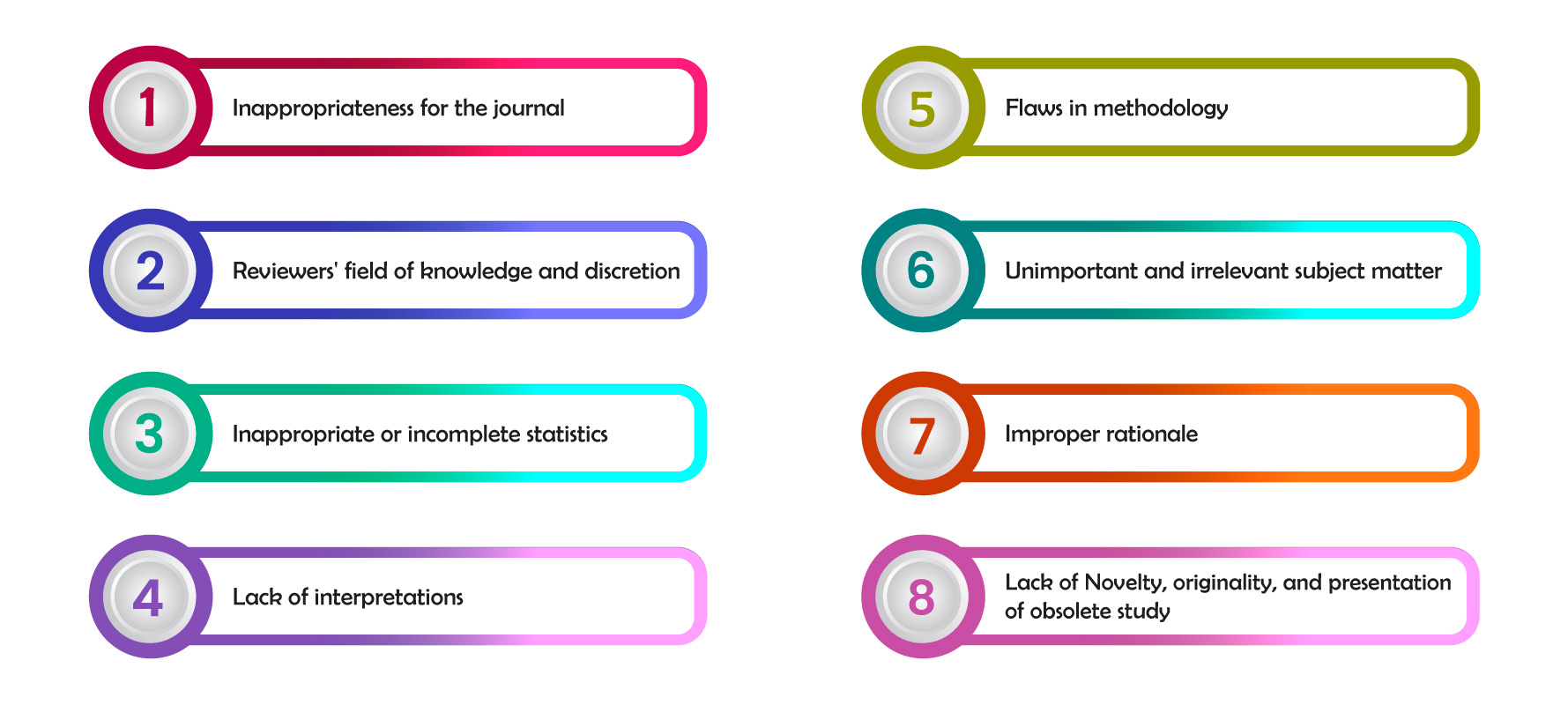
A research paper can be rejected for several reasons, and rejection does not always indicate that the research lacks value. Common reasons include a mismatch between the manuscript and the journal's scope, insufficient novelty, methodological weaknesses, inadequate literature support, unclear presentation, poor manuscript structure, or failure to follow the journal's submission guidelines.
Before submission, researchers should ensure that the manuscript is academically sound, clearly presented, properly referenced, and aligned with the selected journal's requirements.
Our journal publication support can help researchers review manuscript quality, improve presentation, address formatting requirements, and prepare the paper for submission to a suitable journal.
Journal selection should be based on the journal's scope, editorial standards, peer-review process, indexing status, publication ethics, and relevant institutional requirements, rather than on claims of current UGC-CARE approval.


Common Problems Faced by PhD Scholars during Journal Publications
Scholars nowadays are facing many problems in publication process. Here we list some of the common problems faced by PhD scholars in publication process. To know more about it


