
Last updated: 24 September 2026
Turn a proposed blockchain architecture, algorithm, or research paper into a working system you can test, measure, and defend — from algorithm-to-code translation to smart contracts, prototypes, and performance evaluation.
Supporting scholars since
Research papers delivered
Average scholar rating
Nagercoil & Chennai, India
Blockchain implementation for PhD research is the technical stage where a proposed architecture, algorithm, consensus variant, or security mechanism is converted into a working system that can be run, tested, and measured — including algorithm-to-code translation, smart contract development, prototype building, experimental setup, and performance evaluation against relevant metrics or a baseline. It sits between the theoretical contribution chapter and the experimental results chapter of a thesis.
A quick tabular overview of key features, scopes, platforms, and deliverables for doctoral researchers.
| Service Dimension | Details & Scope |
|---|---|
| Core Objective | Translating proposed blockchain algorithms, architectures, or papers into working, testable systems for experimental evaluation. |
| Target Audience | PhD scholars and doctoral researchers in Cybersecurity, IoT, Healthcare, Finance, Supply Chain, and Smart Cities. |
| Primary Activities | Algorithm-to-code translation, research prototype assembly, smart contract development, paper reproduction, and benchmarking. |
| Supported Platforms | Permissionless (Ethereum, Polygon) & Permissioned (Hyperledger Fabric, Corda) blockchains, backed by Python, Solidity, Go, and Java. |
| Evaluation Metrics | Throughput, latency, confirmation time, scalability, computational/storage overhead, and gas/transaction costs. |
| Key Deliverables | Source code, working prototypes, smart contracts, experimental datasets, performance metric logs, and thesis-ready documentation. |
| Investment Range | Starting from ₹15,000 to ₹85,000+ (approx. US $180 – $1,020+) depending on project complexity and scope. |
Convert your proposed blockchain algorithm, architecture, or paper into working, testable code.
Around your methodology, dataset, and evaluation criteria — not a generic blockchain template.
Source code, prototype, smart contracts, experimental results, and thesis-ready documentation.
PhD scholars and doctoral candidates across cybersecurity, IoT, healthcare, finance & more.
Blockchain research doesn't stop at a proposed model. At some point, a scholar has to answer a harder question: does the architecture actually work, and how does it perform against what already exists?
In a PhD, "blockchain implementation" refers to the technical stage where a proposed contribution — an architecture, an algorithm, a consensus variant, a security mechanism — is converted into a functioning system that can be run, tested, and measured. It sits between the theoretical contribution (the chapter that describes what is proposed) and the experimental results chapter (the chapter that reports what happened when it was tested).
Zonduo supports PhD scholars, doctoral candidates, and research students who need to move from a proposed blockchain design to an experimentally validated system: converting an algorithm into executable code, building a research prototype around a chosen architecture, reproducing a published method to compare against it, or extending an existing model and benchmarking the result. The work is scoped around your methodology, your dataset, and your evaluation criteria — not a generic blockchain build.
Converting a proposed algorithm, protocol, or mathematical model into executable logic that preserves the original methodology, inputs, and expected outputs.
Assembling the blockchain components — nodes, consensus logic, smart contracts, data layer, interfaces — needed to run the proposed system under realistic or controlled conditions.
Configuring the environment, datasets, and parameters needed to run repeatable experiments.
Confirming the implementation behaves as the proposed design specifies, and identifying where it doesn't.
Measuring the implemented system against relevant metrics and, where applicable, against baseline or existing methods.
A theoretical contribution can be sound on paper and still fail to produce usable experimental evidence if implementation is rushed, under-documented, or disconnected from the proposed methodology.
A proposed architecture or algorithm is a claim. Implementation is how that claim gets tested. Several things depend on getting this stage right.
Feasibility. Reviewers and committees want evidence that a proposed design can actually be built, not just described.
Experimental evidence. Results chapters, journal submissions, and conference papers need measured outcomes — throughput, latency, security behaviour, resource cost.
Comparison with existing work. Most contributions are positioned as an improvement on something and need a working baseline to compare against.
Hypothesis testing. If the thesis proposes a design change improves a specific property, only a working implementation can confirm or disconfirm that.
Reproducibility. A well-documented implementation lets you, your supervisor, and examiners re-run the experiment and get consistent results.
Identifying limitations honestly. Documenting constraints the proposed design didn't anticipate is part of a rigorous contribution, not a weakness.
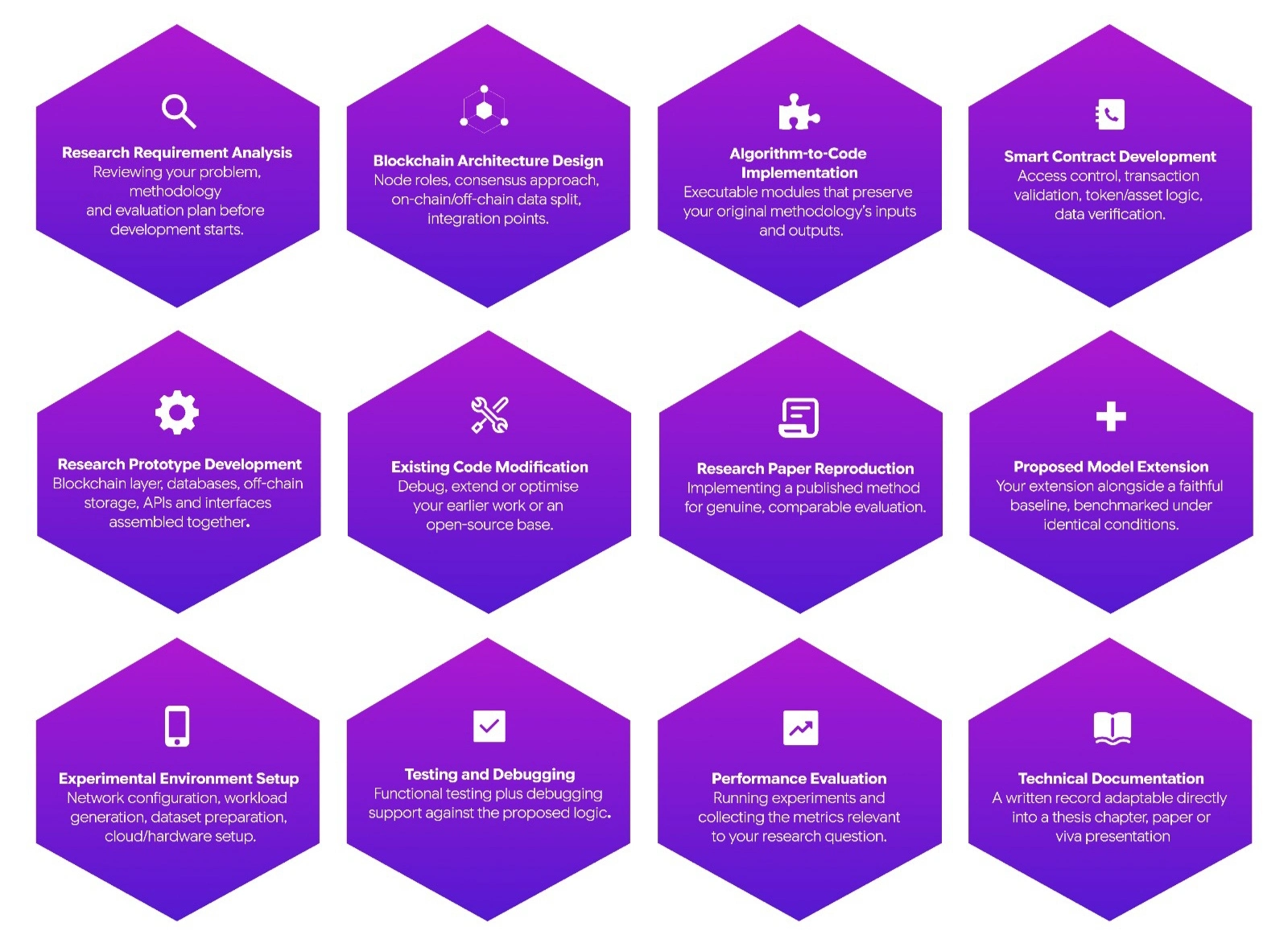
Twelve connected areas of support, scoped to what your specific research stage requires.
Every project is scoped individually after requirement analysis. These starting ranges give you a realistic benchmark before your free consultation.
Single algorithm or protocol translated into executable, tested logic.
≈ US $180 · scope-dependent
Full prototype: blockchain layer, smart contracts, APIs, experimental setup.
≈ US $480 · scope-dependent
Published-method reproduction plus your proposed extension, benchmarked head-to-head.
≈ US $1,020 · scope-dependent
Final pricing depends on platform (e.g. Ethereum, Hyperledger Fabric), scale of experiments, number of baselines compared, and documentation depth. Share your requirement for an exact, no-obligation quote.
The technology stack should follow the research question, not the other way round. Getting this choice wrong early tends to create rework later.
| Decision | Guidance |
|---|---|
| Platform choice | Public/permissionless chains (Ethereum, Polygon) suit research on trust, transparency or open participation. Permissioned platforms (Hyperledger Fabric, Corda) suit controlled data sharing between known organisations — supply-chain partners, hospitals, government departments. |
| Language choice | Python + Web3 libraries for research already in a Python ecosystem. Java, Go or C++ where the architecture integrates with enterprise systems or is performance-sensitive. Node.js/JavaScript is common for the API and interface layer. |
| Smart contract tooling | Solidity is the most common contract language, developed and tested with Remix, Hardhat or Truffle, with Ganache for local test networks and MetaMask for wallet-level testing. |
| Supporting technologies | MongoDB, MySQL or PostgreSQL for off-chain storage; REST APIs to connect the blockchain layer to external systems or IoT devices; Docker for reproducible environments; Git for version control. |
We select from this set based on what your architecture, dataset, and evaluation plan actually require — not a fixed stack applied to every project.
Coverage isn't limited to these eight areas — if your research sits in an adjacent or emerging domain, the same implementation approach applies.
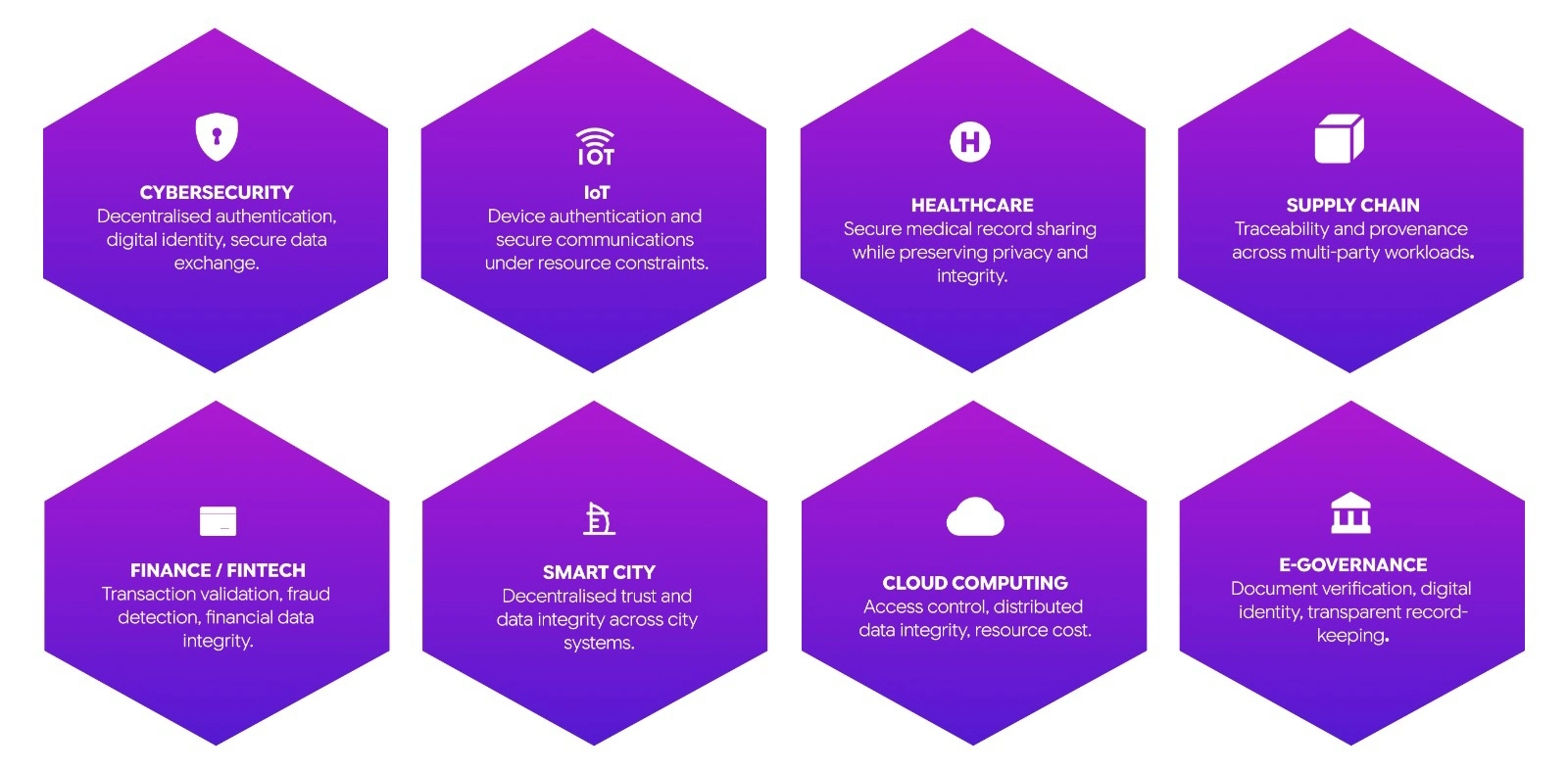
Evaluated on authentication latency, resistance to specific attack scenarios, and cryptographic overhead.
Evaluated on device-side computational overhead, communication latency, and behaviour as device count scales.
Evaluated on access-control correctness, data-sharing latency, and resilience to unauthorised access.
Evaluated on transaction throughput under multi-party workloads and end-to-end verifiability.
Evaluated on transaction processing time, validation accuracy, and throughput under varying volumes.
Evaluated on system responsiveness and data consistency across independent nodes.
Evaluated on security guarantees alongside cloud resource utilisation.
Evaluated on verification speed, auditability, and controlled access to administrative records.
This is usually the core technical journey of a blockchain PhD chapter, end to end.
A gap in existing blockchain-based approaches is identified.
A proposed algorithm or consensus variant is designed to address it.
The algorithm is placed inside a system: on-chain/off-chain split, node communications and data structures.
Inputs, processing steps and outputs are translated into executable code.
Network/testnet, contracts, databases, APIs and interfaces are assembled.
The prototype runs under controlled, varying conditions to generate data.
Results are measured against metrics and, where relevant, a baseline.
Outcomes are interpreted against the original research question and hypothesis.
Each transition in this chain is a place where things commonly go wrong — an algorithm that reads cleanly in a paper can be ambiguous once you try to code it; an architecture that looks complete can be missing a data layer; a prototype that "works" can still produce unreliable experimental data if test conditions aren't controlled properly. Implementation support is largely about handling these transitions carefully and documenting the decisions made at each one.
Blockchain is one of the evolving domain in computer science. There are many other advanced evolving concepts in implementation. Get to know more about our trending evolving technologies our experts works.
Explore Other ImplementationsThere's no single "correct" set of metrics — the right evaluation depends on what the research question actually asks.
| Metric category | When it's relevant |
|---|---|
| Throughput & latency | Claims of improved transaction processing speed or system responsiveness. |
| Transaction confirmation time | Consensus-mechanism research or any claim about faster finality. |
| Scalability | Claims the system performs well as node count, transaction volume, or device count increases. |
| Computational overhead | Lightweight consensus or resource-constrained environments (e.g. IoT). |
| Storage overhead | Designs that change how much data is stored on-chain or off-chain. |
| Resource utilisation | Evaluating cost or efficiency, including cloud-integrated blockchain systems. |
| Transaction / gas cost | Platforms where on-chain operations have an associated cost, or cost-reduction claims. |
| Security metrics | Proposed security mechanisms; resistance to specific attack models rather than a single number. |
| Accuracy | Systems incorporating a classification, detection, or validation component. |
Sound evaluation also depends on the experimental design around these metrics: a documented baseline for comparison, controlled variation of one parameter at a time, testing under multiple workloads, and enough repetition to distinguish a real effect from noise. We help set this up so the resulting data can support a genuine comparative claim, not just a single run under favourable conditions.
Ten steps from requirement analysis to a documented, defensible result. You stay involved throughout.
Understanding the problem & expected contribution.
Checking feasibility & flagging gaps.
Platform, language, tools chosen.
Components & build sequence set.
Blockchain components & contracts built.
Databases, APIs, devices connected.
Confirming specified behaviour.
Datasets, parameters, conditions.
Experiments run, metrics collected.
Results, decisions & limitations written up.
Talk to our experts about your blockchain implementation.
Depending on project scope, deliverables can include:
Source code for the implemented system
A working prototype (blockchain layer plus supporting components)
Smart contracts, where on-chain logic is required
A documented system architecture
Implementation and setup documentation, incl. configuration
Experimental results and raw output data
Performance metrics & baseline comparison data
Charts and tables summarising results
Written explanations suitable for a thesis chapter, paper or viva
Deliverables are agreed before development starts, based on what your specific research stage and evaluation plan require.
PhD scholars implementing a proposed blockchain architecture or algorithm for the first time.
Doctoral candidates who need a working baseline to compare a new contribution against.
Researchers reproducing a published blockchain method to validate or extend it.
Scholars extending an existing blockchain model and needing a benchmarked comparison.
Researchers with partial or non-functioning code that needs debugging, modifying, or completing.
Scholars preparing an implementation chapter, conference paper , or viva presentation who need results documented clearly.
Implementation decisions are tied back to your specific research question and methodology rather than a fixed "blockchain app" build.
Support spans cybersecurity, IoT, healthcare, supply chain, finance, smart cities, cloud computing, and e-governance contexts.
Environments, parameters, and decisions are documented as you go, not reconstructed after the fact.
Results, including limitations and discrepancies, are reported as found — not adjusted to fit a preferred narrative.
Technical write-ups are structured so they can be adapted directly into a thesis chapter , conference paper, or viva presentation.
You review architecture and methodology decisions throughout, rather than receiving a finished system with no visibility into how it was built.
Implementation support is intended to supplement your own research work — helping you build, test, and document a system aligned with your proposed contribution — not to replace your authorship of the underlying research. Explore our wider delivered research projects or browse available research domains for more context.
Tell us your research area, current stage, and the support you need. Our team reviews it and connects you with the right implementation specialist — usually within one business day.
It's the technical stage where a proposed blockchain architecture, algorithm, or security mechanism is converted into a working, testable system, so it can be evaluated experimentally as part of a thesis or research paper.
Yes. Algorithms and mathematical models from your methodology can be translated into executable code that preserves the original logic, inputs, processing steps, and outputs.
Yes. This involves implementing the published architecture, algorithm, and experimental setup as closely as the paper's description allows, then comparing the reproduced results against the reported ones and documenting any discrepancies.
No. Reproduction produces an independent implementation and dataset run under comparable conditions — it's a genuine point of comparison, not a verification of the original claims. Results are reported as found, whether they align with the paper or not.
Yes. Existing code — your own earlier work or an open-source base — can be debugged, optimised, or extended to match a revised research direction, with the effect of the changes evaluated afterward.
It depends on the research question. Public/permissionless platforms (e.g. Ethereum, Polygon) suit research on open participation or transparency; permissioned platforms (e.g. Hyperledger Fabric, Corda) suit research involving controlled data sharing between known participants. Platform selection is discussed as part of requirement analysis.
Yes, where the research design requires on-chain logic such as access control, transaction validation, or data verification, typically written in Solidity and tested in environments like Hardhat, Truffle, or Ganache.
Yes. The implementation, experimental results, and documentation are structured so they can be adapted into an implementation chapter, results chapter, or conference/journal paper.
It depends on the research question — common metrics include throughput, latency, transaction confirmation time, scalability, computational overhead, storage overhead, resource utilisation, transaction/gas cost, and security-related measures.
Yes — including decentralised authentication, access control, secure data exchange, and evaluation of resistance to specific attack scenarios.
Yes — covering device authentication, secure communication, and decentralised data management, with evaluation adapted to the resource constraints typical of IoT devices.
Generally: the research problem, proposed methodology or algorithm, any existing architecture diagrams or code, the dataset (if available), and the evaluation criteria your research design specifies.
It depends on the scope — a focused algorithm-to-code task differs significantly from a full prototype with multi-party experimental evaluation. Timelines are discussed and agreed after requirement analysis.
Typically source code, a working prototype, smart contracts where applicable, architecture documentation, experimental results, performance metrics, and written technical documentation — scoped to the specific project.
Yes. Documentation covers architecture, technology choices, implementation decisions, experimental configuration, results, and limitations, written to support a paper, thesis chapter, or viva presentation.


