
You already have the paper, the proposed algorithm, the architecture diagram and a methodology your advisor signed off on. What's missing is a working system you can actually run, measure and defend in front of a committee. Zonduo builds that missing piece — turning cloud computing research into a working experimental implementation that can be executed, measured, evaluated and documented.
Working source code
Configured, reproducible environment
Result files and performance charts
Technical implementation report
Reproducible experimental setup
Thesis integration guidance
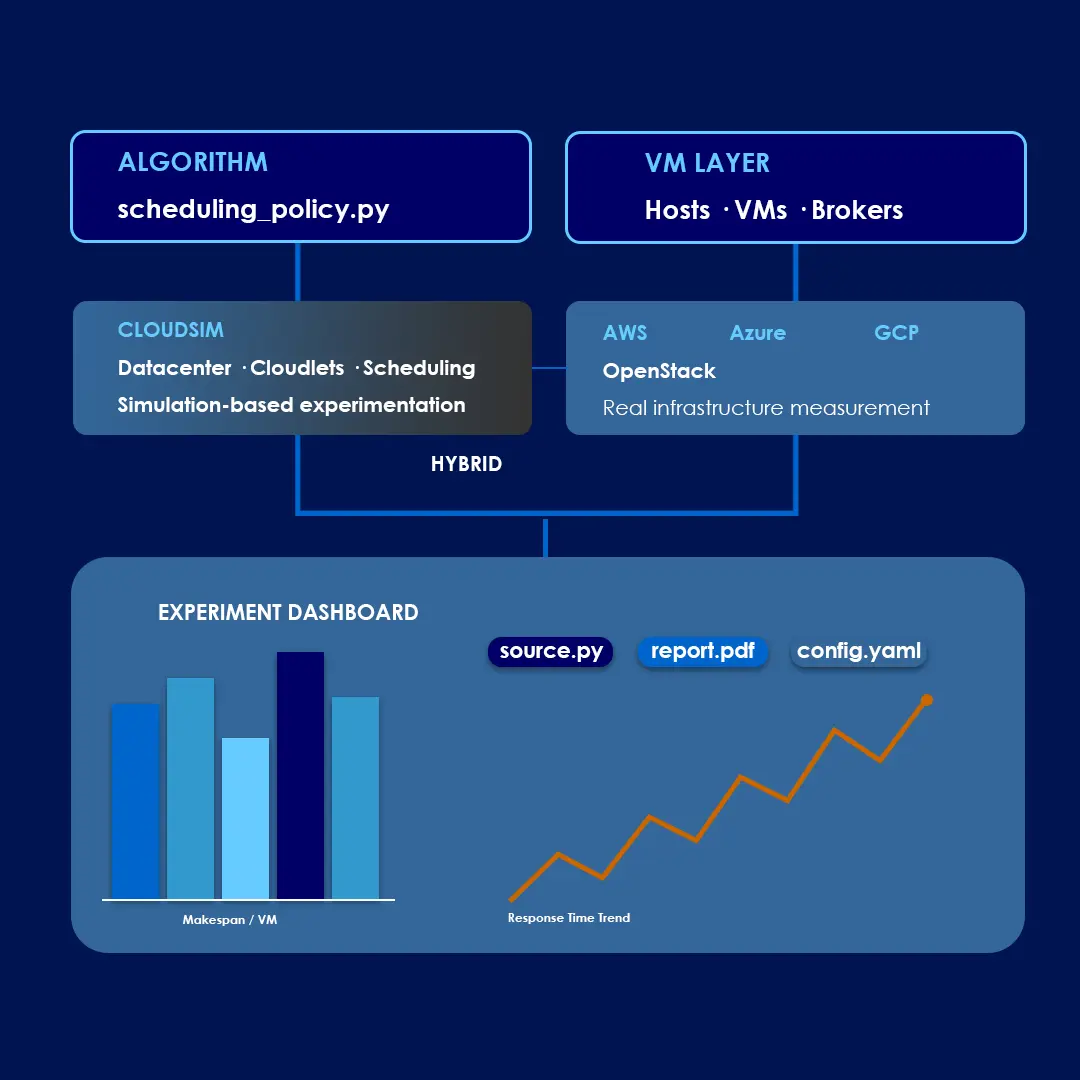
Cloud computing implementation for PhD research converts a proposed cloud architecture, algorithm, simulation model or research methodology into a working experimental system that can be tested, measured and evaluated using CloudSim, real cloud infrastructure or a hybrid approach.
PhD scholars, doctoral candidates, faculty researchers and research teams in cloud computing, distributed systems and related areas.
A proposed algorithm, architecture or methodology, turned into working, measurable code and infrastructure.
CloudSim, AWS, Microsoft Azure, Google Cloud, OpenStack, or a hybrid simulation + real-cloud approach.
Source code, a configured environment, result files, performance charts and a technical implementation report.
Baseline comparison, documented experimental configuration, and repeatable, defensible measurements.
Cloud architecture, scheduling, virtualization, security, optimization, AI/ML workloads, edge-cloud and blockchain-cloud integration.
Cloud computing implementation for PhD research is the process of converting a proposed cloud architecture, algorithm, simulation model, or research methodology into a working experimental system that can be tested and evaluated. It differs from standard IT implementation in almost every respect except the underlying technology.
A business deploying cloud infrastructure cares about uptime, cost and operational stability. A PhD researcher implementing a cloud computing paper cares about whether the implementation faithfully reflects the proposed methodology, whether results are reproducible, and whether the evaluation isolates the variable the research actually claims to improve — scheduling delay, energy consumption, load distribution, fault recovery time, or whatever the paper's contribution centers on.
In commercial deployment, the environment is built once and optimized for production stability. In research implementation, the environment is built to be instrumented — every scheduling decision, every resource allocation event, every timing measurement needs to be observable and logged, because that data becomes your results. Research requirements also shape tool choice directly: a study on VM scheduling policies might be better served by CloudSim's repeatable, cost-free experimentation than a live AWS deployment, while a study on real-world network latency or storage throughput may require the opposite. That decision — simulation, real cloud, or both — is itself a methodological choice, not just a technical one, and it's usually the first thing we work through with a researcher. If your research methodology is still taking shape, that discussion typically happens before any implementation work begins.
Our implementation work spans the areas most PhD cloud computing research actually touches. Not every project touches every area — scope is defined by your specific methodology, not by a fixed package.
Designing the system components a proposed methodology depends on.
Provisioning, isolation and placement strategies.
Task scheduling, workflow scheduling, SLA-aware scheduling.
Static and dynamic resource allocation models.
Access control, encryption and privacy-preserving mechanisms relevant to the research question.
Storage, replication and consistency behavior under research conditions.
Where research explicitly involves edge/fog resource coordination.
Energy efficiency, cost modeling and utilization improvements.
Applying ML to scheduling, prediction or anomaly detection in cloud environments.
Implemented where these appear as part of the proposed architecture, not as generic add-ons.
CloudSim is a Java-based simulation framework that lets researchers model datacenters, virtual machines, brokers and cloudlets to test resource-allocation and scheduling algorithms without deploying real infrastructure. For many PhD cloud computing projects, it's the more practical starting point than a live cloud deployment.
CloudSim is useful when a research objective requires repeatable experimentation — testing a scheduling policy across dozens of workload variations, for instance — without the cost, time and variability that come with repeated real-cloud deployments. Within a CloudSim-based implementation, we typically work with:
Datacenters and hosts — modeling the physical resource layer
Virtual machines — defining VM specifications and lifecycle behavior
Brokers — mediating between user requests and datacenter resources
Cloudlets — representing the workload units being scheduled or processed
Scheduling and allocation policies — the actual algorithm under evaluation
Performance metrics — makespan, resource utilization, response time and other measures the paper's evaluation depends on
The advantage isn't just cost. Simulation gives you full control over variables — network conditions, host failure rates, workload arrival patterns — that are difficult or impossible to control precisely on a real cloud platform, which matters when your contribution depends on isolating one specific factor. CloudSim implementation for PhD research is particularly suited to:
Repeatable experiments — identical conditions on every run
Large workload variations — parameter sweeps at scale
Controlled variables — isolate the factor your contribution addresses
Reduced infrastructure cost — no ongoing platform billing
Host failure scenarios — model conditions hard to trigger live
Workload arrival & network-condition experiments — precise, repeatable control
Simulation isn't always the right choice. Real cloud environments — AWS, Microsoft Azure, Google Cloud, or OpenStack for private/hybrid setups — are appropriate when the research requires measurements from actual infrastructure: real networking behavior, real storage throughput, real compute variability, or real service-level characteristics that a simulator can't reproduce.
Real-cloud measurement and algorithm implementation matched to your methodology's requirements.
Infrastructure-dependent research where actual service behavior matters.
Pricing, performance and service-level data pulled from the platform itself.
Private/hybrid and on-premises-style infrastructure research.

The right platform follows from the research question, not from platform popularity. A study evaluating serverless cold-start latency needs a real serverless environment. A study on container orchestration overhead may need real Kubernetes clusters rather than a simulated approximation. A study comparing public-cloud cost models across providers needs pricing and performance data pulled from the platforms themselves. Where the research explicitly calls for private-cloud or on-premises-style infrastructure, OpenStack is often the more appropriate fit than a public provider. We help identify which platform — or combination — actually matches what the methodology needs to demonstrate, and we're upfront when a project doesn't need real-cloud deployment at all.
Virtualization sits underneath almost every cloud computing research problem, and implementation-level detail here often determines whether an evaluation is credible. In practice, virtualization implementation for research covers:
Virtualization concepts and levels — hardware, OS or application level, and how that choice affects the research's resource model
VM provisioning and allocation — how virtual machines are created, sized and assigned to physical or simulated hosts
Resource isolation — ensuring VMs behave independently enough for measurements to be attributable to the algorithm, not interference
Hypervisor-level considerations — included where relevant to the specific research question, not as a default
Performance under virtualization — overhead, contention, and how these should (or shouldn't) be controlled for
Virtualization experiments — structured tests isolating allocation strategy, VM density or placement policy
Getting the virtualization layer right is often what separates a scheduling algorithm evaluation that holds up from one that doesn't.
Hosts, storage, network
Resource isolation & scheduling
Provisioning, placement, density
The experiment under evaluation
A summary of how common cloud computing research areas translate into implementation focus and the metrics typically used to evaluate them.
| Research Area | Implementation Focus | Possible Evaluation Metrics |
|---|---|---|
| VM scheduling | Scheduling policy implementation, host/VM mapping | Makespan, response time, resource utilization |
| Load balancing | Load distribution algorithm across hosts/VMs | Throughput, latency, load variance |
| Resource allocation | Static or dynamic allocation strategy | Utilization, SLA violations, cost |
| Task/workflow scheduling | DAG-based or independent task scheduling logic | Execution time, deadline compliance |
| Energy optimization | Power-aware placement or consolidation | Energy consumption, PUE-related measures |
| Cloud security | Access control, encryption, threat detection | Detection accuracy, overhead, latency impact |
| Fault tolerance | Failure detection and recovery mechanisms | Recovery time, availability, reliability |
| Autoscaling | Reactive or predictive scaling policy | Response time, resource utilization, cost |
| Cloud storage | Data placement, replication strategy | Throughput, latency, storage cost |
| Edge-cloud computing | Task offloading between edge and cloud tiers | Latency, energy, bandwidth usage |
| Container orchestration | Scheduling and scaling within Kubernetes/Docker | Startup time, resource efficiency |
| AI/ML cloud workloads | Training/inference scheduling on cloud resources | Accuracy, training time, resource cost |
The decision between CloudSim-based simulation for PhD research, a real cloud platform, or a hybrid combination is a methodological choice, not just a technical one.
| Factor | CloudSim / Simulation | Real Cloud Platform | Hybrid Approach |
|---|---|---|---|
| Cost | Free to run repeatedly | Ongoing platform costs | Costs limited to validation phase |
| Control over variables | High — full control of workload, failures, topology | Lower — subject to real-world variability | Controlled simulation, real-world spot-checks |
| Repeatability | Fully repeatable, identical conditions each run | Harder to reproduce exactly | Simulation repeatable; validation confirms realism |
| Realism | Approximated behavior | Real infrastructure behavior | Combines both |
| Scalability of experiments | Easy to test at large scale | Limited by cost/quota | Simulate at scale, validate at smaller real scale |
| Best suited for | Algorithm-level evaluation, large parameter sweeps | Infrastructure-dependent claims (networking, storage, real service behavior) | Papers claiming both algorithmic improvement and real-world applicability |
This is the delivery process we follow on every engagement — distinct from the ten-step paper-to-implementation path above, which describes how an algorithm itself moves from a paper into working code. This is the project workflow around it.
We read the paper or proposal closely to understand the claimed contribution, the evaluation approach, and what "success" means for your specific research question.
We isolate the exact algorithm or mechanism being proposed, separating it from background material and related-work discussion.
We define the system components, workload model, baseline algorithms and metrics before any code is written.
We choose CloudSim, a real cloud platform, or a hybrid setup, and select the programming language and supporting tools the methodology calls for.
We build the actual system: the algorithm, the environment, the workload generators, and the measurement instrumentation.
We verify the implementation behaves as the methodology describes, and that measurements are being captured correctly before results are treated as final.
We run the configured experiments, compare against baseline approaches, and produce the metrics, charts and tables the evaluation requires.
We deliver source code, configuration files, results and a written implementation report explaining what was built, how it was configured, and how to reproduce it.
Share the paper, your research objective and your expected methodology with Zonduo for an initial project assessment.
Discuss Your Cloud Research →Tool selection depends on the research methodology and implementation requirements — not every project uses every tool, and forcing a technology into a project it doesn't fit tends to weaken the evaluation rather than strengthen it.
| Research Requirement | Possible Technology / Tool |
|---|---|
| Algorithm implementation, data processing | Python |
| CloudSim-based simulation | Java |
| Systems-level or performance-critical components | C/C++ (where relevant) |
| Repeatable, cost-free experimentation | CloudSim and related simulation frameworks |
| Real infrastructure measurement | AWS, Microsoft Azure, Google Cloud |
| Private/hybrid cloud research | OpenStack |
| Container-based scheduling research | Docker |
| Orchestration and scaling research | Kubernetes |
Tool selection follows the methodology — Python, Java, C/C++, CloudSim, Docker and Kubernetes are chosen based on what a given study needs to demonstrate, not applied by default.
To explore other emerging domains of computer science
Explore Other ImplementationsAn implementation is only as useful as its evaluation. Depending on the research area, relevant metrics can include the following — accuracy is relevant where the research involves prediction or classification components.
A proposed algorithm's results mean little without a fair comparison against the established methods the paper positions itself against.
Configurations, random seeds (where applicable) and workload parameters need to be documented precisely enough that the same experiment produces the same results when re-run — which is what makes an evaluation defensible.
We don't promise a specific outcome, a particular result trend, or publication acceptance — that depends on your research contribution and the review process, not on implementation work. What we commit to is an implementation and evaluation setup that accurately reflects your proposed methodology and produces results you can stand behind.
What you receive depends on your specific research, but engagements typically include the following.
Implementation of the algorithm/system in the agreed language and framework.
CloudSim setup or cloud platform configuration, ready to run.
System components, data flow and design decisions.
Datacenter, host, VM and workload definitions, where applicable.
Parameters, workload generators and baseline configurations used.
Scripts and config used to reproduce the experiments.
Where applicable to your specific study.
Raw output from experiments.
Processed, presentation-ready performance data.
Written interpretation of what the results show.
Implementation report explaining what was built and how.
Steps to re-run the exact experiments.
Where appropriate, notes on how to frame the implementation within your thesis chapters.
This service is built for research, not business IT deployment.
Working on cloud computing, distributed systems, or related areas.
Who need a proposed algorithm turned into a working, testable system.
Running cloud-related studies at department or lab level.
Whose projects require comparable implementation depth.
As part of a baseline comparison against a new proposed approach.
Adding a new scheduling strategy or modifying an existing cloud algorithm.

Examples of the kinds of problems this service supports. Most projects combine elements from more than one area, and scope is defined around your specific methodology.
The value here isn't a claim, it's the process.
Before any code is written, we work through the methodology and what the evaluation needs to demonstrate.
Tool choice follows what the research actually needs — not whichever platform is trendiest.
Configurations, parameters and workloads documented precisely enough to re-run.
Written for a thesis committee, not a generic project handoff.
Scope, deliverables and timelines defined transparently at the start of each engagement.
Zonduo provides implementation, experimentation and technical research assistance. Our role is to make sure the implementation faithfully reflects your methodology and that your results are ones you can defend and reproduce.
No fabricated experimental results. Results reflect what the implementation actually produces.
No guarantees of publication or acceptance. Those depend on the strength and originality of your research contribution, evaluated through the normal academic review process.
Implementation must faithfully reflect the proposed methodology — not a simplified or convenient approximation of it.
Results should be defensible in front of an advisor, committee or reviewer.
Experiments should be reproducible, with configurations and parameters documented precisely.
Share your paper, algorithm or methodology and we'll get back to you with an honest read on scope, approach and platform fit.
A short, no-obligation assessment of your research paper, proposed algorithm or methodology.
Reviewed by someone who reads the methodology, not just the abstract
Honest recommendation on CloudSim, real cloud, or hybrid
Scope and deliverables explained before you commit
Response from our Nagercoil / Chennai research team
It's the process of converting a proposed cloud architecture, algorithm, or methodology from a research paper or thesis proposal into a working system that can be tested, measured and evaluated — using simulation, real cloud infrastructure, or a combination of both.
Yes. We analyze the paper's methodology, extract the proposed algorithm, design an appropriate implementation approach, and build a working system with results you can compare against the paper's own baselines.
Yes. CloudSim implementation is one of our core services, covering datacenter, VM, broker and cloudlet modeling along with scheduling and resource-allocation policy implementation.
Yes, where the research objective calls for real-cloud measurement rather than simulation. We configure the AWS environment and implement the algorithm to match your methodology's requirements.
It depends on your research question. Simulation (CloudSim) suits algorithm-level evaluation and large parameter sweeps; real platforms like AWS, Azure, or Google Cloud suit research that depends on actual infrastructure behavior. We help determine the right fit.
Yes. This includes VM provisioning, resource allocation, isolation, and performance experiments related to different levels and approaches to virtualization.
Common metrics include execution time, response time, latency, throughput, resource utilization, cost, energy consumption, scalability, availability, and makespan — the specific set depends on what your algorithm is designed to improve.
Yes. Every engagement includes source code, configuration files, results, and a written implementation report covering how the system was built and how to reproduce the experiments.
Yes. Reproducing a published study is a common starting point, particularly when it's needed as a baseline for comparison against a new proposed approach.
Yes. We regularly extend or modify existing implementations — adding a new scheduling strategy, changing the evaluation setup, or adapting code to a different platform or dataset.
Yes, where the research architecture specifically involves edge-cloud or fog-cloud coordination, we implement the relevant offloading, scheduling, and resource-management components.
It follows a structured sequence: paper/problem analysis, algorithm understanding, architecture and experiment design, tool selection, implementation, testing, performance evaluation, and documentation handover — each stage explained in the process section above.


