
Difference Between Dissertation and Thesis: A Complete 2026 Guide
Published: 16 June 2026 · Last updated: 10 August 2026

If you have ever wondered about the difference between a dissertation and a thesis, you are in good company. The two terms are used interchangeably so often that even universities, supervisors and publishers slip up. Yet they usually point to different documents, written for different degrees — and confusingly, the definitions are reversed between the United States and countries like the UK and India.
This guide settles the confusion. We cover what each one actually is, how they differ in level, length, scope and purpose, how the meaning changes by country, and how to figure out which one you will be writing.
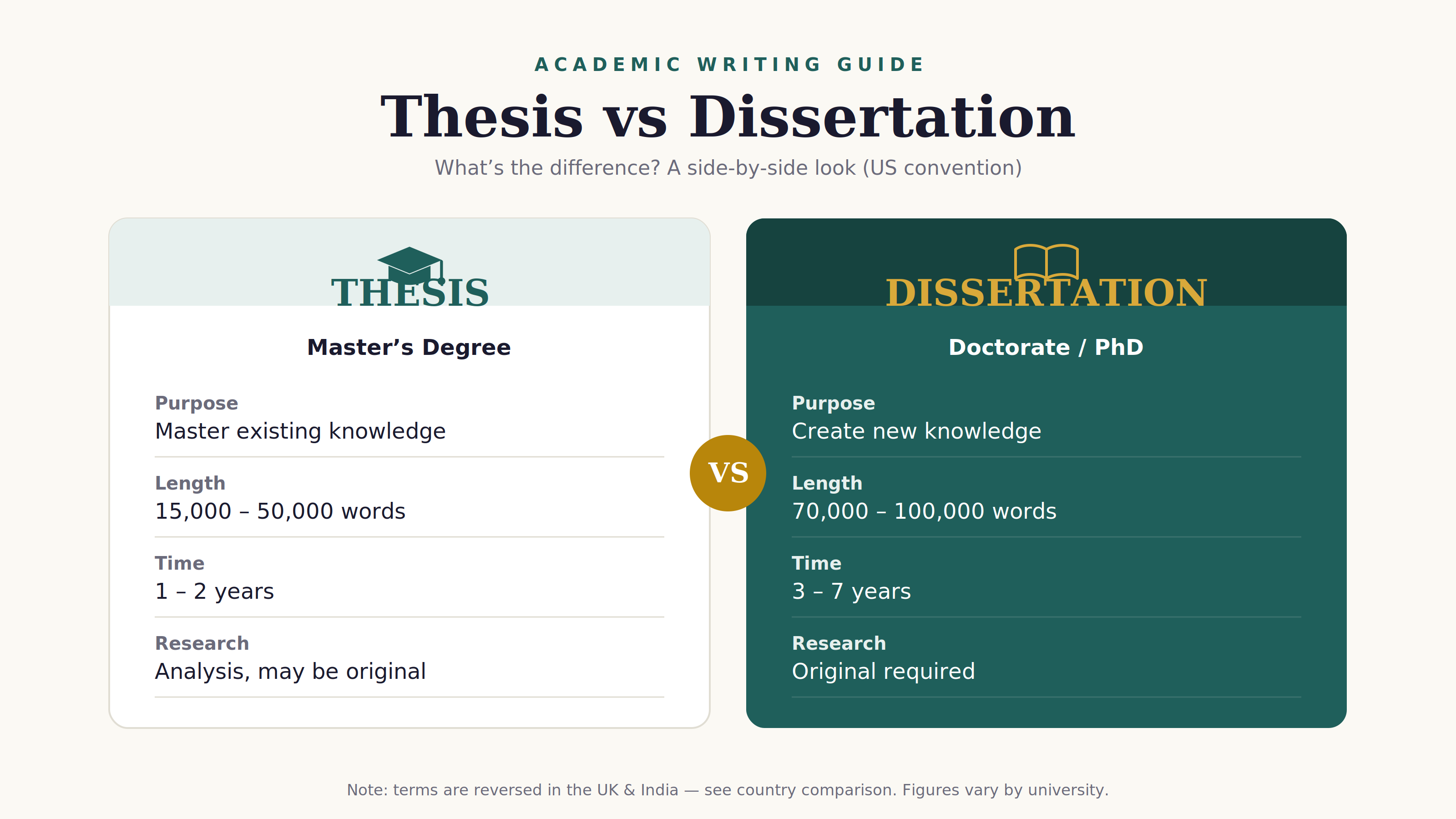
In US academic English, a thesis is the research project you write for a master's degree, while a dissertation is the much longer original-research project you write for a doctorate (PhD). In the UK, India and most of the Commonwealth, the terms are flipped: a dissertation is written at bachelor's or master's level,and a thesis is reserved for a PhD.
What is a thesis?
A thesis is a substantial piece of academic writing that presents and defends a central argument or position on a specific research question. In the US system, it is the capstone project of a master's degree. It demonstrates that you can review existing scholarship, analyse evidence, and communicate a clear, well-supported argument within your field.
A master's thesis often includes a literature review, a methodology section, data analysis and a conclusion. It may involve original research, but its main job is to prove your command of an established body of knowledge rather than to break entirely new ground. The word itself traces back to the Greek tithenai, meaning "to place" or "to put forward" — fitting, since a thesis puts forward a position.
What is a dissertation?
A dissertation is the long, original research project written to earn a doctoral degree (PhD) in the US system. Unlike a thesis, a dissertation is expected to make a genuinely new contribution to knowledge — you are not just analysing what already exists, you are adding something the field did not have before.
This means designing and conducting original research, defending your methodology, and situating your findings within (and against) the existing scholarship across several detailed chapters. The word comes from the Latin disserere, "to examine and discuss." A doctoral dissertation can take years and is widely regarded as the highest demonstration of academic research ability.
Dissertation vs thesis at a glance
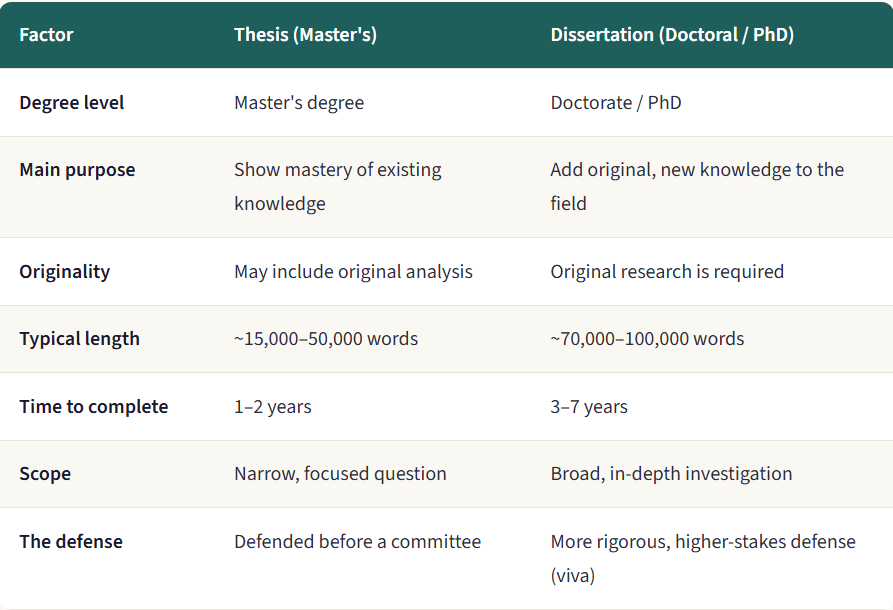
Here is the side-by-side comparison most students are searching for. (This table uses the US convention; see the country section below for the UK/India reversal.)
The key differences explained
The at-a-glance table covers the headlines. Here is what actually drives those differences.
1. Academic level
This is the single biggest distinction. In the US, a thesis belongs to a master's programme and a dissertation belongs to a doctoral programme. The level dictates almost everything else — the expectations, the length and the time commitment all scale up at the doctoral stage.
2. Purpose and originality
A thesis tests whether you can understand, synthesise and argue within your field. A dissertation goes further: it must contribute something original — a new finding, framework, dataset or interpretation. Put simply, a thesis analyses existing knowledge; a dissertation creates new knowledge.
3. Length and word count
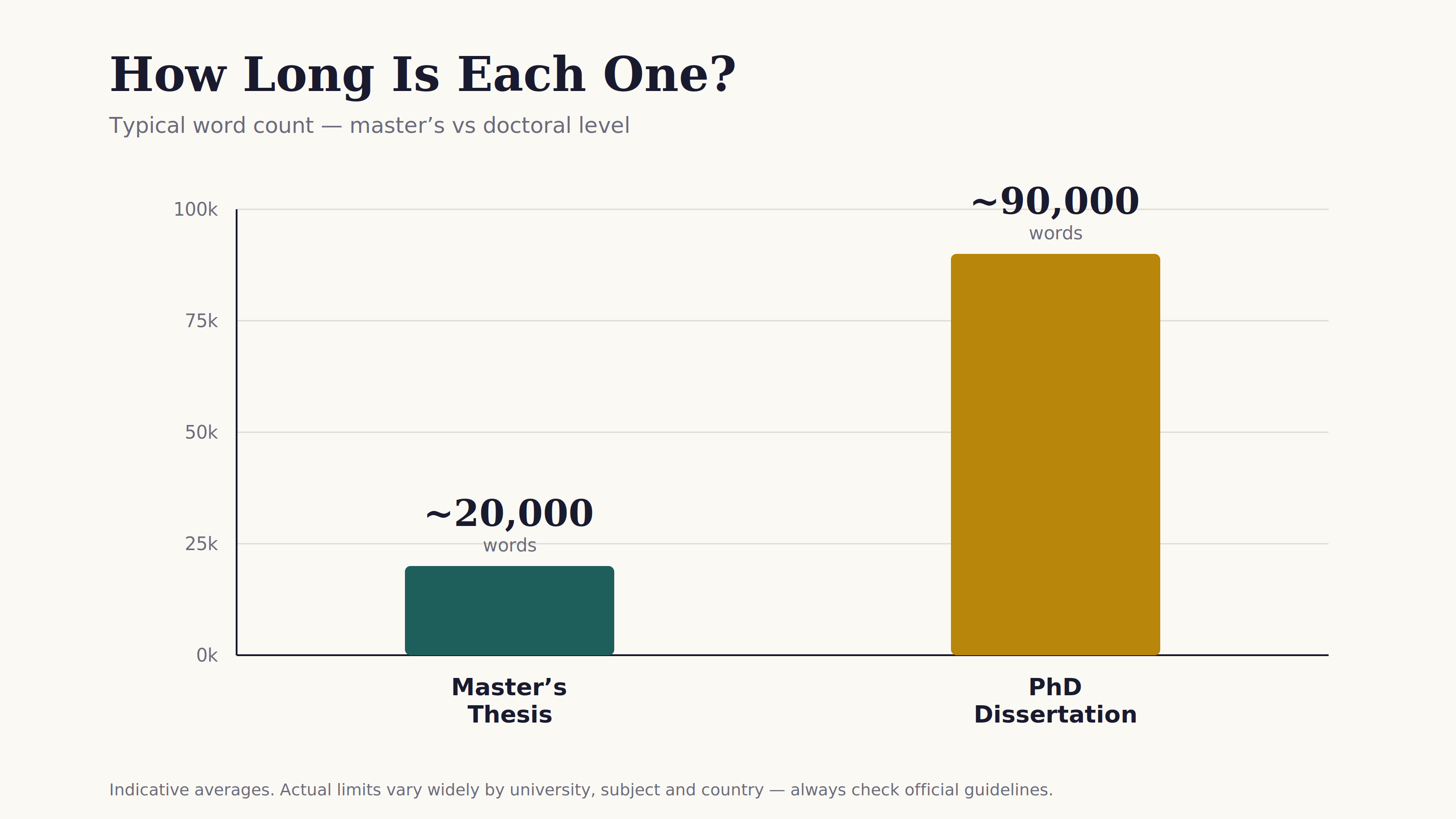
A master's thesis usually runs 15,000 to 50,000 words, depending on the field and institution. A doctoral dissertation is typically book-length — around 70,000 to 100,000 words, and can stretch to several hundred pages. The gap reflects depth: original research simply takes more space to justify.
4. Research scope
A thesis tackles a narrow, well-defined question. A dissertation investigates a broader problem in real depth, often across multiple studies or chapters, and is judged on how convincingly it advances the field.
5. Time and effort
A master's thesis is generally completed in one to two years, often alongside coursework. A doctoral dissertation can take three to seven years and is the central work of the entire PhD.
6. The defense
Both are typically defended in front of an academic committee, where you answer questions and justify your choices. The doctoral defense (often called a viva) is more demanding because the stakes — and the originality being claimed — are higher.
Dissertation vs thesis: US vs UK vs India
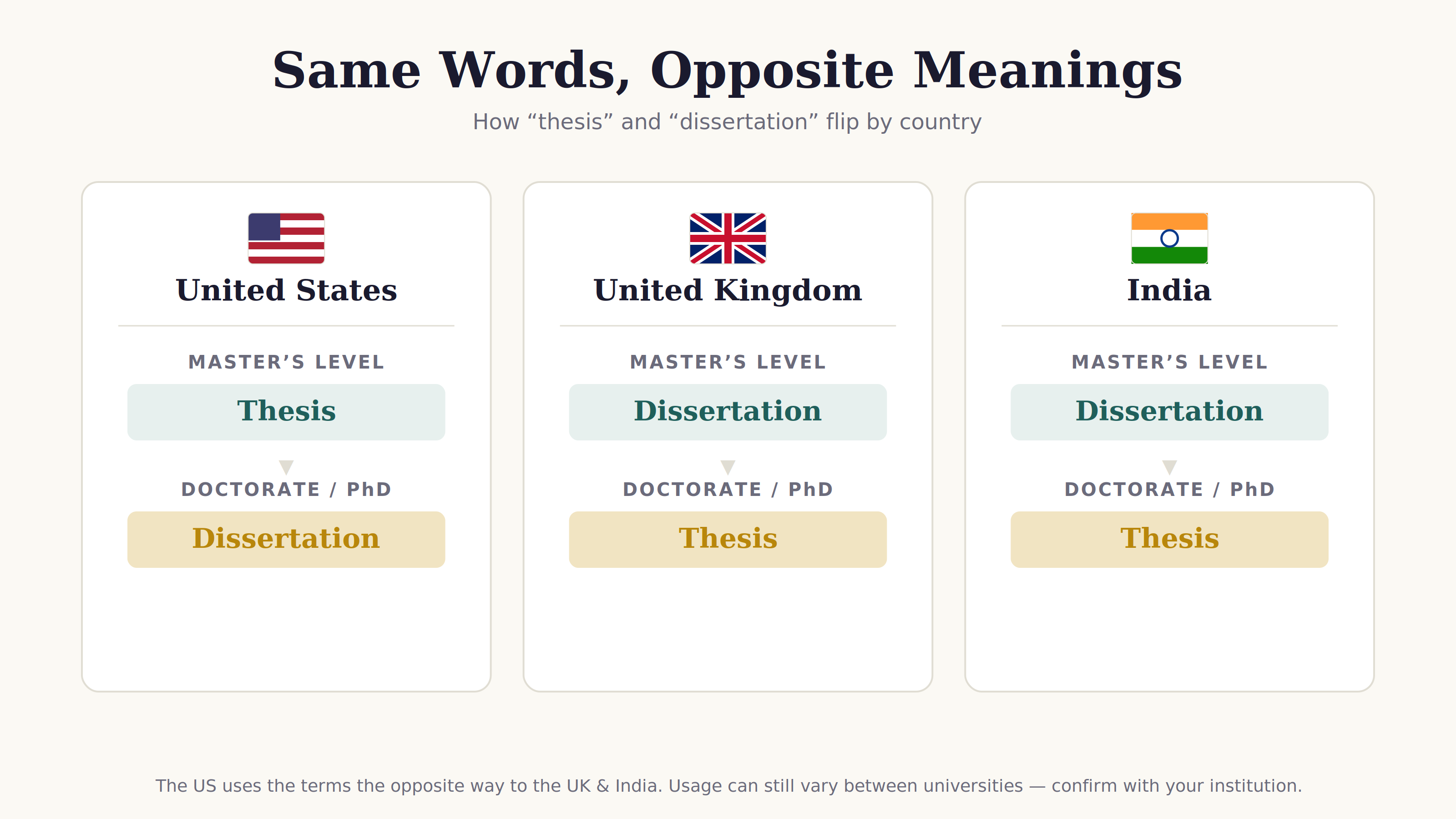
Here is where most confusion comes from: the meanings are reversed between academic systems.
United States: Thesis = master's; Dissertation = doctorate. (This is the convention used throughout this guide.)
United Kingdom & much of Europe: Dissertation = bachelor's or master's; Thesis = doctorate. The exact opposite of the US.
India: Indian universities largely follow the British convention — a dissertation is commonly submitted at master's or M.Phil level, while a thesis is submitted for a PhD. Usage does vary between institutions, so always confirm with your university
Australia & Commonwealth: Generally aligned with the UK pattern, though "thesis" is often used loosely for research at several levels.
The practical takeaway: don't rely on the label alone. Always check what your specific university in your country means by the term, because the requirements — not the name — are what matter.
What a thesis and dissertation have in common
For all their differences, the two share a great deal:
Both are long-form, formal academic documents, far longer than a standard essay.
Both require a literature review, a clear research question and a structured methodology.
Both must be defended and approved before you graduate — they act as a gatekeeper to your degree.
Both demand strong academic writing, citation and proofreading skills.
Both follow strict formatting and word-count rules set by your institution.
Which one will you write?
Figuring out your own document is simpler than the terminology suggests. Work through these three questions:
1.What degree are you doing?Master's or doctorate? This is your biggest clue.
2.Which country / system? US flips the terms compared with the UK and India.
3.What do the official guidelines say?Your university handbook is the final word — it tells you the required length, structure and whether original research is expected.
Once you know what you are writing, the next step is planning it well: a strong proposal, a realistic timeline, and a clear chapter structure make the difference between a smooth submission and a stressful one.
Frequently asked questions
No. They are often used interchangeably, but they usually describe different documents for different degrees. In the US, a thesis is for a master's and a dissertation is for a doctorate; in the UK and India the meanings are reversed.
A doctoral dissertation is generally harder. It requires original research that adds new knowledge, is far longer (often 70,000–100,000 words), and can take three to seven years, compared with a one-to-two-year master's thesis.
A master's-level thesis or dissertation is typically 15,000–50,000 words, while a doctoral thesis or dissertation usually runs 70,000–100,000 words. Limits vary by university and subject.
In US terminology, usually yes — many students complete a master's thesis first and a doctoral dissertation later if they pursue a PhD. You rarely write both for the same single degree.
A dissertation is not a degree itself — it is the major research document you submit to earn a doctorate (in the US system). Completing and defending it successfully is what allows you to be awarded the PhD.