
PhD viva voce preparation is structured coaching that helps a doctoral candidate practise defending their thesis before an examination panel. Zonduo's service builds this preparation around your actual thesis, methodology, findings and contribution through thesis-specific mock viva sessions, examiner-style question banks, presentation review and communication feedback — for first-time vivas, re-vivas, and post-correction defences.
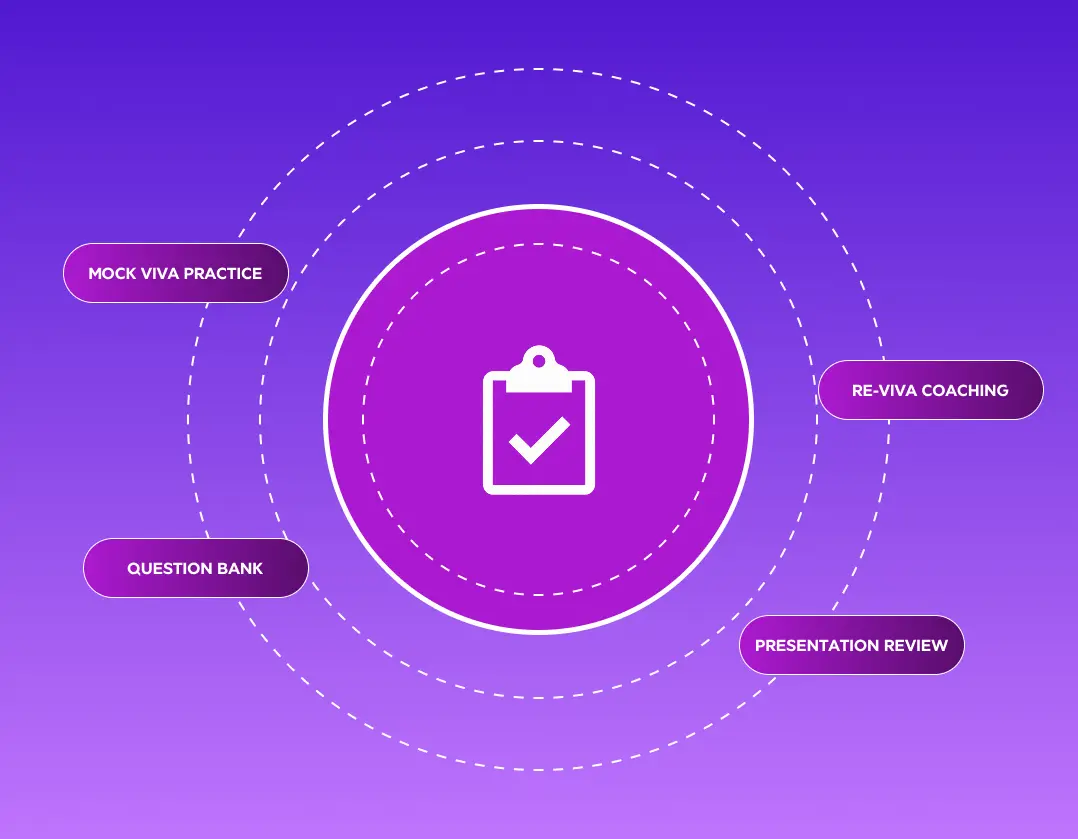
Thesis familiarity review across every chapter of your research.
Thesis-specific mock viva sessions with examiner-style questioning.
Personalised question bank across 16 core viva topic areas.
Presentation, communication and re-viva readiness coaching.
Your PhD viva is where years of research, writing, analysis and academic decision-making come together in a single live discussion. Unlike your thesis writing, a spoken answer cannot be edited after you give it — so preparing for that conversation requires more than rereading your chapters the night before.
Zonduo's PhD Viva Voce Preparation Service helps research scholars prepare for their doctoral defence through mock viva sessions, examiner-style questioning, presentation coaching and structured feedback — built around your actual research methodology, findings and contribution, rather than a generic list of viva questions pulled from the internet. Scholars who have worked with our implementation and journal publication teams often move into viva preparation once their synopsis is finalised, keeping the research story consistent from proposal to defence.
This is a preparation and coaching service — it does not replace your thesis, your supervisor, your academic judgement, or your understanding of your own research. It is designed to strengthen your readiness to discuss and defend the work you have already completed. If you're still finalising written chapters, our research paper editing team can help before you move into viva-stage coaching.
"Viva voce" is Latin for "with the living voice." In a doctoral context, a PhD viva voce is an oral examination in which a research scholar discusses and defends their thesis before an examination panel.
Unlike a written examination, a viva is an interactive academic discussion. Examiners may ask you to explain why you selected a particular research problem, justify your methodology, interpret your findings, discuss limitations, compare your results with previous research, or explain the contribution your study makes to the field.
The exact structure of a PhD viva varies considerably between universities, countries, departments and doctoral programmes. Some institutions require an opening presentation before questioning, while others begin directly with the examination discussion. Examiner composition, duration, correction procedures and final outcomes can also differ.
For this reason, your preparation should always begin by confirming the requirements of your own university and doctoral programme.
Understand your research deeply enough to explain it without relying entirely on the written thesis
Can justify your research problem, objectives, theoretical framework and methodology
Understand how your findings were produced and what they mean
Can explain the originality and contribution of your research
Recognise the limitations and boundaries of your study
Can respond logically to questions, criticism and alternative viewpoints
Can discuss your research confidently and honestly under examination conditions
A well-prepared viva candidate does not need a perfect answer to every possible question. The objective of preparation is to develop a strong understanding of your research and the ability to reason through questions clearly and academically.
Some scholars are confident discussing their research but struggle with unexpected questions. Others know their thesis thoroughly but need practice communicating clearly under live examination conditions.
Structured mock sessions in an examination-style environment instead of relying only on self-study.
For scholars facing detailed questions on methodology, statistics, analysis or research design.
An independent session that adds practice opportunities beyond what busy academic schedules allow.
Focused coaching on clarity, pacing, answer structure and confidence — without replacing your academic voice.
Focused, prioritised sessions rather than open-ended coaching, built around limited available time.
A second viva needs a different strategy — preparation built around examiner comments and past challenges.
Every engagement is shaped around your thesis rather than a fixed script — but most preparation plans move through the same seven areas.
We review your research problem, gap, objectives, methodology, findings, contribution and limitations to identify areas needing stronger verbal explanation.
Questions move from broad research questions to detailed methodological and analytical issues, mirroring how a real examination unfolds.
Organised across methodology, sampling, analysis, originality, contribution and critical-thinking categories — to build reasoning, not memorised scripts.
Clarity, pacing, conciseness and academic tone — helping you communicate your own research more effectively, not sound rehearsed.
Strategies for handling challenge questions honestly, without pretending to know something you don't.
Structure, timing and delivery of your opening slides, where your university requires one — supporting your explanation, not replacing it.
Screen-sharing, audio-video checks and camera presence for scholars defending their thesis in an online viva format.
To keep the service academically responsible and clearly defined, PhD viva preparation does not automatically include:
Your viva is an examination of your research and your understanding of that research. Zonduo's role is to help you prepare to communicate and defend your work effectively.
Writing or substantially rewriting your thesis.
Conducting new research on your behalf.
Collecting research data.
Fabricating or altering research findings.
Reanalysing your study to manufacture a preferred outcome.
Completing your academic work in place of you.
Guaranteeing a pass, grade, or particular viva outcome.
Communicating with your university or examination board on your behalf.
Completing institutional or ethics submissions.
Share your research area and viva timeline — our team will map out exactly which sessions you need before your examination date.
Get My Thesis-Specific Preparation Plan →Research area, university and viva timeline.
Format and priority areas identified.
Thesis-specific question bank built.
Simulated examiner-style session.
Targeted practice on weak areas.
Slides reviewed for clarity and timing.
Readiness review before your viva.
The exact viva process depends on the university and doctoral programme. In some systems, an internal examiner and external examiner participate in the examination. In other settings, the composition and terminology may differ. Your supervisor may attend in some institutions and may have a different role depending on the regulations.
Before your viva, if examiner information is formally provided by your university, it may be useful to review the examiners' academic background and recent research. This does not mean attempting to predict the exact questions they will ask — instead, it can help you understand their research perspective and the kinds of academic issues they may be interested in discussing.
During the viva, questioning may move between different levels of your research:
Examiners may challenge a position you have taken. This does not necessarily mean they believe your research is wrong — academic examination often tests how well a candidate can reason, justify decisions, recognise limitations and respond to alternative perspectives.
Not every university requires a presentation before the viva. Where a presentation is required, the university normally specifies the expected duration and format. Always follow your department's instructions rather than assuming that one presentation format applies to every PhD viva.
As a general planning framework, a short presentation may include:
| Section | Typical Focus |
|---|---|
| 01 Research background | Why the topic matters |
| 02 Research gap | What was missing in existing research |
| 03 Objectives / questions | What the study set out to investigate |
| 04 Methodology | What you did and why |
| 05 Key findings | The most important results |
| 06 Contribution | What your research adds |
| 07 Limitations | Boundaries of the study |
| 08 Future research | Logical next directions |
| 09 Conclusion | The central message of the thesis |
The exact time allocation should be adapted to your university's requirements. Zonduo's presentation preparation can focus on ensuring that your slides are:
Timing practice is particularly useful. Candidates sometimes spend too much time explaining background and leave insufficient time for findings and contribution.
No preparation service can predict every question an examiner will ask. A better strategy is preparing by category and understanding the reasoning behind each answer.
| Category | Typical Focus | Example Question |
|---|---|---|
| 01 Research Topic | Motivation and rationale for the study | Why is this research important? |
| 02 Objectives | Connection between questions and findings | Did your research answer all your research questions? |
| 03 Methodology | Justification of research design and sample | Why did you choose this methodology? |
| 04 Findings | Interpretation and comparison with literature | How do your findings compare with previous studies? |
| 05 Contribution | Originality and practical implications | What is the original contribution of your research? |
| 06 Limitations | Boundaries and honesty about scope | What would you change if you conducted this study again? |
| 07 Critical Thinking | Reasoning under alternative viewpoints | What is the strongest criticism of your study? |
A re-viva requires targeted preparation. If your thesis has undergone major corrections or you have been referred for further examination, simply repeating your original viva preparation may not address the issues that led to the outcome.
The objective is not to hide weaknesses or attempt to manipulate the examination. It is to ensure that you understand the corrections and can clearly explain the changes and reasoning involved.
No legitimate preparation service can guarantee the result of a re-viva. The examination outcome remains the responsibility of the examination process and depends on the quality of the research, corrections, and candidate's responses.
Reviewing examiner comments and correction requirements.
Identifying the specific issues raised during the previous examination.
Understanding the distinction between thesis-level corrections and viva-performance issues.
Rebuilding the question preparation around the examiner concerns.
Practising responses to previously challenged areas.
Preparing to explain what was changed and why.
Reviewing the relationship between the corrected thesis and the original research objectives.
Practising how to discuss remaining limitations honestly.
Five reasons research scholars across India and abroad choose Zonduo when preparing to defend their thesis.
Your viva questions should relate to your research. Zonduo's preparation focuses on your thesis, methodology, findings, contribution and research context — rather than relying exclusively on generic PhD viva question lists.
Reading viva advice is different from actually answering questions aloud. Mock viva practice gives you the opportunity to experience academic questioning and identify areas requiring additional preparation.
Preparation can be adapted for:
Zonduo does not promise a pass, grade, or predetermined examination outcome. The service is focused on helping scholars prepare to discuss and defend their own research.
Zonduo provides online preparation support for scholars across India and internationally, subject to service availability and scheduling.
Pricing depends on thesis length, subject area, number of mock sessions and whether presentation review is required. The ranges below are a starting guide — share your requirement for an exact quote.
For scholars who need one focused practice session before their date.
The most-booked plan for first-time viva candidates.
For technical theses, re-viva cases or extended coaching needs.
*Indicative starting prices in INR. Final pricing is confirmed after reviewing your thesis, university requirements and number of sessions needed. No preparation service can guarantee a pass, grade or specific viva outcome.
Viva voce is Latin for "with the living voice." In doctoral education, it refers to an oral examination in which a candidate discusses and defends their thesis before an examination panel.
The terms are often used interchangeably, although terminology and examination procedures differ between countries and institutions.
There is no universal duration. Some vivas may be relatively short, while others can continue for several hours depending on the institution, research area and examination format. Your university or department's regulations should be treated as the authoritative source for your viva requirements.
No. Some universities require an opening presentation, while others begin directly with examiner questioning. Check your doctoral programme's instructions before preparing your presentation.p>
Yes. Thesis-specific question preparation is central to the service. Questions are developed around your research problem, methodology, findings, contribution and limitations rather than generic internet lists.
A mock viva simulates an academic examination discussion. Questions are asked around your research, and the session helps identify where your explanations, reasoning or delivery need further preparation.
There is no universal number. The appropriate level of preparation depends on your thesis complexity, familiarity with your research, previous viva experience, university requirements and areas requiring improvement.
Yes. Where a presentation is required, support can include reviewing the structure, slide content, timing, clarity and delivery.
Yes. Re-viva preparation focuses specifically on examiner comments, correction requirements, previously challenged areas and your ability to explain the changes made to the thesis.
No. No legitimate preparation service can guarantee a viva outcome. Preparation can improve your readiness, communication and ability to discuss your research, but the final decision belongs to the examination process.
Yes. Preparation can include support with explaining complex research clearly, structuring verbal answers, pacing, fluency and confidence during academic discussion — focused on communicating your own research effectively, not general English tutoring.
No. While Zonduo supports scholars across India, including Tamil Nadu, the preparation can also be relevant to candidates preparing for doctoral viva or defence formats internationally. Because university procedures differ, candidates should always confirm their institution's specific requirements.
Share your research area, university and viva timeline. Our team will review your requirement and connect you with the right preparation specialist.


