Employee Attitudes and Behaviour
Engagement, commitment, satisfaction, motivation

Last updated: 24 September 2026
Good topics are specific, relevant and feasible. Examples include employee engagement in hybrid workplaces, training effectiveness, performance appraisal fairness, retention strategies and AI in recruitment. Each should name a population or context and be answerable with data you can access.
Practical, decision-oriented topics such as talent management strategy, retention of high performers, employee analytics and AI-assisted hiring.
A defined framework, measurable variables and a clear gap, for example mediation studies on psychological safety.
Theory-extending questions on algorithmic management, generative AI and job design, and ethical use of employee data.
Check these seven things before finalizing your topic:
Relevance
Research gap
Data availability
Clear variables
Appropriate methodology
Scope and feasibility
Academic level
Everything on this page at a glance.
| Service | HRM project and research topic guidance: topic selection, refinement and validation |
|---|---|
| Best for | BBA, B.Com, MBA, master's and PhD scholars, and journal-paper authors |
| Topic coverage | 150+ topics across 15 HR specialisations, from recruitment and compensation to AI in HR, people analytics and Green HRM |
| Topic types | Project, research, research paper, thesis, dissertation and PhD topics |
| Research approaches | Descriptive, quantitative, qualitative, mixed-method, comparative, case study and systematic literature review |
| Support included | Topic refinement, research gap identification, proposal and synopsis guidance, methodology, literature review, questionnaire design, data analysis, thesis and paper support |
| How it works | Consultation and guidance. Your work, conclusions and academic integrity stay with you |
| Price range | Free first consultation. Topic-selection pricing is custom quoted; see published Zonduo academic-support ranges below. |
| Offices | Nagercoil and Chennai, Tamil Nadu, India |
| Start here | Send your topic idea or explore Research Topic Selection |
Start with a free chat, then choose the level of support that fits your programme and deadline.
A good HRM topic is more than just a catchy headline. With the time, information, and resources at your disposal, you can genuinely look into this topic. A BBA student, an MBA applicant, a master's thesis writer, or a PhD researcher can all find a starting point with this page, which compiles more than 150 project related topics on human resource management by HR specialization and academic level.
A quick distinction helps. A project topic is usually applied and time-bound: you study a practice in one organisation or sector and recommend improvements. A research topic is framed around a gap in existing knowledge and tests or builds theory. The lists below include both, spanning long-standing areas such as recruitment, appraisal and compensation, and newer ones such as generative AI in HR, people analytics, hybrid work, employee well-being and future skills.
Whatever you pick, judge it on four things: whether a research gap exists, whether the study is feasible, whether you can get the data, and whether the methodology fits. Use the topics here as raw material and narrow them to your context.
Need to read around your topic first? See our literature review support and research problem identification pages.

Choose a topic that is relevant to your course, addresses a gap in existing research, has accessible data, defines clear variables, suits a realistic methodology, fits your deadline and matches your academic level.
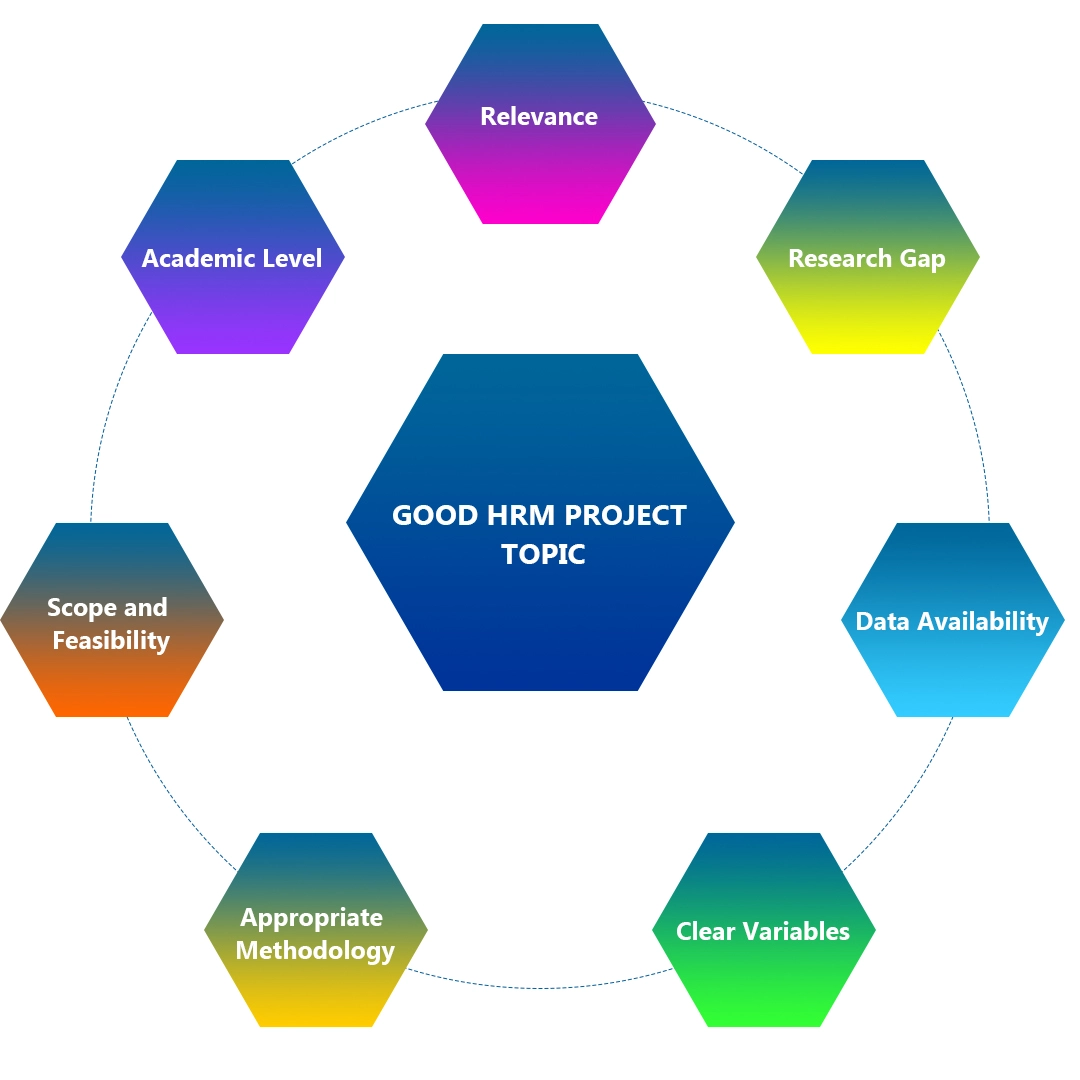
Relevance: it aligns with your programme, specialisation and supervisor's expectations.
Research gap: recent literature leaves something unresolved, such as a new context, sector or population.
Data availability: you can reach respondents, records or interviewees.
Clear variables: you can name what you are measuring or exploring.
Appropriate methodology: survey, interviews, case study or review, matched to the question.
Scope and feasibility: narrow enough to finish within your timeline.
Academic level: a project, MBA report, thesis and PhD need different depth.
Each category below starts with a short note on what the area covers, followed by topic ideas. Topics are written as starting points. Refine the population, sector and geography before you finalise.
Research topics differ from applied projects because they usually rest on a theory, a hypothesis or a defined gap. If you are searching for research areas in human resource management, the useful ones cluster around five themes:
Engagement, commitment, satisfaction, motivation
Recruitment, development, retention, succession planning, career development
Work-life balance, flexible work, psychological safety, organisational justice
Digital HR, HR analytics, AI in HR, employee data privacy
Strategic HRM, Green HRM, diversity, ethics and compliance, future of work
Pick a theme, then a specific relationship or question within it. "Employee engagement" is a theme. "How does psychological safety influence knowledge sharing among hybrid teams" is a research topic.
Get best assistance in selecting impactful research topics with our experts
Quantitative HRM studies test relationships between measurable variables, usually through surveys and statistical analysis. Variables below are suggestions. Do not assume a relationship exists, since testing it is the point of your study.
| # | Topic | Possible IV | Possible DV | Possible Mediator / Moderator |
|---|---|---|---|---|
| 1 | Impact of employee recognition on job satisfaction | Employee recognition | Job satisfaction | Moderator: organisational culture |
| 2 | Leadership style and employee engagement | Transformational leadership | Work engagement | Mediator: psychological safety |
| 3 | Training investment and employee performance | Training and development | Task performance | Moderator: learning culture |
| 4 | Flexible work and work-life balance | Flexible work arrangements | Work-life balance | Moderator: family responsibilities |
| 5 | Pay satisfaction and turnover intention | Pay satisfaction | Turnover intention | Mediator: organisational commitment |
| 6 | Employer branding and talent attraction | Employer brand perception | Intention to apply | Moderator: career stage |
| 7 | Perceived organisational support and burnout | Organisational support | Burnout | Mediator: job control |
| 8 | HR analytics use and retention outcomes | HR analytics adoption | Employee retention rate | Moderator: firm size |
| 9 | Perceived fairness of appraisal and commitment | Procedural justice | Organisational commitment | Mediator: trust in supervisor |
| 10 | Job autonomy and innovative behaviour | Job autonomy | Innovative work behaviour | Mediator: intrinsic motivation |
| 11 | Green HRM and employee eco-behaviour | Green HRM practices | Pro-environmental behaviour | Mediator: environmental commitment |
| 12 | Digital HR adoption and HR service quality | Digital HR tools | Perceived service quality | Moderator: digital literacy |
| 13 | Work stress and job performance | Workplace stress | Job performance | Moderator: social support |
| 14 | Onboarding quality and early turnover | Onboarding effectiveness | Early-tenure intention to stay | Mediator: role clarity |
| 15 | Diversity climate and team effectiveness | Diversity climate | Team effectiveness | Mediator: inclusion |
| 16 | Career development support and employee loyalty | Career development | Employee loyalty | Moderator: tenure |
Qualitative research topics in human resource management focus on meaning and context: how people experience, interpret and explain HR practices. Common methods include semi-structured interviews, focus groups, case studies and thematic analysis.
Lived experiences of employees adapting to AI-supported performance systems
How managers interpret and apply hybrid work policies
Employee perceptions of fairness in promotion decisions
Narratives of burnout recovery among mid-level managers
How HR professionals make sense of ethical dilemmas in employee monitoring
Experiences of women re-entering the workforce after a career break
Case study of culture change following a merger
Perceptions of psychological safety in cross-functional teams
Onboarding experiences of remote-first hires
Older workers' experiences of digital upskilling
How line managers experience the transition to people-analytics dashboards
Employee interpretations of "quiet quitting" and disengagement
Meaning of work among gig and freelance professionals
Case study of a successful reskilling programme: stakeholder perspectives
Experiences of neurodivergent employees with inclusion practices
Organisational stories about leadership during crisis
These shorter topics suit journal-style papers, literature reviews, conceptual papers or systematic reviews.
A systematic review of employee engagement measurement approaches
Conceptual model of AI adoption in the recruitment function
Literature review on hybrid work and employee well-being
Bibliometric mapping of Green HRM research
Review of algorithmic fairness in people analytics
Evolution of strategic HRM theories: a critical review
Conceptual paper on psychological safety and learning behaviours
Systematic review of skills-based hiring practices
Meta-analytic perspectives on training effectiveness measures
Theoretical review of the psychological contract in gig work
Employer branding research: emerging themes and future directions
Review of remote onboarding practices
Conceptual framework for ethical use of employee data
Cross-cultural HRM: a review of recent empirical studies
Comparative literature review of performance appraisal reforms
Future skills and workforce reskilling: a scoping review
Turning a paper topic into a manuscript? See research paper writing, review paper writing and journal publication support.
Have questions about your research topic or need expert academic guidance? Get in touch with our experts.

"Trending" here means areas that are visible in current HR practice and where published evidence is still developing. That makes them promising for research, but always check recent journals to confirm the gap before committing.
Organisations are experimenting with drafting job descriptions, answering employee queries and summarising feedback. Research questions cover accuracy, trust, skill change and governance.
Automation raises questions about candidate perceptions, bias and transparency, all measurable.
Software-guided scheduling and evaluation invites study of autonomy, stress and fairness.
Many firms collect workforce data, but capability, ethics and decision impact are still under-examined.
Shifting from job titles to skills prompts research on mobility, pay and role design.
Researchers still debate how to define and measure it consistently.
Long-term effects on collaboration, promotion and culture remain open questions.
Both are frequently linked to engagement, yet context and mechanisms vary.
The effectiveness of specific practices in different settings is still being tested.
The connection between people practices and sustainability outcomes needs stronger empirical evidence.
Questions about which programmes actually change capability.
Governance, consent and employee reactions are open areas.
The broad area, such as hybrid work and engagement.
The specific issue, for example that engagement drops in some hybrid teams.
What existing studies have not answered.
What you want to find out.
Measurable statements of what the study will do.
what you will measure or explore.
A diagram showing how the main variables or concepts are connected.
The overall approach and methods used in the study.
Instruments, sample, and tests or coding methods.
what the evidence shows and what it means for theory and practice.
Choose an approach based on the type of HRM question you want to answer.
| Research Approach | Best When | Typical HRM Example |
|---|---|---|
| Descriptive | You want to describe current practice | Profiling HR practices in retail firms |
| Quantitative | You want to test relationships with numbers | Training and performance survey |
| Qualitative | You want to understand experiences and meanings | Interviews on appraisal fairness |
| Mixed-method | You need both breadth and depth | Survey plus follow-up interviews on engagement |
| Comparative | You want to compare groups, sectors or countries | HR practices in public vs private sector |
| Case study | You want an in-depth look at one organisation | Culture change at a single firm |
| Systematic literature review | You want to synthesise existing evidence | Review of AI in recruitment studies |
A research gap is a specific question that existing studies leave unanswered or answer inconsistently. Practical ways to find one:
Read the last three to five years of HR and organisational behaviour journals and note where authors suggest future research.
If studies disagree, find out under what conditions.
Frontline workers, contract staff, older employees, small firms.
Many findings come from IT and banking; other sectors may be thin.
A relationship proven in one country may be untested in another.
Heavy reliance on cross-sectional surveys suggests room for longitudinal or qualitative work.
New tools often outpace evidence.
Examine whether an established relationship applies to a different population, sector or setting.
Suppose several studies link flexible work to work-life balance, mostly among office-based professionals. A possible gap is whether the same relationship holds for frontline staff whose flexibility is limited to shift-swapping. Your study could compare both groups and test whether perceived control over schedules moderates the relationship.
See research problem identification and literature review writing .
Use this checklist before you commit:
Relevant to my course
Sufficient literature available
Clear research problem
Clear variables or concepts
Data accessible
Appropriate sample available
Feasible within my deadline
Methodology is realistic
Research gap exists
Topic is sufficiently specific
Supervisor and university requirements are satisfied
| Type | Purpose | Depth | Typical Scope | Methodology | Academic Level |
|---|---|---|---|---|---|
| Project topic | Apply HR concepts to a real situation | Moderate | One organisation or department | Surveys, interviews, secondary data | BBA, B.Com, MBA |
| Research topic | Answer a question or fill a gap | Moderate to high | Defined population and variables | Depends on the question | Any level |
| Research paper topic | Contribute a focused argument or finding | Focused | Narrow, publishable idea | Empirical, conceptual or review | Master's, PhD, faculty |
| Thesis topic | Demonstrate research competence | High | Original but bounded study | Rigorous, justified design | Master's |
| Dissertation topic | Extended independent study | High | Often larger than a project | Rigorous, justified design | Bachelor's, master's (varies by institution) |
| PhD research topic | Contribute new knowledge or theory | Very high | Multi-part, often longitudinal | Advanced, often multi-method | Doctoral |
Picking a topic is often the hardest step. A title may look good but fail because the data is unavailable, the variables are unclear or the methodology doesn't match the question.
Zonduo offers academic research guidance to help you plan and refine your own work. Support can include:
Our approach is consultation and guidance. The aim is to strengthen your understanding of your research, not to replace your own effort. Your work, your conclusions and your academic integrity stay with you.
Tell us your course, sector and topic idea.
Good topics are specific, relevant and feasible. Examples include employee engagement in hybrid workplaces, training effectiveness, performance appraisal fairness, retention strategies and AI in recruitment. Each should name a population or context and be answerable with data you can access.
The best topic depends on your gap, level and data access. Strong areas include employee engagement, retention, leadership, well-being, diversity, HR analytics and AI in HR. Choose one where the literature suggests an unanswered question and you can collect evidence.
Start with an area you can access, read recent literature, identify a gap, define variables and check that your method and timeline are realistic. Confirm requirements with your supervisor. The selection checklist earlier on this page gives a step-by-step test.
MBA topics tend to be practical and decision-oriented, such as talent management strategy, retention of high performers, employee analytics, compensation redesign, employer branding, hybrid work policy and AI-assisted hiring. See the MBA section above for a full list.
Directions include algorithmic management, generative AI and job design, psychological safety across levels, longitudinal well-being studies, skills-based organisations, ethical use of employee data and sustainable HRM. Check recent journals for gaps before finalising.
Quantitative topics test relationships between measurable variables, such as recognition and job satisfaction, leadership and engagement, or training and performance. They typically use surveys and statistical analysis such as regression or structural equation modelling.
Qualitative topics explore experiences and perceptions, such as how employees interpret appraisal fairness, how managers apply hybrid policies or how workers experience AI monitoring. Data typically come from interviews, focus groups or case studies.
Areas receiving attention include generative AI in HR, people analytics, hybrid work, employee experience, psychological safety, DEI, skills-based hiring, reskilling, Green HRM and ethical use of employee data. Verify novelty through a recent literature search.
Review recent studies, note conflicting findings, and look for untested contexts, populations, industries or methods. Author suggestions for future research are also useful. Then frame your study around a specific unanswered question.
A good topic is clear, specific, relevant, supported by literature, researchable within your timeline and matched to a suitable method. It also has accessible data and contributes something beyond repeating earlier work.
Good thesis topics have a defined framework, measurable variables and a clear gap. Examples include mediation studies on psychological safety, comparative studies of HR practices, or mixed-method work on employer branding.
Yes. AI in HR is an emerging area of study, covering AI screening, HR chatbots, algorithmic decision-making, workforce planning and governance. Strong studies focus on perceptions, fairness, adoption or outcomes in a defined context.
Start from your research question and existing literature. Identify the main factor you expect to influence an outcome, define the outcome, then consider mediators or moderators if theory supports them. Use validated scales where possible.
A project topic is usually applied, examining a practice in an organisation and suggesting improvements. A research topic is built on a gap in knowledge and aims to test or develop understanding, often with more rigorous methodology.
Yes. Zonduo provides consultation to help you refine topics, define variables and choose a methodology suited to your programme and academic level. Use the contact link on this page to discuss your idea.
Project management plans and delivers a defined piece of work within scope, time and budget. Human resource management focuses on attracting, developing, rewarding and retaining people across the organisation. They overlap where projects need staffing, skills and team performance.


