
Last updated: 25 September 2026
Zonduo supports researchers, clinicians, and academic teams through every stage of a systematic review and meta-analysis — from research question and protocol development through database search, screening, data extraction, risk-of-bias assessment, statistical pooling, and PRISMA 2020-aligned reporting. Our approach is built around methodological rigor and reproducibility, not shortcuts.
Whether you need support with a single stage — like a database search strategy or a risk-of-bias assessment — or end-to-end systematic review and meta-analysis support, our team works alongside you, not around you.
PRISMA 2020 protocol design with PICO/PECO frameworks
Multi-database search across PubMed, Scopus, WoS, Embase
Dual screening & standardized data extraction
Validated risk-of-bias tools: RoB 2, ROBINS-I, NOS, JBI
Statistical meta-analysis: I² heterogeneity, subgroup, meta-regression
Forest & funnel plots manuscript-ready tables
Systematic review and meta-analysis services are professional research-support services that help researchers plan, execute, and report a systematic review — a structured, reproducible synthesis of existing studies on a defined research question — and, where appropriate, a meta-analysis, which is the statistical pooling of comparable study results into a combined effect estimate.
These services typically cover protocol development, database search strategy, study screening, data extraction, risk-of-bias or quality assessment, statistical analysis (when studies are suitable for pooling), and PRISMA 2020-aligned reporting. A systematic review does not always include a meta-analysis — the two are related but distinct steps, and whether pooling is appropriate depends on how comparable the included studies are. Professional support in this space exists because each of these steps has established methodological standards (PRISMA, Cochrane, PROSPERO, GRADE, and others), and getting them right is what makes a review credible, reproducible, and publishable.
Evidence in most research fields is fragmented across dozens or hundreds of individual studies, often using different populations, methods, and outcome measures. Drawing a reliable conclusion from that evidence — rather than an intuition based on a handful of familiar papers — requires a structured process: a predefined question, a reproducible search, consistent screening, systematic data extraction, and, where the evidence allows, a defensible statistical synthesis.
That structured process is what a systematic review and meta-analysis service provides. Zonduo works with researchers across clinical medicine, public health, life sciences, and related disciplines to plan and execute systematic reviews and meta-analyses that hold up to methodological scrutiny — because the value of a review depends entirely on whether its methods can withstand that scrutiny. Our work follows PRISMA 2020 reporting standards and recognized appraisal frameworks (Cochrane RoB 2, ROBINS-I, Newcastle-Ottawa Scale, JBI, and others, selected by study design), and every stage — from search string to forest plot — is documented so it can be checked, reproduced, and defended.
A systematic review is a research method that answers a predefined question by systematically identifying, screening, appraising, and synthesizing all eligible studies on that question, using explicit, reproducible methods designed to minimize bias.
Unlike a traditional or narrative literature review, a systematic review is built around a protocol that is set before the search begins. That protocol specifies:
A focused, answerable research question (PICO, PICOS, PECO, or SPIDER).
Explicit eligibility criteria — population, intervention/exposure, comparator, outcomes.
A reproducible search strategy across relevant databases.
A defined process for screening studies against eligibility criteria.
A structured approach to extracting data consistently.
A method for assessing risk of bias or methodological quality.
A plan for synthesizing findings — narratively, statistically, or both.
Transparent reporting of every decision, so another researcher could follow the same steps.
A meta-analysis is a statistical method that combines the quantitative results of multiple comparable studies into a single, pooled effect estimate — such as a combined odds ratio, risk ratio, or mean difference — along with a confidence interval that reflects the precision of that combined estimate.
Meta-analysis is a statistical technique, not a standalone study design. It is often — but not always — conducted as part of a systematic review, once the systematic search and screening process has identified a set of studies similar enough to be meaningfully combined.
If included studies differ too much in population, intervention, outcome definition, or study design — or if there simply aren't enough comparable studies — statistical pooling can produce a misleading combined estimate. In those cases, a narrative or structured synthesis without meta-analysis is the more defensible approach.
| Feature | Systematic Review | Meta-Analysis |
|---|---|---|
| Purpose | Systematically identify and evaluate all eligible evidence on a defined question. | Statistically combine comparable study results into a pooled estimate. |
| Literature search | Comprehensive, reproducible, multi-database search. | Draws on studies already identified through a systematic search. |
| Study selection | Screened against predefined eligibility criteria. | Limited further to studies with comparable outcome data. |
| Data extraction | Structured extraction of study characteristics and findings. | Extraction of quantitative effect data suitable for pooling. |
| Quality assessment | Risk-of-bias or critical appraisal of included studies. | Considered when weighting studies or interpreting pooled results. |
| Evidence synthesis | Narrative, tabular, or statistical. | Statistical, expressed as a pooled effect estimate. |
| Statistical pooling | Not always performed. | Core output of the method. |
| Effect sizes | Reported per study where relevant. | Calculated and combined across studies. |
| Heterogeneity | Assessed qualitatively across included studies. | Assessed statistically (I², τ²) and addressed methodologically. |
| Forest plots | Not required. | Standard visual output. |
| Applicability | Appropriate whenever a structured evidence summary is needed. | Appropriate only when studies are sufficiently comparable to combine. |
A systematic review is the overall method for identifying, appraising, and synthesizing evidence on a research question; a meta-analysis is a statistical technique that may be used within a systematic review to combine comparable study results into a single pooled estimate. Every meta-analysis should be built on a systematic search process, but not every systematic review includes a meta-analysis.
Neither is universally "better" — they answer different questions and are not interchangeable choices. A systematic review is the framework that ensures the evidence base is identified and appraised comprehensively; a meta-analysis is an optional statistical layer applied when the included studies are similar enough for pooling to be meaningful. Some of the most methodologically sound systematic reviews use narrative synthesis because the available studies are too heterogeneous to pool responsibly.
Individual studies rarely tell the full story. Sample sizes are limited, populations vary, and results can point in different directions even when studying the same question. Systematic review and meta-analysis methodology exists to address that fragmentation.
Brings scattered findings into a single, structured picture rather than leaving conclusions to whichever few papers a reader happens to encounter.
Helps identify where studies agree, where they conflict, and why.
Where appropriate, gives a more precise and statistically grounded effect estimate than any single study can offer.
Highlights populations, outcomes, or comparisons that haven't been adequately studied, helping direct future research.
Documented methods mean conclusions can be checked, replicated, and updated as new evidence emerges.
Clinical practice, public health policy, and further research all depend on a trustworthy synthesis to draw from.
Support scoped to what you actually need — a single stage, or the full pipeline from research question to publication-ready reporting.
We help refine a broad topic into a focused, answerable research question using PICO, PICOS, PECO, or SPIDER frameworks, plus inclusion/exclusion criteria for population, intervention, comparator, and outcomes.
A written protocol sets objectives, eligibility criteria, database selection, search strategy, screening methodology, extraction plan, risk-of-bias methodology, and synthesis plan before the search begins.
We align documentation and reporting with the PRISMA 2020 checklist and flow diagram — identification, screening, eligibility, and inclusion — so methods and results are transparently reported.
We prepare protocol information in a registration-ready format for PROSPERO, the prospective register of systematic review protocols, and help manage amendments as the protocol evolves.
Reproducible search strategies across PubMed/MEDLINE, Scopus, Web of Science, Embase, Cochrane Library, CINAHL, PsycINFO and IEEE Xplore, using Boolean operators and MeSH terms.
Structured screening — duplicate removal, title/abstract screening, and full-text screening — with exclusion reasons documented at each stage to populate the PRISMA flow diagram.
Study characteristics — sample size, population, intervention, comparator, outcomes, effect estimates, design, and follow-up — extracted using standardized, consistent templates.
Tool selection matched to study design: Cochrane RoB 2, ROBINS-I, Newcastle-Ottawa Scale, JBI, or QUADAS-2 for diagnostic accuracy studies.
Where studies are comparable, we calculate effect sizes, pool them using fixed-effect or random-effects models, and assess heterogeneity (I², τ²), subgroup and sensitivity analysis, and meta-regression.
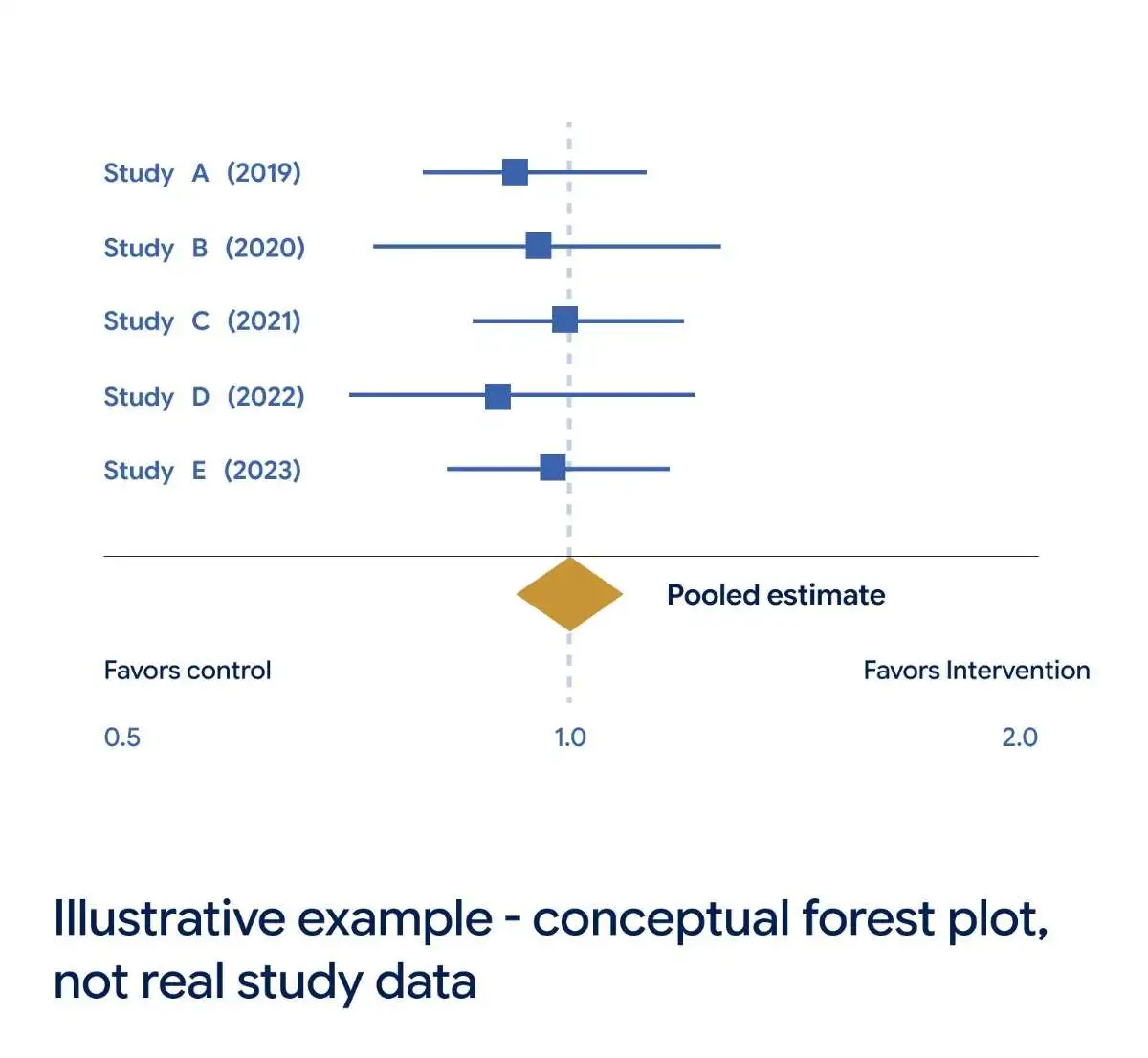
Forest plots display each study's effect estimate and confidence interval, its weight in the pooled analysis, and the overall pooled effect.
We assess small-study effects and potential publication bias, applying tests such as Egger's test alongside visual inspection and reporting limitations rather than overstating conclusions.
When studies are too heterogeneous for pooling to be meaningful, we structure a narrative or tabular synthesis instead — a defensible, often more accurate approach.
Twelve stages, each with a defined output, so decisions are documented as they're made — not reconstructed afterward to fit the findings.
Define a focused question and eligibility criteria that anchor every downstream decision.
Document objectives, methods, and analysis plans in advance.
Prepare and submit protocol information for registration where eligible.
Execute the documented search strategy across selected databases.
Remove duplicate records across databases before screening begins.
Shortlist for full-text review, with exclusion reasons logged.
Assess full texts against the same criteria; finalize included studies.
Extract characteristics and outcome data using a standardized template.
Appraise each included study using the design-appropriate tool.
Synthesize findings narratively and/or statistically.
Pool comparable results and assess heterogeneity, where appropriate.
Report per PRISMA 2020: checklist, flow diagram, plots, and tables.
Database selection depends on the topic, discipline, research question, population, intervention or exposure, study design, and target publication venue — not a single fixed list. Most systematic reviews search more than one database, often combining a biomedical database with a multidisciplinary one, and many also search grey literature or trial registries depending on the topic.
Not every review type suits every research question — the right choice depends on your objective, the nature of the available evidence, and your timeline. We help you select the most appropriate type during scoping.
Comprehensive evidence synthesis on a focused question.
Includes statistical pooling.
Maps the extent and nature of evidence on a broader topic.
A streamlined systematic review for time-sensitive questions.
Synthesizes findings across multiple existing systematic reviews.
Synthesizes qualitative findings through meta-synthesis.
Evaluates diagnostic test performance.
Synthesizes prevalence or incidence data.
Pools effects of treatments or interventions.
Pools findings from cohort or case-control studies.
Compares multiple interventions simultaneously, where appropriate.
Continuously updated as new evidence emerges, where appropriate.
| Study / Evidence Type | Potential Assessment Approach |
|---|---|
| Randomized controlled trials | Cochrane Risk of Bias tool (RoB 2) |
| Non-randomized intervention studies | ROBINS-I |
| Cohort and case-control studies | Newcastle-Ottawa Scale |
| Mixed study designs / broader appraisal | JBI Critical Appraisal Tools |
| Diagnostic accuracy studies | QUADAS-2 |
| Overall review methodological quality | AMSTAR 2 |
| Certainty of the body of evidence | GRADE |
It's important to distinguish three related but separate concepts that are often used interchangeably:
A study-level assessment of methodological flaws that could affect the validity of that individual study's results.
Evaluates the quality of the review itself — its methods, not the underlying studies.
Evaluates confidence in the body of evidence as a whole, accounting for risk of bias plus consistency, precision, and directness.
A defensible meta-analysis depends on choosing methods that fit the research question and the available data, not applying the same formula to every dataset.
Effect-size selection Depends on outcome type — binary outcomes typically use odds ratios or risk ratios; continuous outcomes use mean differences or standardized mean differences; single-group studies may use prevalence or proportion estimates.
Pooled estimates & confidence intervals summarize the combined effect and its statistical precision.
Heterogeneity (I², τ²) describes how much studies vary beyond chance. Model choice — fixed-effect or random-effects — should weigh clinical and methodological heterogeneity and study count, not a single I² cutoff applied mechanically.
Subgroup analysis Explores whether effects differ across predefined subgroups.
Sensitivity analysis Tests whether results are robust to specific methodological choices, such as excluding high-risk-of-bias studies.
Meta-regression Examines whether study-level characteristics explain variation in effect size, where enough studies are available.
Publication-bias assessment Uses funnel plots and, where appropriate, tests like Egger's test — interpreted alongside their known limitations.
Influence analysis & prediction intervals Assess how individual studies affect the pooled result and the expected range of true effects in future settings.
A forest plot displays each included study's effect estimate and confidence interval, its statistical weight, and the overall pooled effect estimate.
Conceptual visualization — study labels and estimates are not real data.
A funnel plot is a scatter plot of effect size against study precision, used to visually assess small-study effects and potential publication bias. Asymmetry can suggest bias but is not, on its own, proof of it.
Symmetric scatter shown for illustration — not a claim about any specific evidence base.
Documented objectives, eligibility criteria, and planned methods.
Database-specific search strings and Boolean logic.
Databases searched, dates, and results per source.
Title/abstract and full-text decisions with exclusion reasons.
Visual record of identification, screening, eligibility, inclusion.
Structured study-level data across all included studies.
Study-level appraisal using the design-appropriate tool.
Summary and detailed judgments per study.
Pooled effect estimates, heterogeneity statistics, model details.
Visual summary of individual and pooled effect estimates.
Visual assessment of small-study effects and publication bias.
Structured summary of included study characteristics and findings.
Item-by-item mapping of the review against PRISMA 2020.
Structuring and formatting support for journal submission.
Conducting a systematic review or meta-analysis as part of a thesis or dissertation.
Building an evidence base for publication, research projects, or grant applications.
Synthesizing clinical evidence to support research and evidence-based practice.
Examining population-level patterns, outcomes, and risk factors.
Evaluating intervention, treatment, or exposure evidence across relevant studies.
Supporting faculty, student research, publications, and institutional research output.
When you need a comprehensive, reproducible answer to a focused research question and want to minimize the bias of informally selecting a handful of familiar studies.
When the systematic search has identified multiple studies similar enough in population, intervention, comparator, and outcome that pooling produces a meaningful combined estimate.
When included studies are too heterogeneous for statistical pooling to be defensible, or when there are too few comparable studies.
It doesn't automatically rule out meta-analysis, but requires investigation — subgroup analysis, a random-effects model, or a decision not to pool at all.
Yes, when appropriate — using tools such as the Newcastle-Ottawa Scale or ROBINS-I, and interpreting estimates with caution given confounding.
Ideally before the search begins, so the registered protocol reflects the original research plan rather than decisions made after seeing the results.
There is no universal minimum. What matters more: whether included studies are genuinely comparable, the overall amount and quality of available evidence, and that certain methods (some heterogeneity tests, subgroup analyses, meta-regression) become less reliable with very few studies. A small number of studies can still support a valid, cautiously interpreted pooled estimate when appropriately similar and limitations are clearly reported. Rather than a fixed cutoff, the right question is whether pooling adds meaningful precision without overstating certainty.
PRISMA (Preferred Reporting Items for Systematic Reviews and Meta-Analyses) is a reporting guideline — a checklist and flow diagram that specifies what a systematic review or meta-analysis should transparently report, covering identification, screening, eligibility, and inclusion of studies.
Original illustrative visualization of the PRISMA workflow stages — not the official PRISMA figure.
PRISMA 2020 is the current version of this guideline. A review can fully comply with PRISMA's reporting items while still having methodological weaknesses in its search, screening, or analysis — reporting transparency and methodological rigor are related but separate things. Zonduo aligns documentation with PRISMA 2020 to ensure transparent, complete reporting, alongside — not instead of — sound methodology.
PROSPERO is an international, prospective register for systematic review protocols, maintained to promote transparency in the review process and reduce unplanned duplication of effort across the research community.
Registering a protocol on PROSPERO before a review begins provides a public, time-stamped record of the review's planned question, methods, and analysis plan. Zonduo supports the preparation of registration-ready protocol documentation and the submission process, along with amendments where a protocol evolves as the review progresses.
PROSPERO registration, PRISMA reporting, peer review, and journal acceptance are four separate things. Registration on PROSPERO does not guarantee methodological quality, PRISMA-compliant reporting does not guarantee registration or acceptance, and neither guarantees that a journal will accept the finished manuscript. Each serves a distinct purpose, and Zonduo does not represent any of them as a substitute for the others.
| Feature | Traditional Literature Review | Systematic Review |
|---|---|---|
| Research question | Often broad or exploratory | Focused, predefined, and answerable |
| Search strategy | Informal, non-exhaustive | Comprehensive, reproducible, documented |
| Eligibility criteria | Usually not predefined | Explicit and set before screening |
| Screening | Subjective, undocumented | Structured, with documented exclusion reasons |
| Quality appraisal | Rarely systematic | Formal risk-of-bias or critical appraisal |
| Reproducibility | Low — depends on the author's choices | High — methods documented so others can replicate |
| Bias control | Limited | Built into the process at every stage |
| Synthesis | Narrative, author's interpretation | Structured — narrative and/or statistical |
| Reporting | Variable | Standardized (PRISMA 2020) |
Poorly defined or overly broad research questions that make eligibility criteria impossible to apply consistently.
Inadequate database selection, missing key sources relevant to the topic or discipline.
Undocumented search strings, making the search impossible to reproduce or verify.
Unclear inclusion/exclusion criteria, applied inconsistently during screening.
Inadequate screening processes, without documented reasons for exclusion.
Inconsistent data extraction, without a standardized template.
Inappropriate appraisal tools, applied without matching them to study design.
Inappropriate statistical pooling, combining studies too heterogeneous to compare meaningfully.
Failure to investigate heterogeneity, rather than exploring its sources.
Overinterpretation of pooled results, treating significance as more certain than the evidence supports.
Misinterpreting publication bias, treating funnel-plot asymmetry as definitive proof.
Confusing PRISMA compliance or PROSPERO registration with methodological quality or publication approval.
Sound methodology — a predefined protocol, documented search, structured screening, appropriate appraisal, and careful statistical judgment — directly addresses each of these.
Differences in populations, interventions, or settings.
Differences in study design and conduct.
Variation in results beyond chance.
Incomplete outcome reporting across studies.
Non-comparable measurement across studies.
Smaller studies sometimes showing larger, less reliable effects.
Positive findings more likely to be published.
Studies reporting only some measured outcomes.
Each of these affects how confidently a pooled estimate can be interpreted, and a rigorous meta-analysis addresses them explicitly rather than pooling regardless.
Every stage of a Zonduo systematic review or meta-analysis is documented so it can be audited and reproduced.
Documented search strings, with database-specific syntax preserved.
Recorded eligibility criteria applied consistently throughout.
Screening records showing decisions and exclusion reasons at each stage.
Standardized extraction templates used across all included studies.
Documented quality-assessment methodology and tool-selection rationale.
Recorded statistical assumptions and model choices.
Full analysis documentation supporting every reported statistic.
An audit trail connecting every reported result back to its source data.
This documentation is what allows a review to be checked, defended in peer review, and updated as new evidence emerges — and it's the standard we hold every project to.
Research question, eligibility criteria, and protocol checked for clarity and consistency before work begins.
Database coverage and search-string reproducibility verified against the protocol.
Eligibility decisions checked for consistency, with documentation of exclusion reasons.
Extracted data checked for completeness and internal consistency across studies.
Effect measures, model assumptions, heterogeneity statistics, and interpretation reviewed for soundness.
Final output checked against the PRISMA 2020 checklist; tables, figures, and references reviewed for accuracy.
Every stage follows recognized frameworks (PRISMA, Cochrane, JBI, GRADE) selected to fit the study design and research question.
Documented decisions at every stage, not a black-box deliverable.
Model and effect-size choices explained and justified, not applied by default.
Search strategies, screening records, and analysis documentation built to withstand peer review.
You stay involved in key decisions throughout, not just at the start and end.
Your research question, data, and unpublished findings are handled with appropriate discretion.
Plain explanations of methodological choices, so you understand and can defend every decision.
Discover unexplored areas through Zonduo’s best review paper writing service
Zonduo's systematic review and meta-analysis support is built on a straightforward commitment: no fabricated studies, no fabricated data, and no manipulated statistical outcomes. Citations are accurate, methodology is documented transparently, and statistical results are reported and interpreted responsibly — including their limitations. Researchers remain actively involved in key methodological decisions throughout, and all project information is treated confidentially.
A systematic review is a research method that identifies, screens, appraises, and synthesizes all eligible studies on a predefined research question, using explicit and reproducible methods to minimize bias. It differs from a traditional literature review in its structured, documented approach at every stage.
Meta-analysis is a statistical method that combines the quantitative results of multiple comparable studies into a single pooled effect estimate with a confidence interval. It is often, but not always, conducted as part of a systematic review.
A systematic review is the overall framework for identifying and appraising evidence; a meta-analysis is a statistical technique that may be used within a systematic review to combine comparable results. Not every systematic review includes a meta-analysis.
The typical steps are: defining the research question and scope, developing a protocol, registering the protocol where appropriate, conducting the database search, removing duplicates, screening titles and abstracts, screening full texts, extracting data, assessing risk of bias, and synthesizing and reporting the findings.
You conduct one by following a predefined protocol: define a focused research question, search relevant databases reproducibly, screen and select eligible studies, extract data using a standardized template, assess risk of bias, and — where studies are sufficiently comparable — statistically pool results into a meta-analysis, then report according to PRISMA 2020.
Yes. A systematic review is complete with a narrative or structured synthesis alone. Meta-analysis is an additional statistical step used only when included studies are comparable enough to pool meaningfully.
PRISMA 2020 is the current version of the Preferred Reporting Items for Systematic Reviews and Meta-Analyses guideline — a checklist and flow diagram specifying what a systematic review should transparently report. It is a reporting guideline, not a guarantee of methodological quality.
PROSPERO is an international, prospective register for systematic review protocols, designed to promote transparency and reduce unplanned duplication of review efforts. Registration is subject to PROSPERO's own eligibility criteria.
No. Registration is recommended for transparency and is often expected in health-related fields, but it is not a universal requirement for every systematic review, and eligibility for registration depends on PROSPERO's own criteria.
Commonly used databases include PubMed/MEDLINE, Embase, Cochrane Library, CINAHL, Scopus, Web of Science, PsycINFO, and discipline-specific databases such as IEEE Xplore for engineering topics. Selection depends on the research question and discipline.
The Newcastle-Ottawa Scale is a tool used to assess the methodological quality and risk of bias of non-randomized studies, such as cohort and case-control studies, included in a systematic review or meta-analysis.
The Cochrane Risk of Bias tool (RoB 2) is a structured framework for assessing the risk of bias in randomized controlled trials, evaluating specific domains such as randomization, deviations from intended interventions, missing data, and outcome measurement.
A forest plot is a visual summary used in meta-analysis that displays each included study's effect estimate and confidence interval, its statistical weight, and the overall pooled effect estimate.
A funnel plot is a scatter plot of effect size against study precision, used to visually assess small-study effects and potential publication bias. Asymmetry can suggest bias but is not, on its own, proof of it.
Heterogeneity refers to variation in study results beyond what would be expected from chance alone. It can be clinical (differences in populations or interventions), methodological (differences in study design), or statistical (measured variation in effect estimates).
A random-effects model is a statistical approach to meta-analysis that assumes the true effect size varies across studies, rather than assuming a single common effect — an assumption often more realistic when studies differ in population or methods.
There is no universal minimum. What matters is whether the studies are sufficiently comparable and whether the available statistical methods remain reliable given the number of studies; some analyses become less robust with very few studies.
Yes, when appropriate to the research question, using risk-of-bias tools suited to observational designs and interpreting results with appropriate caution regarding confounding.
Timelines vary significantly based on scope, the volume of literature, and whether meta-analysis is included — a narrowly scoped review may take weeks, while a comprehensive review with meta-analysis and publication support can take several months.
Typical scope includes protocol development, database search strategy, study screening, data extraction, risk-of-bias assessment, statistical meta-analysis where appropriate, and PRISMA 2020-aligned reporting — scoped to what each researcher actually needs.
GRADE assesses the certainty of evidence across a body of studies for a given outcome, considering factors like risk of bias, consistency, and precision together. Risk of bias, by contrast, is a study-level judgment about one individual study's methodological validity — GRADE builds on risk-of-bias findings but is a separate, broader judgment.
"Systematic literature review" is often used interchangeably with "systematic review" — both describe the same structured, reproducible method for identifying and synthesizing evidence on a defined research question.
No. PRISMA is a reporting guideline that specifies what to report and how; it does not itself define the search, screening, or analysis methods used to conduct the review, though it does require those methods to be transparently described.
Kanyakumari Main Road,
Suchindram Akkarai,
Nagercoil, Tamil Nadu 629704
5/586, 9th Cross Street,
Nehru Nagar, Chandrasekara
Avenue, Thuraipakkam, Chennai,
Tamil Nadu
Tell us about your research question and where you are in the process — we'll scope the support that actually fits your stage and timeline.


