
What Is a Synopsis in Research? Meaning, Format & How to Write One
Published:June 17, 2026 · Last updated: 15 October 2026

A research synopsis is a brief, structured summary of a study you intend to carry out. It states your topic, the problem you are addressing, your objectives, your proposed methodology, and the outcomes you expect — usually in 1,000 to 3,000 words. It is submitted to a supervisor or doctoral committee for approval before full research begins.
Every PhD, MPhil, and postgraduate program asks for one, and most students underestimate it. A synopsis is not a formality or a shortened thesis. It is the document your committee uses to decide whether your research is worth three to five years of institutional time — which means a weak synopsis costs you months before you have written a single chapter.
This guide covers what a synopsis is, the standard format expected by most universities, the word limits you should plan for, and a step-by-step method for writing one.
Synopsis Meaning in Research
In research, "synopsis" means a condensed written outline of a proposed study — its rationale, aims, methods, and expected contribution. The word comes from the Greek synopsis, meaning "a general view." In academic use, it is a forward-looking document: it describes work you plan to do, not work you have finished.
This is the distinction most students miss. An abstract summarizes completed research. A synopsis proposes research that has not started yet. The tense alone gives it away — an abstract says "this study found," a synopsis says "this study will investigate."
Dissertation Synopsis vs Thesis Synopsis
The terms are used interchangeably in India, which causes confusion when a department specifies one. A master's dissertation synopsis typically runs 1,500 to 2,500 words and is reviewed within the department. A doctoral thesis synopsis runs 2,000 to 3,000 words and goes to a Research Degree Committee.
The structural difference sits in the methodology section. A doctoral synopsis is expected to justify each methodological choice against the alternatives. A master's synopsis usually needs only to state the approach clearly.
Where your department uses one term rather than the other, follow their handbook rather than the general convention.
Synopsis vs. Abstract vs. Research Proposal vs. Thesis
| Document | Written When | Length | Purpose |
|---|---|---|---|
| Synopsis | Before research begins | 1,000–3,000 words | Get committee approval to proceed |
| Abstract | After research is complete | 150–300 words | Summarize findings for readers |
| Research Proposal | Before research begins | 2,000–10,000 words | Detailed research plan, often for funding |
| Thesis | At the end | 40,000–80,000+ words | Present the completed research |
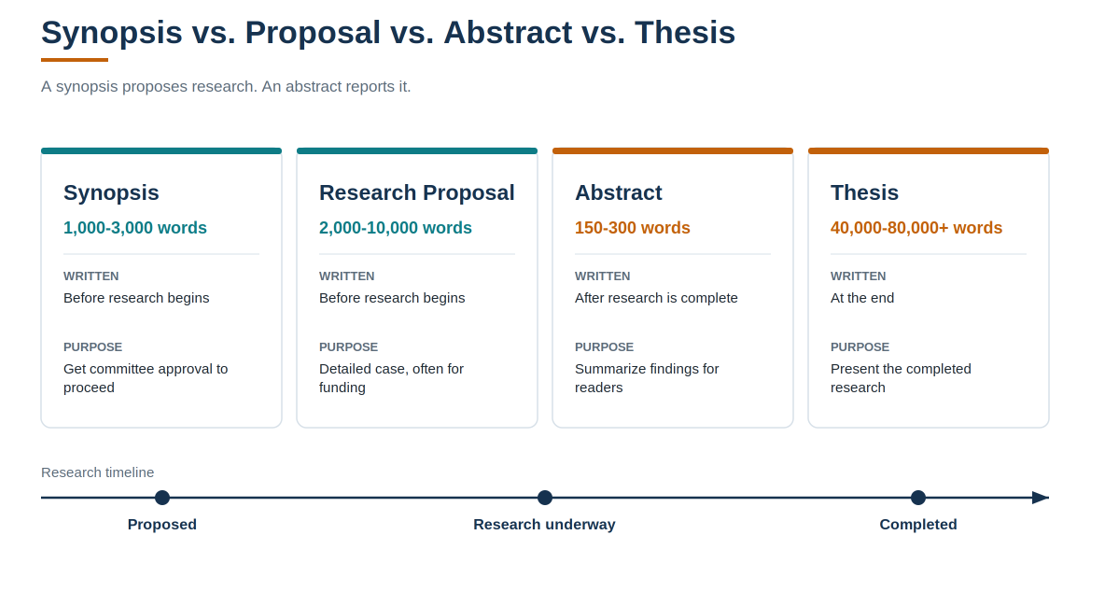
In many Indian and South Asian universities the terms "synopsis" and "research proposal" are used interchangeably, with the synopsis being the shorter, institutionally standardized version. Always check what your own department means by the word.
The synopsis is the first document in that chain and the thesis is the last. Every commitment you make here — your scope, your objectives, your methodology — resurfaces three years later when you begin thesis writing, which is why a loosely worded synopsis is expensive rather than harmless.
What Is the Purpose of Writing a Synopsis?
A synopsis does four jobs at once:
It proves the research gap is real. Your committee needs to see that the question has not already been answered.
It proves the study is feasible. Scope, timeline, data access, and methods must be realistic for a single researcher.
It locks the scope. An approved synopsis is your protection later when scope creep sets in.
It gives your supervisor something to argue with. A vague synopsis produces vague feedback.
Approval is the visible outcome. The invisible outcome matters more: writing a synopsis forces you to discover whether your research question actually holds together before you have invested years in it.
Synopsis Format: The Standard Structure
The standard research synopsis format has ten components: title, introduction, literature review, research gap, problem statement, objectives, hypothesis or research questions, methodology, expected outcomes, and references. Some universities also require a timeline, chapter plan, and budget.
| Section | Typical length | What it Must Do | |
|---|---|---|---|
| 1 | Title | 12–15 words | Name the variables, population, and context. No vagueness. |
| 2 | Introduction / Background | 300–500 words | Move from broad field to your specific problem. |
| 3 | Literature Review | 400–800 words | Show what is known thematically, not paper by paper. |
| 4 | Research Gap | 100–200 words | State plainly what has not been done. |
| 5 | Problem Statement | 100–150 words | One tight paragraph naming the problem. |
| 6 | Objectives | 3–5 Bullet Points | Measurable, each starting with an action verb. |
| 7 | Hypothesis / Research Questions | 100–200 words | Testable statements tied to each objective. |
| 8 | Research Methodology | 400–700 words | Design, population, sampling, instruments, analysis. |
| 9 | Expected Outcomes | 150–250 words | What the field gains if the study succeeds. |
| 10 | References | 15–30 Sources | Your department's citation style, applied consistently. |
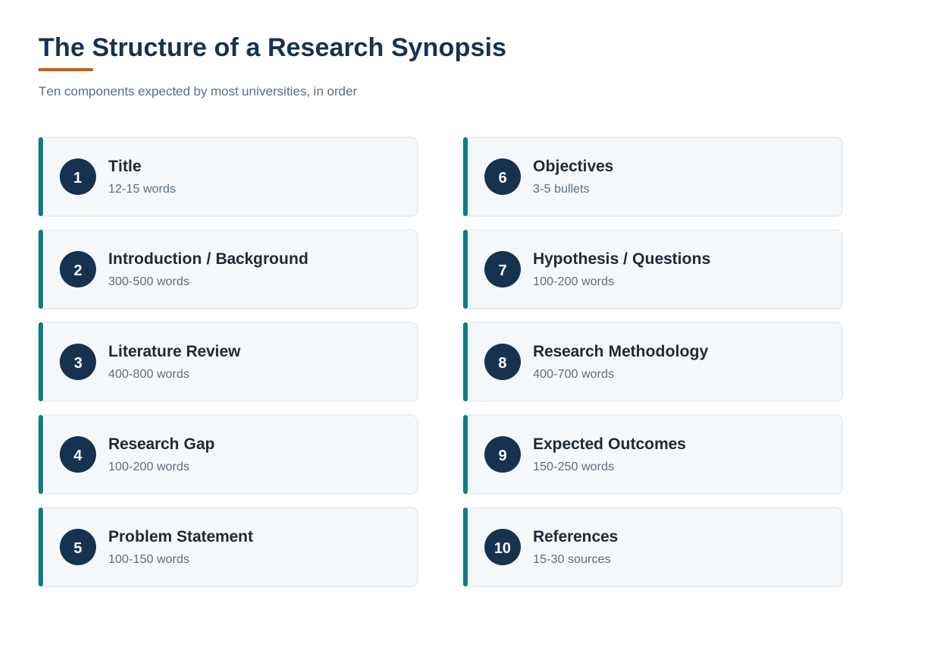
This ten-part structure is near-universal for degree synopses, but do not confuse it with a publication template. A journal or conference submission follows the publisher’s own layout — the format for an IEEE research paper, for instance, fixes section order, heading levels, and even column width before you write a word. A synopsis has no equivalent universal template. Your department’s handbook is the only authority that matters.
PhD Synopsis Format: What Changes at Doctoral Level
A PhD synopsis follows the same skeleton but is held to a higher standard in three places:
Literature review must be substantially deeper — 30 to 50 sources rather than 10 to 15, and organized around themes and debates rather than summaries.
Research gap must be defensible against a committee that knows the field. "No one has studied X in India" is not a gap unless you can show why studying it in India changes the answer.
Methodology must justify choices, not just list them. Why this sampling frame? Why this instrument? Why this analytical technique over the obvious alternative?
Many universities also require a proposed chapter scheme and a research timeline in the PhD version.
Discipline changes the emphasis as well. A synopsis in computer science engineering is expected to name algorithms, datasets, evaluation metrics, and an implementation plan, where a management or social science synopsis is judged mainly on sampling design and instrument validity. Read three recently approved synopses from your own department before you draft yours.
Synopsis Format for a Research Paper
A synopsis for a research paper (as opposed to a full degree program) is shorter — typically 500 to 1,000 words — and compresses the literature review and methodology into single paragraphs each. The structure is otherwise unchanged.
Synopsis Word Limit
Most universities set a research synopsis word limit between 1,000 and 3,000 words, or 8 to 25 pages. PhD synopses typically run 2,000–3,000 words; master's and MPhil synopses run 1,000–1,500 words; a synopsis for a research paper is often 500–1,000 words.
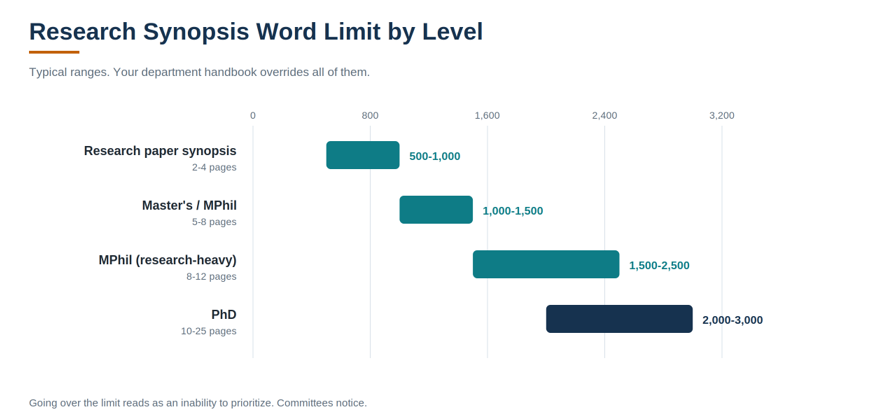
These are norms, not rules. Word limits are set by your department, and departments vary widely — some Indian universities specify 15 to 25 pages including references, others cap at 3,000 words excluding references.Your department's handbook overrides every number in this table. If the handbook is silent, ask your supervisor before you draft, not after.
One thing that is consistent everywhere: going over the limit reads as an inability to prioritize. Committees notice.
How to Write a Synopsis for Research: Step by Step
The eight steps below are the working method in condensed form.A complete worked example follows below.
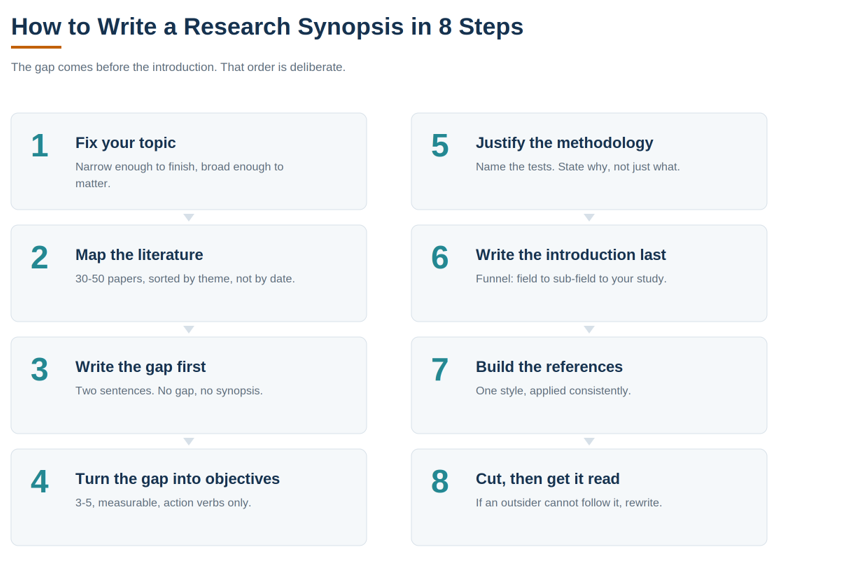
Step 1 — Fix your topic before you write anything
A synopsis cannot rescue a bad topic. Before drafting, your topic needs to be narrow enough to complete, broad enough to matter, and supported by literature you can actually access. Test it by writing it as a single sentence naming your variables, your population, and your context. If you cannot, the topic is not ready
Step 2 — Read the literature and map it thematically
Read 30 to 50 papers for a PhD synopsis, and read the right kind. Work from peer-reviewed research articles rather than blog posts or textbook chapters — a committee checks sources, and a reference list of secondary summaries reads as a shortcut. In engineering disciplines,IEEE papers and conference proceedings usually carry more weight than review articles, because they document the methods you will be expected to build on. As you read, sort them into themes and disagreements rather than a chronological list. The gap you are looking for usually sits where two bodies of work fail to talk to each other — not in the "future scope" section of somebody else's paper.
Step 3 — Write the research gap first
This is out of order deliberately. The gap is the load-bearing wall of the entire synopsis. Write it before the introduction, in two or three sentences, in plain language: "Studies A and B established X. Study C assumed Y. No one has tested whether X holds when Y is false." If you cannot write that sentence, you do not have a gap yet — go back to Step 2.
Step 4 — Convert the gap into objectives
Each objective should be one action, measurable, and traceable back to the gap. Use verbs like examine, measure, compare, model, evaluate — not understand, explore, study, which cannot be assessed. Three to five objectives is the sweet spot. Ten objectives tells a committee you have not decided what your research is about.
Step 5 — Write the methodology as a set of justified decisions
For each choice, state what you will do and why the alternative was rejected. Cover: research design, population and sampling, data collection instruments, and analysis technique. Name your statistical tests or your qualitative coding approach explicitly. Vague methodology is the single most common reason synopses come back for revision.
Step 6 — Write the introduction last
Now that you know exactly what the study is, the introduction almost writes itself. Structure it as a funnel: field → sub-field → problem → your study. Four paragraphs, no padding.
Step 7 — Build the reference list properly
Use one citation style consistently and match it to your department's requirement. Every in-text citation appears in the list; every entry in the list appears in the text. Use a reference manager — Zotero or Mendeley — because manual formatting errors in a synopsis signal carelessness about the thesis to come.
Step 8 — Cut, then get it read
Draft long, then cut to the word limit. Then give it to someone outside your specialization. If they cannot tell you what your research is about after one read, the synopsis is not finished — regardless of how good the research is.
If you are stuck at any of these stages, Zonduo's PhD synopsis writing service works with researchers on topic selection, gap identification, and methodology design.
Sample Synopsis
A worked example at PhD level, condensed. Each heading shows what that section does.
Title
Effect of Federated Learning on Diagnostic Accuracy in Multi-Hospital Chest X-Ray Classification
Introduction
Deep learning models for chest X-ray classification achieve high accuracy on single-institution datasets but degrade when applied across hospitals with different imaging equipment and patient demographics. Data-sharing restrictions prevent pooling. Federated learning offers a route to multi-institutional training without transferring patient data, but its diagnostic performance in this setting is not well established.
Research Gap
Existing federated learning studies in medical imaging report aggregate accuracy but do not disaggregate performance by imaging equipment or by demographic subgroup. Where a model underperforms is therefore unknown, which limits clinical adoption.
Objectives
1. To implement a federated learning framework across three hospital chest X-ray datasets.
2. To compare its diagnostic accuracy against centrally trained and single-site models.
3. To measure performance variation by imaging equipment type and patient age group.
Methodology
Quantitative, experimental. Three publicly available datasets (NIH ChestX-ray14, CheXpert, MIMIC-CXR) simulate separate institutions. A ResNet-50 architecture is trained under three conditions: federated, centralised, and single-site. Performance is measured by AUC-ROC, sensitivity and specificity, with subgroup analysis by equipment manufacturer and age band. Statistical significance tested using DeLong's test for paired AUCs.
Expected Outcomes
Quantified accuracy cost of federated training relative to centralised, and identification of subgroups where federated models underperform. Findings will inform whether federated learning is clinically viable where data sharing is restricted.
Timeline
Months 1–4 literature review and framework setup · Months 5–10 implementation and training · Months 11–14 subgroup analysis · Months 15–18 writing and submission.
What makes this work: the gap names something specific that existing studies omit, each objective is measurable, and the methodology states which statistical test will be used. Committees reject synopses where objectives cannot be tested against a result.
Free Synopsis Template
An editable Word template with all nine sections, word-count guidance for each, and prompts showing what committees look for.
Download Template (.docx)Citable version: https://doi.org/10.5281/zenodo.23259506
Synopsis in Research Methodology: What This Section Must Contain
In a research synopsis, the methodology section explains how the study will be conducted — the research design, the population and sampling strategy, the data collection instruments, and the analytical techniques. It is the section committees scrutinize most, because it determines whether the study can actually be executed.
Cover these five elements, in this order:
Research design — Quantitative, qualitative, or mixed methods? Experimental, quasi-experimental, correlational, ethnographic, or case study? Name it and justify it against the research question.
Population and sample — Who or what are you studying? How many? Selected how — random, stratified, purposive, snowball? State your inclusion and exclusion criteria.
Data collection — Surveys, interviews, instruments, secondary datasets, simulation, lab measurement. If you are using an existing instrument, cite it and note its validity and reliability.
Data analysis — Name the specific tests or techniques. "Statistical analysis will be performed" is not a methodology. "Data will be analyzed using two-way ANOVA in SPSS, with post-hoc Tukey tests where the interaction is significant" is.
Ethical considerations — Approval requirements, consent, anonymization, data storage. Increasingly non-negotiable.
Common Mistakes That Get Synopses Rejected
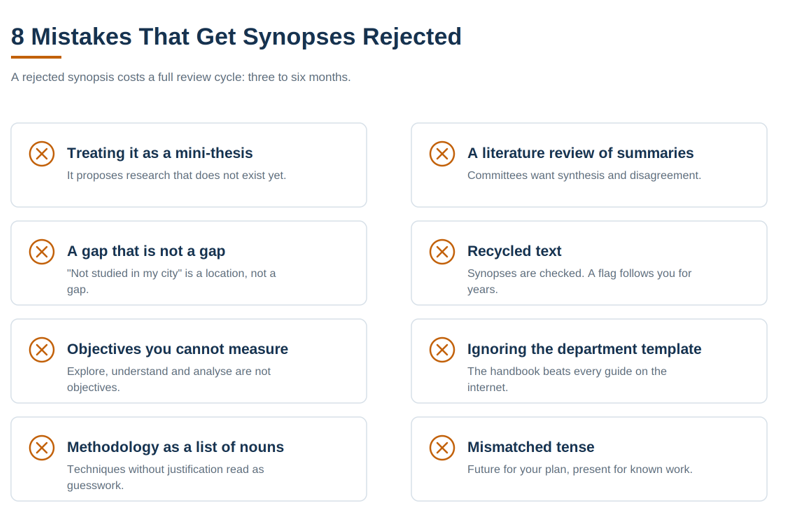
Treating it as a summary of the thesis. It is a proposal for research that does not exist yet.
A research gap that is not a gap. "Not studied in my city" is a location, not a gap. You need a reason the answer would differ.
Objectives that cannot be measured. Explore, understand, and analyze the impact of are not objectives.
Methodology written as a list of nouns. Techniques without justification read as guesswork.
A literature review that is a stack of summaries. Committees want synthesis, argument, and disagreement — not annotated bibliography.
Recycled text. Synopses are checked for plagiarism, and a flagged synopsis follows you through the program.
Ignoring the department template. If your handbook specifies a format, that format wins over every guide on the internet, including this one.
Mismatched tense. Future tense for what you will do; present tense for what is known.
Research Synopsis Writing Checklist
Before submitting, confirm:
Title names variables, population, and context in under 15 words
Research gap is stated in two to three plain sentences
Every objective traces back to the gap and starts with a measurable verb
Every objective has a matching research question or hypothesis
Methodology names specific tests, instruments, and sampling method
Ethical approval requirements are addressed
Word count is within the department's limit
Citation style matches the department requirement, applied consistently
Every in-text citation appears in the reference list, and vice versa
Formatting matches the department template exactly
Someone outside your field has read it and understood it
How Long Should a Synopsis Be?
These are typical ranges. Where your department states a limit, follow it — exceeding a stated word count is a common and entirely avoidable reason for a synopsis being returned.
What Happens After Your Synopsis Is Approved
Approval is a starting line, not a finish line. In most Indian and South Asian doctoral programs the synopsis is the first of three gates — approval, publication, and thesis submission — and the second gate is the one that catches people out.
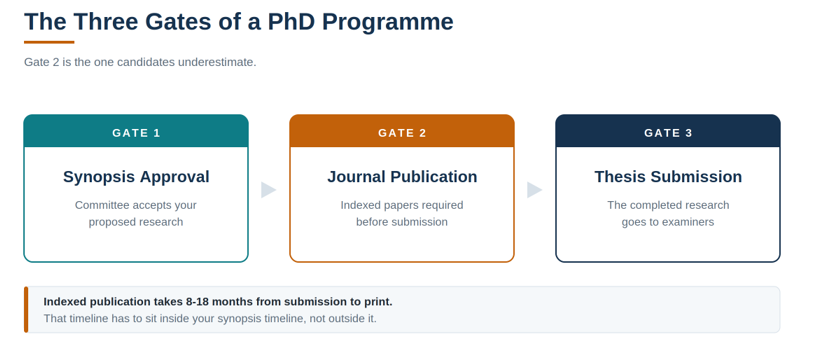
Most universities will not accept a thesis for submission until the candidate has published a minimum number of papers from the research. Which venues count is decided by your university, not by you:
Indexing requirements. Many programs accept only SCI-indexed journals or Scopus-indexed venues. Some departments raise the bar to a Q1 journal — the top quartile by impact within a subject category — for at least one paper.
Approved lists. Anna University and several affiliated institutions publish and Annexure I list of accepted journals. A paper placed outside that list may not count toward your requirement, however good the work is.
Lead time. Journal publication in an indexed venue routinely takes 8 to 18 months from submission to print once revision rounds are counted. That timeline has to sit inside your research plan, not outside it.
This is why the methodology you commit to in the synopsis matters well beyond the approval meeting. A design that cannot produce a publishable result will pass a committee and then strand you at the second gate. Check your university’s publication requirement before you finalize your objectives — not after.
If you would like the synopsis prepared to your university's requirements, see our synopsis writing service.
Get Expert Help With Your PhD Synopsis
A rejected synopsis costs a full review cycle — often three to six months. Zonduo works with PhD researchers across topic selection, literature review, research gap identification, methodology design, and synopsis drafting, formatted to your university's specific requirements.
FREQUENTLY ASKED QUESTIONS
Final Thoughts
Your synopsis is the door to your entire research journey. Master the structure, follow your university's format and word limit, define a sharp research gap, and present a feasible methodology — and you give your committee every reason to say yes. Use the ten parts and eight-steps process above as your checklist, and you will have a synopsis that stands on its own.