
Last updated: 17 October 2026
Zonduo's deep learning implementation services provide technical support for the computational components of a deep learning study: preparing and splitting datasets, selecting and building an architecture (CNN, RNN, LSTM, GRU, Transformer, autoencoder, GAN, or hybrid), training and tuning the model, designing controlled experiments with baselines and ablations, evaluating results with task-appropriate metrics, and documenting the work for reproducibility. The service supports PhD, master's, faculty, and interdisciplinary researchers across the implementation stages of a study — while the researcher retains full responsibility for the research question, interpretation, and conclusions.
Dataset preparation, preprocessing, and leakage-aware splitting.
Architecture selection matched to the research question.
Model training, fine-tuning, and hyperparameter optimization.
Controlled experiments: baselines, ablations, fixed seeds.
Task-appropriate evaluation metrics and error analysis.
Methodology and reproducibility documentation.

One log per run — architecture, parameter count, optimiser, learning-rate schedule, batch size, early stopping and the checkpoint you kept. Includes result tables for classification, segmentation and regression, an across-seeds table, and an ablation grid for any component you claim improves performance.
Download Template (.docx)Technical support scoped to academic and scientific deep learning studies, not generic product development.
Cleaning, normalization, augmentation, labeling, class-imbalance handling, and leakage-aware train/validation/test splits.
Building the selected architecture — CNN, RNN, LSTM, GRU, Transformer, autoencoder, GAN, or hybrid — in PyTorch, TensorFlow and Keras.
Hyperparameter tuning, regularization, and optimizer configuration aimed at generalization, not memorization.
Baselines, controlled comparisons, ablation studies, and fixed random seeds for defensible findings.
Task-appropriate metrics, error analysis, and documentation a methodology chapter typically requires.
Deep learning has become a standard computational tool across disciplines that work with image, text, sequential, or sensor data — because it can learn representations directly from data rather than relying on hand-engineered features. In a research setting, this creates both opportunity and risk. A model that fits well but was not validated against a proper baseline, or was trained on data that leaked into the test set, produces results that look convincing but do not hold up to scrutiny.
Implementation quality matters because a research contribution is only as strong as the experiment behind it. The choice of architecture has to follow from the research question and data characteristics, not from what is fashionable. Evaluation methodology has to match the type of problem — classification, regression, detection, or segmentation each call for different metrics. And because computational research is expected to be checked and repeated, reproducibility is not optional: the dataset, preprocessing steps, model configuration, and evaluation procedure all need to be documented clearly enough that another researcher could rerun the study.
Deep learning implementation services can support this work at the technical level, helping researchers build, train, and evaluate models correctly, while the intellectual direction of the research stays with the researcher.
Architecture choice follows the research question, not trends.
Evaluation metrics must match the problem type.
Reproducibility requires full documentation, not optional extras.
Leaked or poorly split data invalidates a finding.
Technical implementation support across the computational stages of a deep learning study, scoped to research rather than commercial delivery.
Support for translating a research problem into a computational task: identifying what the model needs to learn, what data is available, and which classes of architecture are suited to the problem (e.g., convolutional networks for spatial data, recurrent or transformer models for sequential data). This support helps align the computational approach with the stated research objective; it does not determine the researcher's academic conclusions.
Assistance with organizing raw data into a usable form: cleaning, normalization, augmentation, labeling, addressing class imbalance, and constructing appropriate training, validation, and test splits so that later evaluation results are trustworthy.
Implementation of the selected architecture — CNN, RNN, LSTM, GRU, Transformer, autoencoder, GAN, or a hybrid approach — using standard frameworks. Architecture choice is driven by the research problem, data modality, and available compute, not a default preference for any one model family.
Support for training runs, transfer learning, and fine-tuning, including hyperparameter tuning, regularization, and optimizer configuration, aimed at a model that generalizes rather than one that only memorizes the training set.
Design of baseline models, controlled comparisons between architectures or configurations, ablation studies that isolate the effect of individual components, and repeatable experiment structures with fixed random seeds — the elements that let a research finding be defended rather than just reported.
Selection and computation of evaluation metrics appropriate to the task — precision, recall, F1-score, ROC-AUC, and confusion matrices for classification; MAE, MSE, RMSE, and R² for regression; IoU and mAP for detection; Dice coefficient for segmentation — along with validation on held-out data and error analysis.
Work on hyperparameter optimization, addressing overfitting and underfitting, applying regularization, and considering computational efficiency and inference cost where relevant to the research context.
Support for organizing experimental outputs, comparing model performance across configurations, interpreting what evaluation metrics indicate, analyzing error patterns, and documenting limitations. This support does not extend to fabricating, manipulating, or guaranteeing particular findings — the results are whatever the experiments produce.
Documentation of methodology, dataset characteristics, preprocessing steps, architecture details, training configuration, hyperparameters, and evaluation methodology — the record a thesis or dissertation methodology chapter typically requires.
Walk through your dataset, architecture options, and evaluation plan with our implementation team.
Deep learning implementation in a research context typically follows an 18-stage sequence, from defining the research problem through documenting limitations and reproducibility.
Iterative, not linear. Findings from later stages routinely send the process back to an earlier one — a poor result at validation (step 11) often means returning to dataset preparation (step 3) or architecture selection (step 5) rather than simply retraining with the same setup.
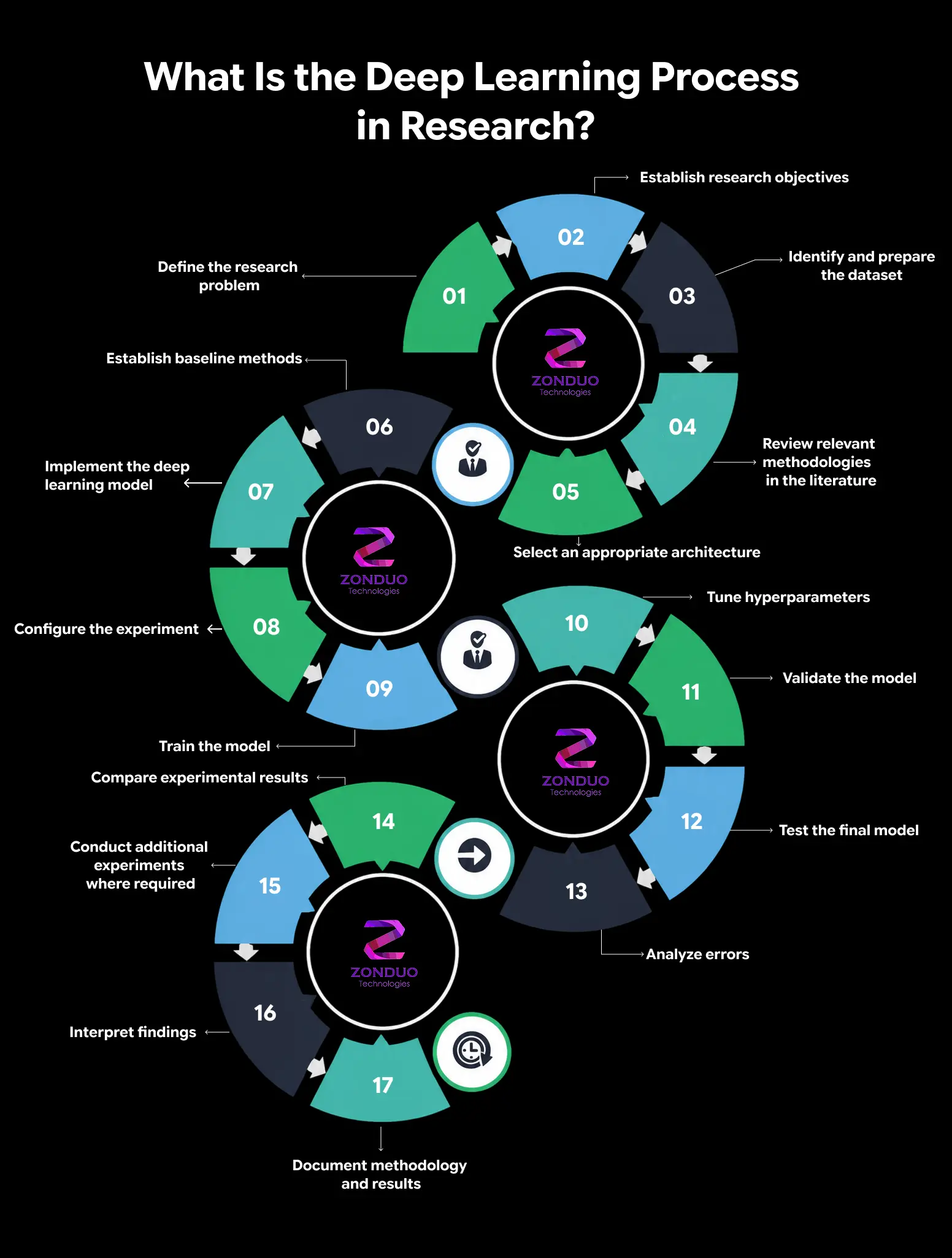
A deep learning example is a specific application pattern — data, model, experiment, and evaluation suited to a particular research task. The patterns below are illustrative.
Illustrative research patterns — not Zonduo client case studies.
Distinguishing categories within an image dataset.
CNN or vision Transformer.
Compare against a baseline classifier.
Accuracy, precision, recall, confusion matrix.
A validated classification approach for a specific domain.
Identifying patterns in medical images for classification or segmentation research (not diagnosis).
CNN-based segmentation or classification architecture.
Dice coefficient or classification metrics, with careful attention to data leakage between patients.
Classifying or extracting information from text.
Transformer or LSTM.
F1-score, accuracy, per-class performance on an imbalanced label set.
Predicting future values in sequential data.
LSTM or Transformer-based forecaster.
MAE, RMSE, comparison against a naive or statistical baseline.
Converting audio to text or classifying audio events.
A sequence model over spectrogram or waveform features.
Word error rate or classification accuracy.
Locating and classifying objects within images.
An object-detection architecture.
Precision, recall, mAP at defined IoU thresholds.
Identifying rare or abnormal patterns.
Autoencoder-based reconstruction error or a dedicated anomaly-detection architecture.
Precision/recall on the minority class, since accuracy alone is misleading under imbalance.
Which architecture performs better on a given dataset.
CNN vs. Transformer under matched conditions.
Controlled comparison with identical splits and training budgets.
Comparative metrics with error analysis explaining the difference.
A rigorous deep learning research methodology generally documents the following, adapted to the specific research question rather than a fixed template:
The research objective
The dataset and its provenance
Preprocessing steps
The rationale for model selection
The baseline used for comparison
Training, validation, and test procedures
Evaluation metrics chosen and why
Statistical or comparative analysis used
Error analysis
Steps taken to support reproducibility
The limitations of the approach
A classification study, a forecasting study, and an architecture-comparison study each require different methodological emphasis — see research methodology support for the broader methodology-development process.
Dataset quality determines whether a research result is meaningful. Preparation typically covers:
Identifying appropriate data sources
Assessing dataset quality and completeness
Labeling
Preprocessing and normalization
Data augmentation where it helps generalization without distorting the research question
Addressing class imbalance
Constructing training, validation, and test splits that reflect how the model will actually be used or evaluated
Data leakage occurs when information from outside the training set — often from the validation or test set, or from a source correlated with the label — inadvertently influences model training.
Common causes: splitting data randomly when samples are correlated (e.g., multiple images from the same patient appearing in both training and test sets), preprocessing the full dataset before splitting, or using features not available at prediction time.
Leakage inflates evaluation metrics and can invalidate a research finding, because reported performance no longer reflects how the model would perform on genuinely unseen data.
Selection depends on data type, research objective, dataset size, available computational resources, and the specific task (classification, regression, detection, segmentation, generation). No single architecture is universally superior; the appropriate choice follows from the research problem.
| Architecture | Typical Data | Strengths | Considerations |
|---|---|---|---|
| CNN | Images, grid-structured data | Strong spatial feature extraction | Less suited to long-range sequential dependencies |
| RNN | Short sequences | Captures temporal order | Struggles with long sequences, vanishing gradients |
| LSTM / GRU | Sequences, time series | Handles longer dependencies than plain RNNs | Slower to train than some alternatives |
| Transformer | Text, long sequences, increasingly images | Captures long-range dependencies, parallelizable training | Typically needs more data or pretraining |
| Autoencoder | Unlabeled or partially labeled data | Useful for anomaly detection, dimensionality reduction | Requires careful threshold/interpretation choices |
| Transfer learning | Any modality with limited labeled data | Reduces data and compute requirements | Pretrained model may not match the target domain well |
Training involves configuring epochs, batch size, learning rate, optimizer, and loss function, then applying regularization techniques such as dropout and early stopping to control overfitting. Transfer learning and fine-tuning can reduce data and compute requirements when a suitable pretrained model exists.
Training performance reflects how well a model fits the data it was trained on; generalization performance reflects how well it performs on new, unseen data. A model with excellent training performance but poor validation or test performance has overfit — it has learned patterns specific to the training set rather than patterns that transfer. Research conclusions should be based on generalization performance, not training performance alone.
| Task Type | Common Metrics |
|---|---|
| Classification | Accuracy, precision, recall, F1-score, ROC-AUC, confusion matrix |
| Regression | MAE, MSE, RMSE, R² |
| Object Detection | IoU, precision, recall, mAP |
| Segmentation | IoU, Dice coefficient |
Researchers should not rely on a single metric without considering the research context — accuracy can be misleading on imbalanced classes, for example, where precision, recall, and F1-score give a more informative picture.
Controlled experimentation is what allows a research conclusion to be defended. Key elements include:
A baseline model to compare against
Systematic hyperparameter experiments
Ablation studies isolating individual components
Error analysis to understand why, not just how well
Clearly separated control and experimental variables
Architecture comparisons run under matched conditions
Repeated experiments with fixed random seeds
Without controlled experimentation, an observed improvement may reflect noise, a lucky split, or an uncontrolled variable rather than a genuine effect.
Reproducibility strengthens computational research by allowing others — including the researcher's own future self — to verify and build on the work.
Missing any key item makes a result difficult or impossible to independently verify.
Deep learning work is almost always Python. See our Python implementation services for PhD research for the full environment, reproducibility and delivery specification.
Code versioning
Documentation of the dataset and how it was obtained
Documentation of preprocessing steps
Recorded model configuration and hyperparameters
Fixed random seeds
Environment and dependency version information
Experiment logs
Clearly documented evaluation methodology
Deep learning implementation support is commonly relevant to research in: computer vision research, medical image analysis research, natural language processing research, speech research, time-series research, anomaly detection research, predictive modeling research, recommendation research, remote sensing research, and scientific or academic image analysis. Specific research outcomes are not guaranteed or implied for any domain.
| Research Factor | Traditional ML | Deep Learning |
|---|---|---|
| Feature engineering | Often manual, domain-driven | Learned automatically from raw data |
| Data requirements | Can work with smaller datasets | Generally needs larger datasets |
| Model complexity | Typically lower | Typically higher |
| Computational requirements | Lower | Higher, often requires GPU acceleration |
| Unstructured data | Requires substantial preprocessing for image, text, or audio data | Handles unstructured data with less manual feature engineering |
| Interpretability | Often higher | Often lower, although interpretability methods exist |
| Typical research applications | Tabular data, smaller-sample studies, statistical modeling | Image, text, audio, and large-sample studies |
Get to Explore Zonduo’s Machine learning Implementation Service
Explore →It tends to be a reasonable fit when the data is unstructured (images, text, audio, or long sequences), when a sufficiently large and representative dataset is available, and when the research question benefits from learned representations rather than manually engineered features. Traditional machine learning, or classical statistical methods, may be preferable when the dataset is small, when interpretability of individual features is central to the research question, or when a simpler model already explains the data adequately.
Deep learning does not automatically replace statistical analysis, hypothesis testing, descriptive statistics, inferential statistics, regression analysis, or experimental design. These remain relevant for interpreting results, testing whether an observed difference is meaningful, describing a dataset, and structuring a study. The appropriate methodology — deep learning, statistical methods, or a combination — depends on the research question, the nature of the data, and what the research is trying to establish.
A documented preprocessing pipeline
The model implementation itself
A record of the training configuration
The trained model
Evaluation results
Comparison tables across configurations or architectures
Experiment logs
Visualizations of results
Error analysis
Methodology documentation
Reproducibility documentation
This output can support a research paper, thesis, or dissertation, but publication acceptance is never implied or guaranteed.
Deep learning implementation support can assist with components of thesis and dissertation research, including methodology development, the computational experiments themselves, model implementation, experimental evaluation, organizing results, and technical documentation.
Common challenges include: limited or small datasets; class imbalance; overfitting; data leakage; computational cost; sensitivity to hyperparameter choices; reproducibility gaps; limited model interpretability; poor generalization to new data; evaluation bias from an unrepresentative test set; dataset bias; and flawed experimental design.
These are typically addressed through careful dataset curation, appropriate baselines, cross-validation where suitable, regularization, systematic hyperparameter search, and thorough documentation of every methodological choice.
Responsible practice in deep learning research covers:
Handling data with appropriate privacy and consent considerations
Maintaining transparency about methods and limitations
Supporting reproducibility
Reporting results honestly, including negative or inconclusive findings
Disclosing limitations explicitly
Avoiding fabricated or manipulated results
Properly citing the methodologies and prior work the research builds on
Where a study involves human subjects, sensitive data, or regulated domains, researchers should follow their institution's ethics review requirements.
Zonduo supports the technical implementation side of deep learning research: building models aligned with a stated research problem, running structured experiments, documenting configurations for reproducibility, applying evaluation methodology appropriate to the task, and being transparent about what the results do and do not show. The work is scoped around helping researchers execute rigorous computational experiments, with the researcher retaining full ownership of the intellectual direction and conclusions of their work.
Computational experiments built directly around academic research frameworks and strict evaluation baselines.
Comprehensive logs, hyperparameter tracking, and fixed seed configurations for repeatable findings.
Researchers retain complete intellectual control, thesis direction, and academic authority over all findings.
Implementing novel architectures or methodologies as part of original research contributions.
Building and evaluating models for coursework-linked or thesis research.
Running computational experiments alongside teaching and other research commitments.
Coordinating larger, multi-experiment research projects.
Applying deep learning to a domain (biology, social science, medicine, engineering) without a deep computational background.
Cost depends on the project rather than a fixed rate, and varies with: the complexity of the research problem; dataset size and how much preprocessing it needs; the model architecture involved; the number of experiments and comparisons required; training time and compute demands; the extent of hyperparameter tuning; the depth of evaluation required; documentation requirements; and overall project scope. A specific estimate requires understanding the research project's details.
There is no universal timeframe. Duration depends on: whether the dataset is already prepared or needs substantial work; model and architecture complexity; the number of planned experiments; training time, which can range from minutes to days depending on model and dataset size; compute availability; how much evaluation and comparison the research design calls for; and how much documentation the methodology requires.
Transparent pricing tailored to your project scope and requirements.
Final cost depends on project scope, deliverables, and timeline.
Starts at 10,000 for standard setup and core deliverables.
Tailored features priced transparently per requirement.
Clear project estimates provided before starting work.
Deep learning development services for research provide technical support for implementing the computational components of a deep learning study — dataset preparation, model implementation, training, experimentation, and evaluation — adapted to research standards rather than commercial product delivery.
Deep learning implementation in research is the process of translating a research question into a working computational experiment: selecting or designing an architecture, training it on prepared data, and evaluating its performance in a way that supports a defensible research conclusion.
The deep learning process in a research context moves from defining the research problem through dataset preparation, model selection, implementation, training, validation, testing, error analysis, and documentation. It is iterative rather than a strict one-way sequence.
A deep learning example is a specific application pattern, such as using a CNN to classify images, an LSTM to forecast a time series, or a Transformer to classify text — each following the sequence of data, model, training, and evaluation suited to that task.
Research examples include image classification, medical image analysis, natural language processing tasks, time-series forecasting, anomaly detection, object detection, speech recognition, and controlled comparisons between architectures.
Deep learning is used in research to build models that learn patterns directly from data, supporting tasks like classification, prediction, detection, and pattern discovery that would be difficult to address with manually engineered features alone.
Implementation typically starts with defining the research problem and preparing the dataset, then selecting an architecture suited to the data and task, training the model, tuning hyperparameters, and evaluating it against an appropriate baseline.
Evaluation should use metrics matched to the task — classification, regression, detection, or segmentation each require different metrics — computed on a held-out test set, alongside error analysis to understand where and why the model fails.
Common metrics include accuracy, precision, recall, F1-score, and ROC-AUC for classification; MAE, MSE, RMSE, and R² for regression; and IoU, mAP, or Dice coefficient for detection and segmentation tasks.
Architecture choice depends on the data type (image, text, sequence), dataset size, computational resources, and the specific task — there is no single architecture that is best for every research problem.
Machine learning is the broader field of algorithms that learn from data; deep learning is a subset that uses multi-layer neural networks to learn representations automatically, typically requiring more data and compute but less manual feature engineering.
Data leakage happens when information from outside the training set — often from the test set or a correlated source — influences model training, inflating reported performance and undermining the validity of the research finding.
Reproducibility depends on documenting the dataset, preprocessing steps, model configuration, hyperparameters, random seeds, software environment, and evaluation methodology clearly enough for another researcher to repeat the study.
Transfer learning reuses a model pretrained on one dataset or task as a starting point for a new, related research problem, reducing the amount of data and training time needed to reach strong performance.
Yes — deep learning implementation can support the methodology, experiments, and evaluation components of thesis research, while the student remains responsible for the research question, interpretation, and final submission.
Yes, in the same way as thesis research — deep learning implementation can support the computational experiments, though the researcher retains full responsibility for the intellectual contribution and conclusions of the dissertation.
Requirements vary by task, but generally include a sufficiently large, representative, and properly labeled dataset relevant to the research question, along with clear documentation of how the data was collected.
Cost depends on factors like dataset size, model complexity, the number of experiments, training and compute requirements, and documentation needs — there is no fixed rate applicable to every project.
Timelines vary based on dataset readiness, model complexity, number of experiments, training time, and evaluation scope, so no single timeframe applies across projects.
Researchers can discuss their research objectives, dataset, model requirements, experimental design, implementation needs, and evaluation approach.
Prefer email or phone? Reach the team directly at info@zonduo.com or +91 78459 26182.


