
Whether your editor sent a minor revision or a demanding revise-and-resubmit, we quote every comment, answer it with evidence, revise the manuscript to match sentence for sentence, and hand you a resubmission package your editor can verify in minutes — not a generic rewrite that risks a second rejection.
Point-by-point, comment-matched letter
Manuscript revised to match every reply
Tracked-changes file plus clean copy
Delivered before your resubmission deadline
Zonduo's Reviewer Response Letter Service drafts a point-by-point response to every editor and reviewer comment on your manuscript, revises the paper itself to match each response, and prepares the full resubmission package — tracked-changes manuscript, clean copy, response letter, and cover letter — ready to upload to your journal's submission portal before your resubmission deadline.
The short version, if you're deciding whether this page is worth reading in full.
Point-by-point response letter, manuscript revision, tracked-changes file, clean copy, and a resubmission cover letter.
PhD scholars, corresponding authors, non-native English researchers, clinicians, and teams facing statistical comments outside their expertise.
Elsevier, Springer Nature, Wiley, Taylor & Francis, MDPI, Oxford University Press, IEEE, and Scopus / Web of Science journals.
Scoped honestly against your specific decision letter and resubmission window — not a flat quote.
The document that decides whether your revision gets a second look, or a second rejection.
A reviewer response letter — also called a response to reviewers, an author response, or a rebuttal letter — is a formal document submitted alongside your revised manuscript. It restates each comment raised by the editor and reviewers, explains what you changed in the manuscript to address it — with a page, section, or line reference — and, where you did not make a change, gives a reasoned, evidence-backed explanation for why.
Every major publisher — Elsevier, Springer Nature, Wiley, Taylor & Francis, MDPI, Oxford University Press, the Nature portfolio — expects some version of this document at resubmission. The format varies slightly by journal, but the underlying discipline is the same: quote, respond, locate, justify.
Zonduo's team builds this against your actual journal publication requirements rather than a generic template, and revises the affected manuscript sections alongside it.
A cover letter reintroduces your manuscript to the editor in a few paragraphs.
A response letter is held next to your revised paper and checked off, comment by comment, before an editor recommends acceptance.
Written to be verified quickly — quoted comment, exact action taken, location, and evidence.
Reviewers seeing your manuscript a second time are checking one thing above all: did the author engage with what I said?
Comments answered out of order or grouped together, so the editor cannot tell which specific concern was addressed.
Changes made with no corresponding note in the letter, so the reviewer has to hunt for them — or assumes they weren't made.
Disagreement expressed defensively without data, citations, or a clear scope-based reason.
These aren't writing failures in the usual sense — they're structural failures. A response letter is closer to a legal brief than an essay, and it rewards a discipline that most researchers have never been taught. That's the gap this service closes.
Built around your actual decision letter — minor revision, major revision, or revise-and-resubmit — not a generic template.
Every comment quoted, numbered, and answered — with the manuscript change located by page, section, or line number.
We revise the affected sections directly, so the letter and the paper match, sentence for sentence.
A tracked-changes file plus a clean version, matching your target journal's resubmission format.
A short, formal letter summarizing major changes and confirming every concern has been addressed.
A respectful, evidence-backed rebuttal rather than a forced compliance edit that weakens your paper.
Handled by someone familiar with your field's specific reviewer conventions — see our research paper editing team.
Not sure which category your decision letter falls into? Send it over — we'll tell you honestly what it will take before you commit to anything.
Contact UsEditors don't send the same kind of decision twice, and a letter that treats every decision type the same way underperforms.
| Decision Type | What It Usually Means | What the Response Requires |
|---|---|---|
| Minor Revision | Reviewers are largely satisfied; concerns are about clarity, wording, missing citations, or small formatting issues. | A tight, accurate letter with every small point still addressed individually — editors reject on principle when even minor comments are skipped. |
| Major Revision | Substantive concerns about methodology, data interpretation, missing analyses, or literature gaps. Re-review is likely. | A structured letter backed by manuscript rewrites, new tables or figures, and additional analysis, with each change traceable to a specific comment. |
| Revise & Resubmit | The journal sees potential but expects a near-complete rework of framing, methodology, or argument before formal reconsideration. | A strategic response that reframes the contribution clearly, supported by a substantially revised manuscript rather than surface edits. |
| Reject with Resubmission Invited | Either a fresh submission after a prior rejection, or a follow-up round after your first revision. | A response confirming which earlier changes were retained, addressing new or escalated concerns, and rebuilding reviewer confidence from round one. |
Journals differ in formatting requirements, but a response letter that reads well to any editor follows a consistent internal logic.
Thanks reviewers, confirms manuscript ID, states every comment is addressed.
A short bullet list of significant changes before the detail begins.
Each comment quoted, followed by a factual, specific reply.
Addressed in their own clearly marked section.
The revised sentence quoted so reviewers can verify without opening the paper.
Sample pages from an anonymized resubmission package, so you know exactly what format lands in your inbox before you commit to anything.
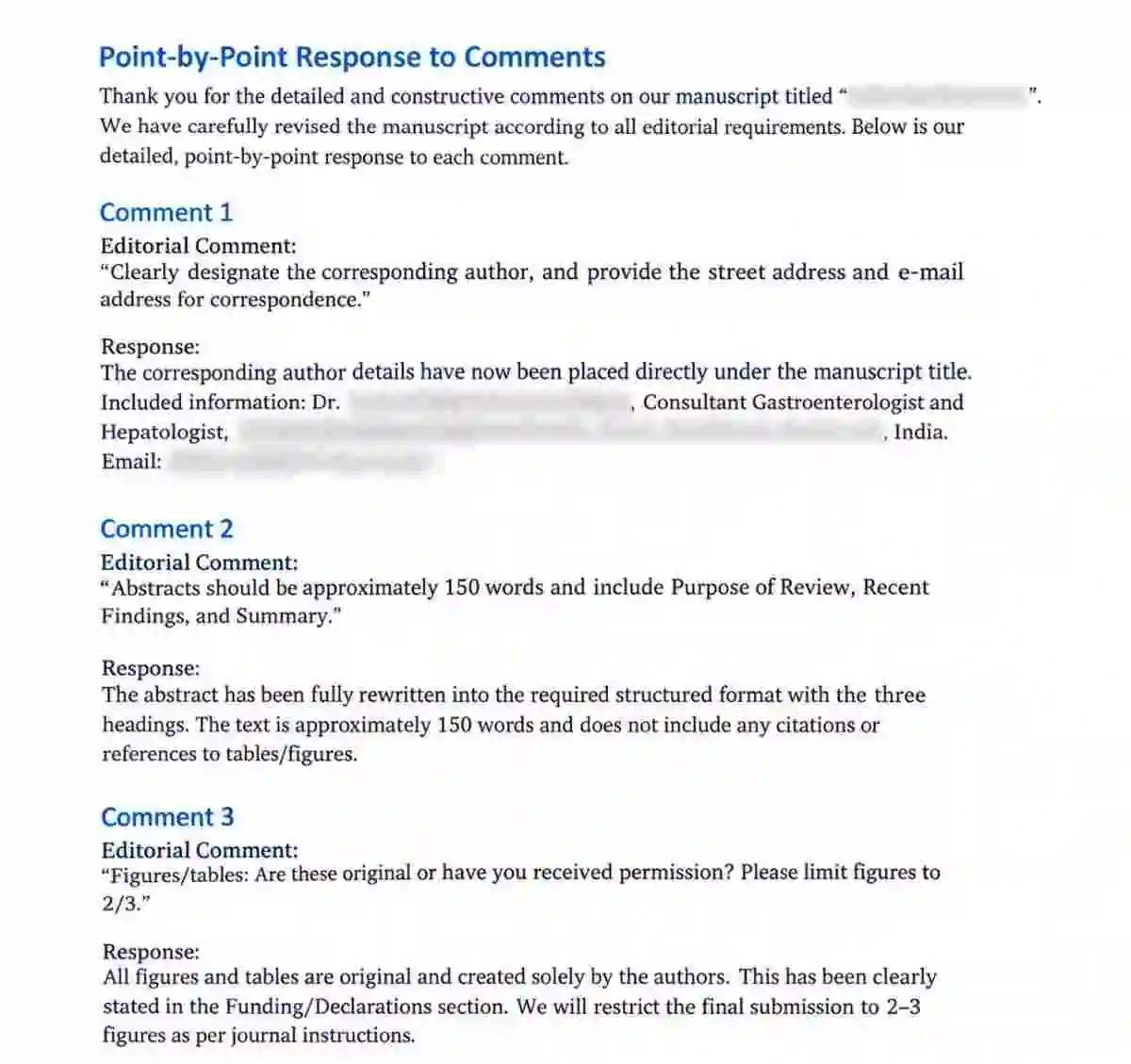
Every comment quoted, numbered, answered, and backed by the exact revised sentence.
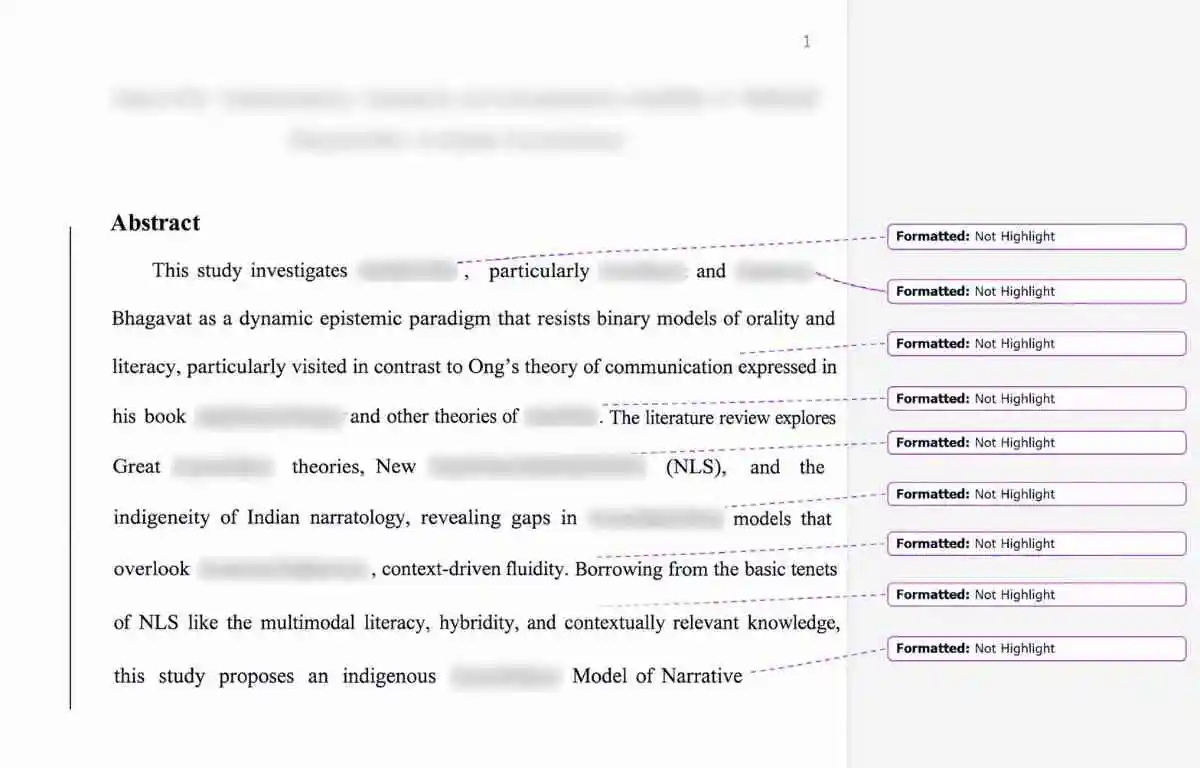
Deletions and insertions visible against your original text, plus a matching clean copy.
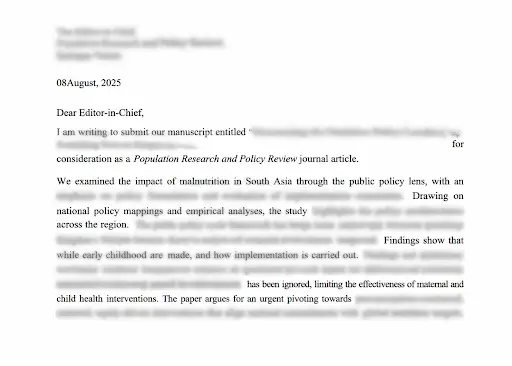
A short, formal summary of major changes, ready to paste into the journal's submission portal.
These are illustrative mockups built to show structure and formatting only — no actual manuscript or reviewer content is reused. Send your own decision letter and we'll show you a scoped plan built around it, at no obligation.
One response that does everything an editor is looking for: acknowledges the comment, states the action taken, gives the location, and quotes the new text.
An editable Word template with the full letter structure, a worked example, and a pre-submission checklist.
Download Template (.docx)We thank the reviewer for this important point. A post-hoc power calculation has now been added to Section 2.3 (page 6, lines 14–19), confirming that our sample size (n=142) achieves 82% power to detect the effect size reported in comparable studies.
"A power analysis conducted using G*Power 3.1 indicated that a minimum sample of 128 participants was required to detect a medium effect size (d=0.5) at α=0.05 with 80% power; our final sample of 142 exceeds this threshold."
Not every reviewer comment has a clean answer. Here's how we handle the situations that trip most authors up.
We don't ignore the conflict — we name it in the response, explain the reasoning behind the choice we made, and note respectfully that the two reviewers' comments pointed in different directions, so the editor sees the tension was considered, not accidentally missed.
Extra experiments requiring equipment you don't have, a dataset that doesn't exist, or an analysis answering a different research question — these get a firm, polite decline supported by a scope-based argument and, where relevant, citations to established methodology or reporting standards such as CONSORT, PRISMA, or STROBE.
Rather than implying the reviewer is wrong, we treat the misunderstanding as a signal the manuscript wasn't clear enough — and revise the relevant passage so a future reader won't hit the same confusion, framing the response as a clarification rather than a correction.
This is the hardest category. We help you find the version of compliance that satisfies the concern without conceding ground you don't need to — often through added nuance or a limitations statement rather than a structural rewrite.
We draft the most reasonable good-faith interpretation of the comment and respond to that directly, stating the interpretation explicitly so the reviewer can correct us if we read it wrong.
Format gets most of the attention in advice about response letters. Tone decides almost as much.
"We thank the reviewer for catching this inconsistency in Table 3" reads as genuine. Repeating generic thanks on every point starts to grate.
Even the simplest fix — a typo, a missing comma — gets one sentence confirming what was changed and where.
"We respectfully disagree," followed immediately by evidence, lands well. The same phrase with no justification does not.
A terse, numbered list of comments usually gets a terse, precise set of responses.
Repeated apology across a fifteen-page letter reads as anxious rather than professional.
A quality check we run against every letter before delivery — the errors that most often trigger a second unnecessary revision round.
A comment quoted incompletely, so the response answers only part of what was asked
Manuscript changes made but not mentioned in the letter — or claimed but not actually made
No page, section, or line reference given for a stated change.
Comments answered in a different order than they were raised.
A rebuttal with no citation, data, or scope-based reasoning — just an assertion.
Formatting that doesn't match the journal's stated resubmission requirements.
A response letter shorter than the list of comments raised, suggesting some were skipped.
From your decision letter to a resubmission-ready package.
Send the editor's decision email, the full reviewer reports, your original manuscript, and any supplementary files. We map the scope within one business day.
A short plan: how each comment will be handled, whether new analysis is needed, and a confirmed delivery date. Nothing starts without your sign-off.
We write the point-by-point letter and revise the manuscript in parallel, so every claim in the letter matches what's actually in the paper.
Every letter is checked against our resubmission checklist above — completeness, references, tone, and journal-format compliance.
You request any changes, then receive the final package: clean manuscript, tracked-changes manuscript, response letter, and cover letter.
Journals set resubmission windows — often 30, 60, or 90 days. We scope turnaround honestly against your specific decision letter rather than quoting a flat number.
Typically the fastest turnaround — work is concentrated in clarity and small manuscript fixes.
Timelines depend on whether new experiments, data reanalysis, or expanded literature review are involved.
The longest lead time, since it usually involves reframing sections rather than editing them.
If your window is closing fast, tell us upfront — we confirm honestly whether it's achievable before you commit.
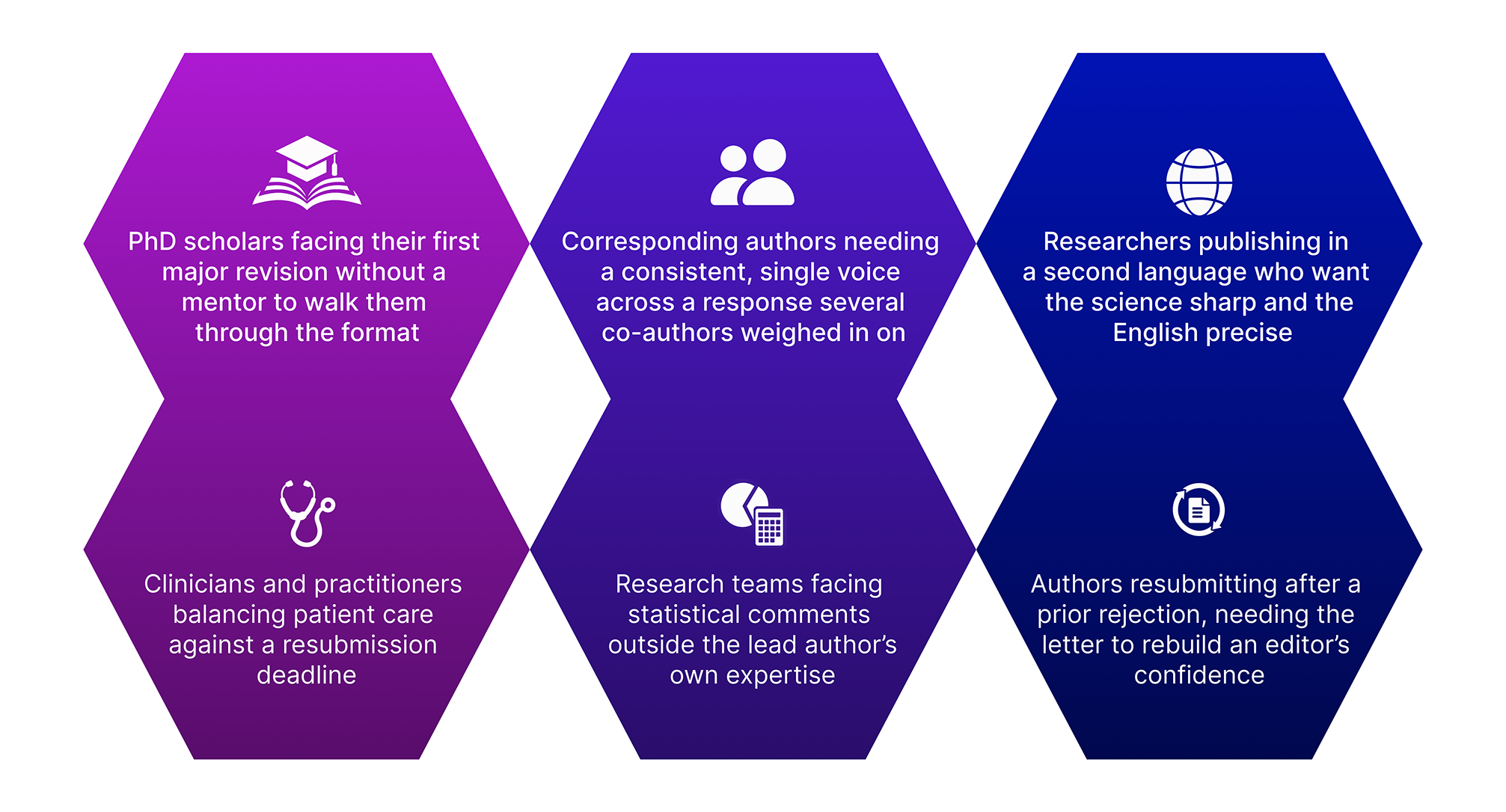
Six situations that bring authors to Zonduo for their resubmission.
Subject specialists across the fields below, familiar with the resubmission conventions of COPE- and ICMJE-aligned journals.
If your target journal has a resubmission format we haven't seen before, share the author guidelines with your project brief — we build the response and cover letter to match. Many clients also come to us for related thesis writing support during the same research journey.
Six reasons authors come back to us for every resubmission round, not just the first one.
Your letter is drafted by someone familiar with your field's specific reviewer conventions — not a generalist working from a template.
Every response follows the same discipline: quote, respond, locate, justify — so an editor can verify it in minutes, not guess at it.
We revise your paper and draft the letter in parallel, so every claim in the response matches the paper word for word.
Turnaround is scoped honestly against your specific decision letter and resubmission window — never a flat, one-size quote.
Every revised manuscript ships with a Turnitin / iThenticate originality report, so you can check it before you submit.
We confirm scope, timeline, and cost against your actual decision letter before any drafting begins — no surprise revisions later.
Send your decision letter, the reviewer comments, and your manuscript. We'll map out exactly what's involved and confirm a delivery date before any work begins.
In practice, most journals use the terms interchangeably. Some authors use "rebuttal" specifically for sections where they disagree with a reviewer, and "response letter" for the document as a whole. We use whichever term your target journal's guidelines specify.
As long as it needs to be to answer every comment properly — there's no fixed page count. A response to eight straightforward minor comments might run two pages; a response to a lengthy major revision with new analyses can reasonably run fifteen to twenty pages. Length isn't the goal; completeness and precision are.
Yes, and it's often the right call. Editors don't expect blind compliance — they expect a well-reasoned position. A polite, evidence-backed disagreement, especially one supported by citations or established methodology standards, is usually respected. What damages your case is silence on a comment, not disagreement with it.
Yes — briefly and specifically. A short line of genuine appreciation at the start of the letter, and specific acknowledgment where a comment meaningfully improved the manuscript, sets a collegial tone. Generic, repeated thanks on every single point start to read as filler rather than sincerity.
Address the conflict directly in your response rather than quietly picking one side. Explain your reasoning, note that the two reviewers' suggestions pointed in different directions, and let the editor see that the tension was considered, not missed.
We draft the full letter based on your manuscript, your data, and the reviewer comments — including the scientific reasoning where possible. For highly technical or data-specific points, we'll flag anything that needs your direct input rather than guessing.
Yes. Where reviewers request additional analysis, sensitivity testing, or expanded literature coverage, we scope that work as part of the project and integrate the results directly into both the manuscript and the response letter.
Yes — many authors come to us with a draft already written that isn't landing the way they hoped. We can review, restructure, and strengthen an existing draft rather than starting from zero, which is often faster than a full rewrite.
Tell us about your decision letter and we'll confirm the scope, timeline, and cost before any drafting begins.


“The authors do not justify their choice of sample size. Was a power calculation performed?”