
Last updated: 24 September 2026
Get expert support to identify, refine and develop a focused PhD research topic in management — built around a real research gap, a suitable theory, defined variables and a methodology you can actually execute.
Research partner since
Papers published
Google & Justdial rating
Countries supported

PhD research topics in management are specific, researchable problems — not broad subject areas — within disciplines like strategy, HRM, marketing, finance or operations.
A workable topic combines a clear research gap, a relevant theory, defined variables, and a methodology that fits your data access and program timeframe.
Zonduo helps scholars move from a broad interest (e.g. "AI in HR") to a bounded, defensible topic through structured topic brainstorming, gap identification and methodology-feasibility screening.
Covers 18+ management specializations, from strategic management to healthcare and aviation management
Includes 2026 emerging areas: generative AI, algorithmic management, ESG, fintech, hybrid work
Support spans topic brainstorming through to proposal/synopsis-ready topic direction
Adoption patterns, managerial trust in AI-generated analysis, and how decision quality changes when AI assists rather than replaces judgement.
Worker autonomy under algorithmic supervision, perceived fairness of automated performance evaluation, and its effect on retention.
Disclosure quality under new mandates, greenwashing detection, and whether ESG performance translates into financial outcomes in emerging markets.
Now past the pandemic-response phase — research is shifting to long-term effects on career progression, informal learning and team cohesion.
Digital credit scoring and SME lending access, UPI adoption effects on informal businesses, and behavioural responses to embedded finance.
Multi-tier visibility, supplier diversification under geopolitical risk, and the cost of resilience against efficiency.
Adoption barriers among SMEs, product-as-a-service viability, and whether circularity claims survive scrutiny.
Worker classification, platform dependency effects, and how regulatory change in India reshapes gig-work conditions.
A word of caution on all eight: an area being active means more literature to build on, but it also means more competition for the obvious gaps. Check what has been published in the last twelve months before committing — several of these have moved quickly.
Overview of Zonduo’s PhD Research Topics in Management service, deliverables, and alignment.
| Service Name | PhD Research Topics in Management Selection & Refinement Support |
|---|---|
| Target Audience | PhD scholars, doctoral applicants, executive PhD scholars, MBA graduates |
| Specializations Covered | Strategy, HRM, Marketing, Finance, Operations, Analytics, OB, Governance, Healthcare, Aviation, Construction, Environmental Management, etc. |
| Core Deliverables | Bounded topic title, problem statement, research gap, core research questions, theoretical framework guidance, methodology feasibility |
| Price Range |
$250 – $800 USD / ₹2,000 – ₹15,000 INR
(Based on specialization complexity and level of proposal alignment) |
| Related Services | PhD Proposal Support · Literature Review Service · ABDC Publication Support |
| Consultant Access | WhatsApp: +91 87547 14627 |
If you're searching for phd research topics in management, you've probably already found long lists of ideas — and you're likely still stuck. That's because a workable PhD topic isn't just an interesting subject area; it's a specific, researchable problem backed by a clear gap in the literature, a suitable theory, defined variables, and a methodology you can actually execute.
Zonduo helps management PhD scholars move from a broad area of interest to a focused, researchable, and academically defensible research topic — by working through the research gap, theoretical foundation, methodology, data availability and expected contribution, not just handing over another list. This sits alongside our broader Research Topic Selection service for scholars across every discipline.
Discuss Your Research Topic →
Choosing phd research topics in management is one of the most consequential early decisions in a doctoral journey. A topic that’s too broad, too generic, or disconnected from an identifiable research gap creates downstream problems throughout the literature review, methodology design, data collection and even the viva defense.
Our topic selection support covers the full arc of narrowing an idea into a workable research direction:
Topic brainstorming based on your interests, background and career goals
Research-area selection across management specializations
Topic refinement from a broad theme into a specific, bounded research problem
Research gap identification through structured literature scanning
Research problem development that clearly states what is unknown or unresolved
Research question development that is answerable within a doctoral timeframe
Theory and framework selection appropriate to your research problem
Variable and construct identification for quantitative or mixed-method designs
Methodology feasibility screening, including data and sample accessibility
A broad interest — "AI in HR," "sustainability in supply chains," "leadership and performance" — is a starting point, not a topic. Doctoral research requires a bounded problem, a defensible gap, and a method that can actually be executed within your program's timeframe and resources. That transformation is where most scholars get stuck, and it's exactly where Zonduo's support is focused.
This is a structured research-support service, not a topic-generation tool. Depending on where you are in your process, our support can include:
Mapping your interests to viable management research areas.
Generating multiple candidate directions worth exploring further.
Narrowing a broad theme into a specific, bounded topic.
Identifying what existing literature has not yet addressed.
Articulating the core issue your research will investigate.
Framing answerable and testable research questions.
Translating questions into clear and achievable objectives.
Identifying relevant variables and constructs for your study.
Pointing toward management theories that fit your research problem.
Structuring the relationships your study will examine.
Matching your topic to a suitable research design.
Checking whether the required data or respondents are realistically accessible.
Defining the industry, sector, region or organisational context.
Reviewing how your direction compares with existing published work.
Ensuring your final topic is ready for proposal or synopsis writing.
The following are example research directions, organized by specialization, to illustrate the kind of doctoral-level topics we help scholars develop and refine. These are starting points for discussion, not final topics — every direction should be adapted to your specific gap, context and methodology.
The influence of dynamic capabilities on strategic renewal in mid-sized manufacturing firms.
Ambidexterity as a mediator between strategic flexibility and firm performance under market disruption.
The role of strategic foresight in platform-based business model transitions.
Resource orchestration and competitive advantage in resource-constrained emerging-market firms.
Strategic decision-making under algorithmic and AI-assisted forecasting environments.
The interplay between corporate strategy and ESG integration in family-owned businesses.
Strategic agility as a response mechanism to global supply chain disruption.
The effect of generative-AI-personalized content on consumer purchase intention.
Trust and privacy concerns as moderators of consumer response to hyper-personalized marketing.
Influencer credibility and its impact on purchase intention among Gen Z digital consumers.
Sustainable packaging cues and their influence on green purchase behaviour.
The role of brand authenticity in consumer loyalty within D2C e-commerce models.
Voice-commerce adoption drivers among urban Indian consumers.
Social commerce trust mechanisms in cross-border online retail.
The impact of AI-based audit tools on auditor judgment and audit quality.
Earnings management practices under evolving ESG reporting mandates.
Forensic accounting effectiveness in detecting financial statement fraud.
Blockchain adoption and its implications for audit trail integrity.
Sustainability reporting assurance practices among listed Indian companies.
Agile project management adoption and its effect on project success in hybrid IT teams.
Risk management maturity and project outcomes in infrastructure megaprojects.
The role of stakeholder engagement in reducing scope creep in construction projects.
AI-assisted project scheduling and its impact on delivery predictability.
Project governance structures and success rates in public-sector digital projects.
Servant leadership and its influence on employee voice behaviour in hybrid teams.
The mediating role of psychological empowerment between transformational leadership and innovative work behaviour .
Emotional intelligence and conflict management styles among middle managers.
Remote leadership practices and their effect on team cohesion.
Organizational cynicism as a response to repeated change initiatives.
Authentic leadership and employee resilience during organizational restructuring.
Explainable AI adoption and managerial trust in data-driven decision-making.
The role of predictive analytics in customer churn management.
Algorithmic management practices and their effect on gig-worker autonomy.
AI adoption maturity and organizational decision-making speed.
Data governance practices and analytics-driven strategic agility.
Patient trust and adoption behaviour toward AI-assisted diagnostic tools.
Healthcare workforce burnout and organizational support mechanisms.
Telemedicine adoption drivers among rural healthcare providers.
Hospital supply chain resilience during public health emergencies.
BIM adoption and its effect on project delivery efficiency.
Safety culture maturity and accident reduction in large-scale construction projects.
Supply chain coordination challenges in modular construction.
Sustainable construction material adoption drivers among contractors.
Perceived algorithmic fairness and applicant trust in AI-assisted recruitment processes.
The role of psychological safety in the relationship between inclusive leadership and employee innovation in hybrid work environments.
Employee wellbeing and productivity outcomes under algorithmic performance management.
Talent retention strategies in knowledge-intensive Indian IT firms post-pandemic.
The mediating role of organizational trust between HR analytics adoption and employee engagement.
Reskilling strategies and workforce adaptability in AI-disrupted industries.
Gig-worker HRM practices and their effect on organizational commitment.
Fintech adoption and financial inclusion outcomes among underbanked populations.
Behavioural biases in retail investor decision-making during high-volatility markets.
ESG disclosure quality and its relationship with firm valuation in emerging markets.
The role of AI-driven credit scoring in SME lending access.
Capital structure decisions and firm resilience during macroeconomic shocks.
Cryptocurrency adoption behaviour and risk perception among retail investors.
Working capital management practices and profitability in Indian manufacturing SMEs.
Supply chain resilience strategies in response to geopolitical disruption.
The role of digital twins in predictive maintenance and operational efficiency.
Circular economy practices and their effect on supply chain sustainability performance.
Blockchain traceability adoption in food supply chains.
Last-mile delivery optimization in urban e-commerce logistics.
Supplier relationship management and resilience in multi-tier supply networks.
The impact of Industry 4.0 adoption on manufacturing flexibility.
Bricolage strategies among resource-constrained women entrepreneurs.
The role of digital platforms in scaling rural entrepreneurship ventures.
Effectuation versus causation logic in early-stage startup decision-making.
Open innovation practices and their effect on startup survival rates.
Institutional voids and entrepreneurial opportunity recognition in emerging markets.
Crowdfunding success factors among first-time technology entrepreneurs.
Entry mode choice and performance outcomes for Indian firms expanding into African markets.
The effect of psychic distance on knowledge transfer within multinational subsidiaries.
Reshoring decisions and their drivers among manufacturing firms post-supply-chain disruption.
Institutional distance and subsidiary autonomy in emerging-market multinationals.
Cross-cultural leadership adaptation among expatriate managers in Indian subsidiaries.
Born-global firm internationalisation speed and survival in technology sectors.
Board diversity and its relationship with ESG disclosure quality.
CSR authenticity perception and its effect on stakeholder trust.
The role of institutional investors in shaping ESG accountability.
Governance mechanisms and greenwashing risk in sustainability reporting.
Family ownership structures and CSR engagement patterns.
Passenger trust and adoption of biometric processes in airport operations.
Low-cost carrier operational efficiency strategies in emerging markets.
Sustainability practices and carbon-reduction strategy adoption among airlines.
Crew resource management effectiveness in high-reliability aviation operations.
Corporate environmental strategy and regulatory compliance behaviour.
Green supply chain practices and firm competitiveness.
Environmental disclosure practices among energy-sector firms.
Circular economy adoption barriers in manufacturing SMEs.
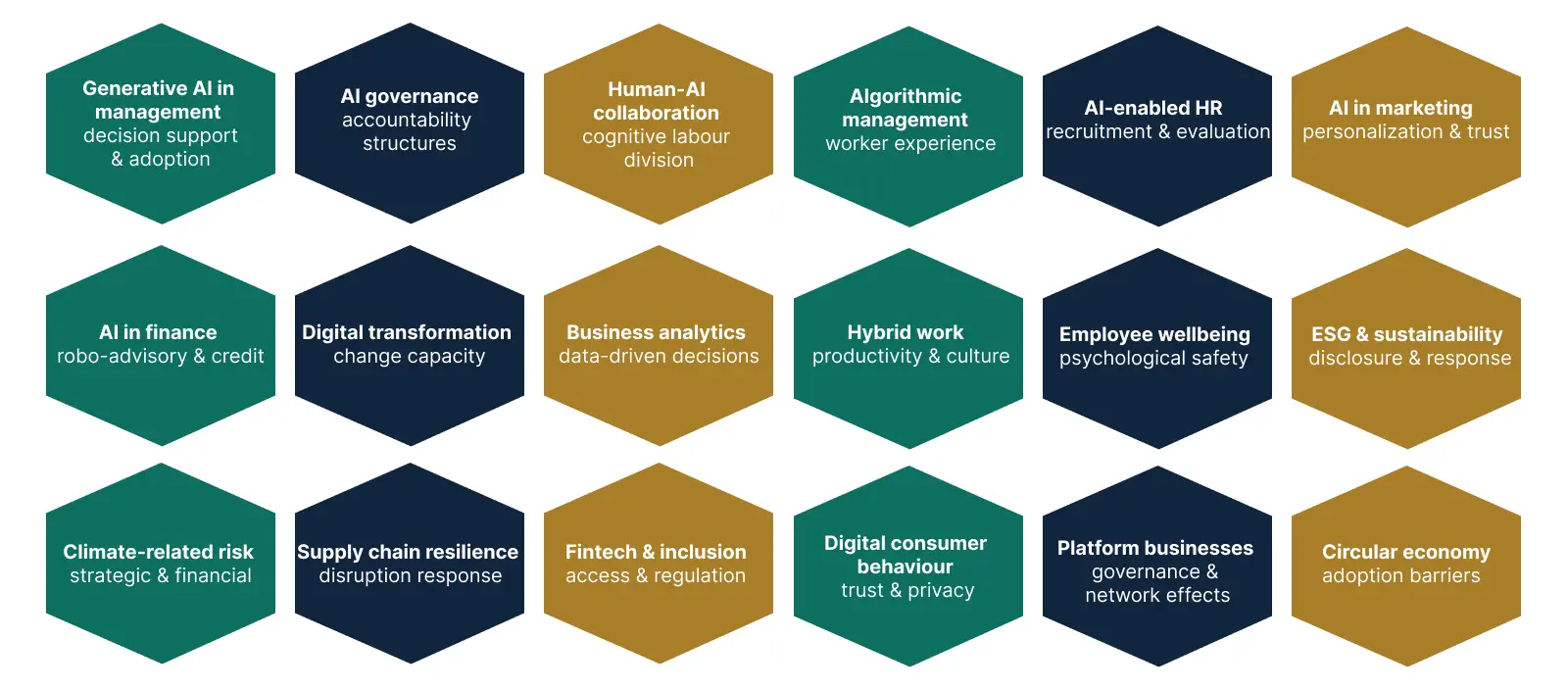
Several research areas are attracting growing academic attention. These represent promising directions — not guaranteed "hot topics" — and each still requires the same rigor of gap identification and methodological fit.
A strong PhD topic doesn’t appear fully formed — it’s built through a sequence of narrowing decisions:
Here's how that looks in practice:
For a broader collection of HR project and research topic ideas, explore Project Topics on Human Resource Management.
Explore our detailed Research Topics in Finance page for specialized finance research areas and topic ideas.
Your final topic should be developed according to your discipline, institutional requirements, available literature and personal research objectives — this framework shows the process, not a fixed answer.
When we work with scholars on topic selection, we evaluate candidate directions against a consistent set of criteria:
| Criterion | Why it matters |
|---|---|
| Research interest | Sustained motivation over a multi-year doctoral timeline |
| Originality | Distinct contribution rather than duplication of existing studies |
| Research gap | A defensible, evidenced gap in current literature |
| Academic relevance | Alignment with management theory and scholarly discourse |
| Practical relevance | Value to organizations, policy or practice |
| Theoretical contribution | Potential to extend, test or challenge existing theory |
| Data availability | Realistic access to required data or respondents |
| Sample accessibility | Feasible recruitment of participants or organizations |
| Methodology fit | A research design that can actually answer the question |
| Timeframe | Achievable within your program's duration |
| Research scope | Neither too broad to complete nor too narrow to sustain a thesis |
| Institutional requirements | Alignment with your university's and supervisor's expectations |
| Publication potential | Reasonable alignment with target journals in your field |
A topic that performs well across these criteria is far more likely to survive proposal review, data collection and the final defense without major rework.
Topic direction and methodology should be decided together, not separately.
Suitable for testing relationships, causal models, and hypotheses using measurable constructs — typically through surveys, panel data, or regression/SEM-based analysis (using tools such as SPSS, AMOS or SmartPLS/PLS-SEM).
Suitable for exploring experiences, processes and emerging organizational phenomena — typically through interviews or case studies.
Suitable when both statistical relationships and contextual explanation are needed.
We help align your topic direction with the methodology you're best positioned to execute — considering your data access, statistical background, and supervisor expectations.
For scholars researching in or on the Indian context, a well-justified geographic or contextual focus can add meaningful relevance to a PhD study — when supported by the literature, not simply added for its own sake.
Indian SMEs and family businesses
Indian startups and entrepreneurial ecosystems
Indian banks and financial institutions
Indian fintech and digital payments adoption
Indian consumer behaviour and e-commerce
Indian manufacturing and IT sector organizations
Women entrepreneurship and rural entrepreneurship
Indian healthcare and higher education institutions
Indian supply chains and logistics networks
ESG practices among Indian listed companies
A focus on India can strengthen a topic's practical relevance and data accessibility, particularly where local regulatory, cultural or market dynamics are directly relevant to the research question. That said, not every management PhD topic needs a geographic anchor — the right context should follow from the research gap, not be added as an afterthought.
Your topic shapes almost everything that follows in the doctoral process:
A poorly bounded topic leads to an unmanageable literature review.
The wrong topic-method fit creates avoidable data collection difficulties.
A vague research problem produces a weak thesis narrative.
An undertheorized topic struggles to justify its academic value.
A topic disconnected from real organizational relevance limits impact.
Topics without a clear gap are harder to place in target journals.
Revising a poorly defined topic midway through a PhD is time-consuming and can affect your literature review, ethics approval, and data collection timeline. Getting the topic right early reduces this risk substantially.
Our topic-development process is built specifically to surface and resolve these issues before they become larger problems later in the research journey.
Understand your
research interests
Identify potential
research areas
Explore relevant
research gaps
Shortlist research
directions
Refine the topic &
question
Align methodology &
data feasibility
Develop for
proposal/synopsis
This process is a starting point for your doctoral research — it supports topic development but does not guarantee university approval, supervisor approval, or admission.
A well-developed topic should give you clarity on:
— the core management area under investigation.
— the specific issue being addressed.
— who or what is being studied, and where.
— what is being measured or explored.
— the framework grounding your study.
— how the research will be conducted.
— what your study adds to theory and/or practice.
“This study examines how perceived algorithmic fairness (variable) influences applicant trust (variable) in AI-assisted recruitment (context) among job seekers in the Indian IT sector (population), grounded in organizational justice theory (theoretical direction), using a quantitative survey design (methodology), contributing to emerging literature on algorithmic HRM (contribution).”
PhD scholars actively searching for a research topic
Doctoral applicants preparing research proposals for admission
Research scholars revising or narrowing an existing topic
Management researchers exploring new research directions
MBA graduates preparing to transition into doctoral research
Working professionals pursuing part-time or executive management PhDs
Scholars whose topic has been challenged by a supervisor or review panel
Scholars struggling to narrow a broad research interest into a workable topic
Research-focused approach — we work through the problem, gap and question rather than handing over a generic list.
Refinement over dumping — our process is built around narrowing, not just generating, ideas.
Methodology-aware guidance — direction considered alongside data availability and design from the start.
Research-gap orientation — every recommended direction is examined against existing literature.
Broad specialization coverage — from strategy and HR to analytics, ESG and aviation management.
Structured, scholar-specific support — guidance tailored to your interests, background and institution.
Professional, transparent communication — clear scope of support with no inflated claims.
Focus on practical feasibility — topics assessed for what can realistically be researched in your timeframe.
We do not promise PhD admission, university or supervisor approval, publication outcomes, or thesis acceptance — our role is to help you arrive at a strong, defensible, well-reasoned research topic.
Pricing depends on your specialization, the depth of gap analysis required, and your program's stage. These are indicative starting ranges for topic-selection support only; your exact quote is confirmed after a free consultation.
* Indicative starting ranges (INR) for illustration only; final pricing varies by scope, specialization and turnaround and is confirmed in writing before work begins. No fee guarantees admission, approval or publication outcomes.
PhD research topics in management are specific, researchable problems within management disciplines — such as strategy, HRM, marketing, finance or operations — that are original, grounded in a clear research gap, and feasible to investigate through an appropriate methodology.
There is no single "best" topic — the right topic depends on your research interest, the strength of the research gap you can identify, data accessibility, and alignment with your program's requirements. A topic that performs well across originality, feasibility and theoretical relevance is generally the strongest choice.
Start with a broad area of interest, then narrow it by identifying a specific research gap, formulating a clear research question, checking data and respondent accessibility, and confirming the topic fits within your program's timeframe.
Emerging areas include generative AI in management, algorithmic management, AI-enabled HR and marketing, ESG and sustainability, supply chain resilience, fintech and financial inclusion, and digital consumer behaviour — each of which can support multiple distinct research directions.
Quantitative topics work well when they involve measurable variables and testable relationships — for example, examining how algorithmic fairness affects applicant trust, or how ESG disclosure quality relates to firm valuation.
Qualitative topics suit research into experiences, processes or emerging phenomena — for example, exploring how entrepreneurs make sense of business failure, or how organizations experience digital transformation..
Common India-specific contexts include Indian SMEs, startups, fintech adoption, digital payments, women's entrepreneurship, and ESG practices among Indian listed companies — used when the research gap justifies a geographic focus.
A research gap is identified by systematically reviewing existing literature to find questions that remain unanswered, contexts that haven't been studied, or relationships between variables that haven't been tested together.
A PhD topic should be narrow enough to investigate thoroughly within your program's timeframe, but broad enough to sustain a full thesis — typically focused on one specific research problem within a defined context.
Yes, many scholars refine or adjust their topic during the early stages of their research, particularly after literature review or supervisor feedback. Significant changes later in the process are more time-consuming, which is why early topic development matters.
Commonly used theories include organizational justice theory, resource-based view, dynamic capabilities theory, technology acceptance-related frameworks, institutional theory, and stakeholder theory, among others — the appropriate theory depends on your specific research problem.
Feasibility depends on whether you can realistically access the data or respondents required, whether the methodology fits your resources and skills, and whether the topic can be completed within your program's timeframe.
A research topic is the broad subject area of study, while a research question is the specific, answerable question your research will investigate within that topic.
Yes. Zonduo supports scholars in refining a broad idea into a focused research topic by working through the research gap, theoretical foundation, methodology and feasibility considerations together.
A well-defined topic with a clear gap and theoretical contribution generally aligns better with the expectations of academic journals, which can support — though not guarantee — publication potential.
Have a management research idea but unsure whether it’s specific, original and feasible enough for a PhD? Zonduo can help you move from a broad area of interest to a focused research direction by considering the research gap, theoretical foundation, methodology, data availability and intended contribution.


